
Emotion-Based Textile Indexing: Bridging the "Semantic Gap" with Fuzzy Logic and Neural Networks
Emotion-Based Textile Indexing Using Colors, Texture and Patterns
The paper introduces a hybrid emotional textile indexing system that classifies textile images into ten pairs of human emotional dimensions. It utilizes a dual-engine approach combining fuzzy logic for color/texture analysis and a neural network for complex pattern recognition to bridge the gap between low-level visual features and high-level affective perception.
TL;DR
This paper presents a sophisticated textile indexing system that categorizes fabrics not just by what they are, but by how they make us feel. By combining Fuzzy Logic (for color and texture) with Neural Networks (for patterns), the researchers successfully mapped physical textile features to 10 pairs of emotional adjectives (e.g., Warm vs. Cold, Dynamic vs. Static) with an accuracy of over 85%.
Problem & Motivation: The Affective Wall
In the world of textile and fashion design, the "Semantic Gap" is a notorious hurdle. While computers are excellent at identifying that an image contains "Red" or "Rough Texture," they historically fail to understand if that red textile feels "Gaudy" or "Cheerful."
Previous works by Kobayashi and Soen established emotional scales, but early attempts to automate this using regression equations fell short. These models couldn't handle the non-linear complexity of human perception—where a specific pattern might look "Dynamic" regardless of its color, or where a certain saturation level might feel "Sober" only when combined with a specific texture.
Methodology: The Hybrid Intelligence Approach
The researchers recognized that different emotional reactions are triggered by different visual stimuli. They split the emotion-indexing task into two specialized pipelines:
1. The Fuzzy Rule-based Engine (Color & Texture)
For emotions like Warm/Cold and Light/Dark, color and texture (sparseness) are the primary drivers.
- Color Space: RGB was converted to HSI (Hue, Saturation, Intensity) to better mimic human vision.
- Texture: The system used GLRLM (Gray Level Run Length Matrix) to calculate "Short Run Emphasis" (SRE), representing the degree of sparseness.
- Logic: 14 fuzzy rules were defined (e.g., “If Saturation is very small and Intensity is high, it is Cold”).
2. The Neural Network Engine (Pattern Recognition)
Emotions like Natural/Unnatural or Dynamic/Static depend on structural patterns (lines, shapes, and floral motifs).
- Feature Extraction: Edges were detected using a mask and divided into sub-images to isolate the most complex patterns.
- Architecture: A Multi-Layer Perceptron (MLP) with 129 input nodes, 77 hidden nodes, and 2 output nodes served as a pattern filter to classify these complex affective states.
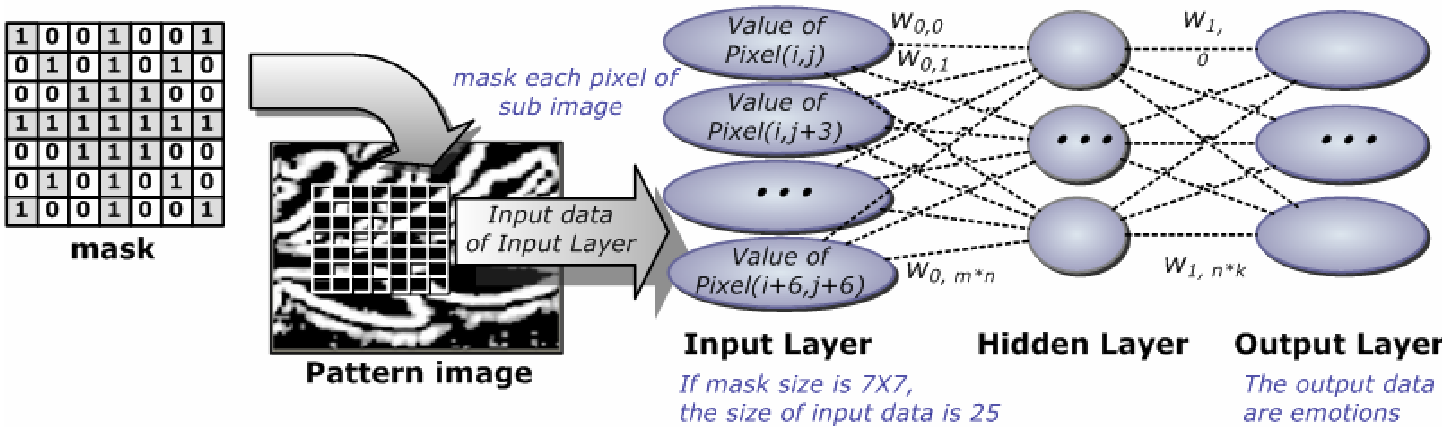 Fig 1: The proposed Neural Network architecture for pattern-based emotion classification.
Experiments & Results: Proving the Intuition
The team tested their system on 160 textile images with 70 human subjects providing the ground-truth "labels."
Key Findings:
- Color/Texture Supremacy: For emotions like "Dismal-Cheerful," the color/texture system achieved a perfect 100% recall/precision.
- Pattern Relevance: The neural network was far more effective at identifying "Dynamic-Static" (92.86% accuracy) compared to color-based methods, confirming that our sense of "motion" in a fabric comes from its shapes, not its hue.
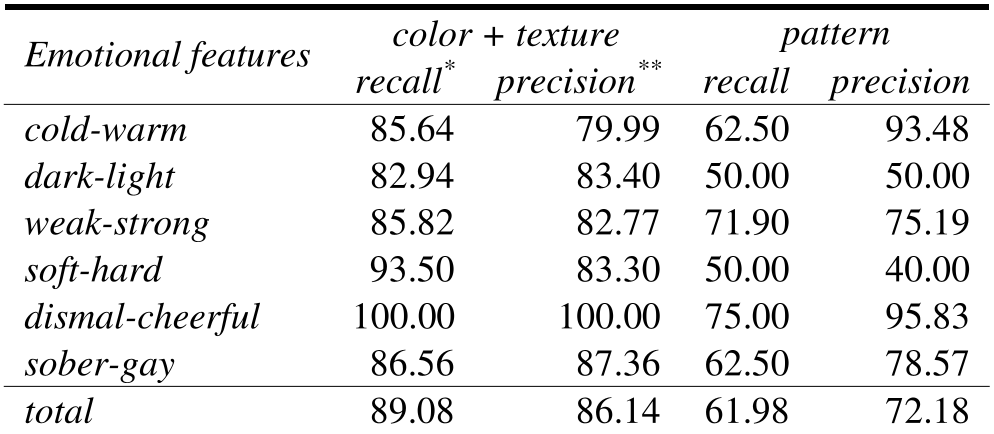 Table 1: Performance comparison showing the synergy between feature types and emotional categories.
Critical Analysis & Conclusion
Takeaway
The genius of this work lies in its feature-emotion alignment. Instead of forcing a "one-size-fits-all" model, the authors correctly identified that some emotions are "chromatic" while others are "morphological," applying the appropriate mathematical tool (Fuzzy vs. NN) to each.
Limitations
- Dataset Scale: 160 images is small by modern standards, though 70 subjects provided a robust human baseline.
- Context Sensitivity: The model treats textile images in isolation. In reality, lighting and the environment would drastically change the emotional impact.
Future Outlook
As we move toward AI-driven fashion retail, this system provides a roadmap for Emotional Search Engines. Imagine a shopping app where you don't search for "Navy Blue Cotton," but for "A stable, sober fabric for a professional setting." This paper laid the groundwork for turning that subjective desire into objective image retrieval.