
Beyond the Battery Life: Reimagining Autonomy through Organismic Embodiment
On the role of emotion in biological and robotic autonomy
This paper explores the conceptual divide between biological and robotic autonomy, proposing that true cognitive robotics must transcend simple sensorimotor loops. It advocates for "Organismic Embodiment," a theoretical framework where homeostasis and emotional regulation serve as the bridge between constitutive identity and interactive behavior.
TL;DR
Is a robot truly autonomous if it doesn't "care" about its own survival? This paper argues that the robotics industry has confused interactive independence with biological autonomy. By bridging the gap between metabolic homeostasis (constitutive processes) and environmental interaction, we can move toward "Organismic Embodiment"—a state where emotions and internal drives provide the "glue" for genuine cognition.
Background: The Autonomy Paradox
In robotics, "autonomy" is often a pragmatic buzzword referring to how long a drone can fly without human intervention. In biology, however, autonomy refers to Autopoiesis: the ability of a system to continuously produce and maintain itself. The paper highlights a critical gap: robots are physical and situated, but they are not "embodied" in the way organisms are. They lack a "life task."
The Problem: The Poverty of Sensorimotor Loops
For decades, the "Symbol Grounding Problem" has haunted AI. We thought that by giving a robot a body and sensors, it would understand the world. But as the author points out, a robot following a trajectory is just "movement," not "action."
- The Missing Link: Traditional robots lack a two-way link between their internal organization and their outward behavior.
- The Thermostat Trap: Without internal needs (like hunger or pain), a robot's "world" is just a set of external variables, making it more like a high-tech thermostat than a living agent.
Methodology: Bringing the "Inside" Out
The paper proposes a shift from External Robotics to Internal Robotics. This involves modeling the interplay between two systems:
- Sensorimotor Nervous System (SMNS): Handles external interaction.
- Internal Nervous System (INS): Handles homeostasis, neuroendocrine cycles, and "visceral" states.
The Multi-Tiered Affective Hierarchy
The author references Damasio’s hierarchy to show how high-level cognition is built upon basic bioregulations:
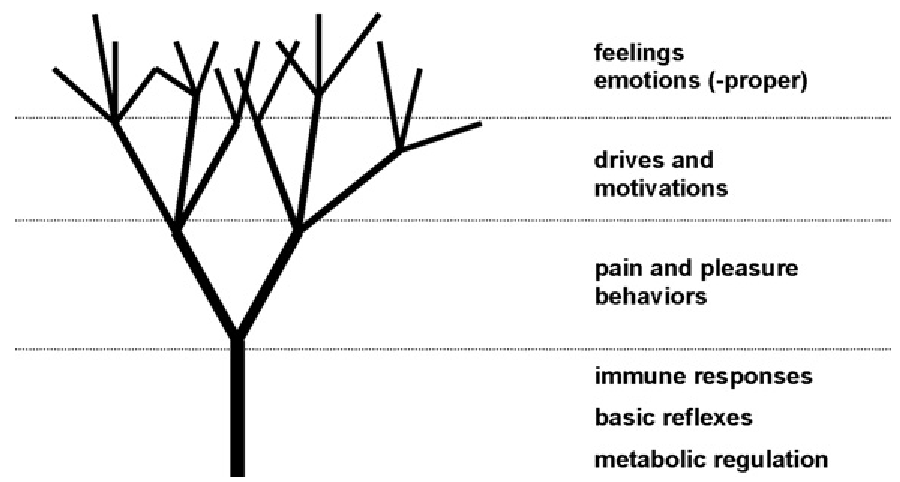
Figure 1: The nested levels of regulation, from simple metabolic processes to complex emotions.
By simulating these layers, a robot doesn't just "process data"—it "feels" its internal state, creating a Somatic Marker that guides its decision-making toward survival and well-being.
Critical Insight: Why Emotions Matter for Machines
In this framework, emotions aren't "feelings" in a poetic sense; they are bioregulatory reactions. They provide a sense of "urgency" and "priority."
- Insight: An autonomous agent needs an "agenda." In organisms, that agenda is staying alive.
- Application: The ICEA Project (Integrating Cognition, Emotion, and Autonomy) is currently working to build architectures based on the mammalian brain that integrate these homeostatic drives into robotic control.
Experimental Perspective & Future Work
The paper admits that we are far from building a truly autopoietic robot (one that can self-repair and self-construct at a cellular level). However, by modeling the "Self-X" properties (self-monitoring, self-adapting), we achieve a middle ground: Cognitive Autonomy.

Figure 2: Conceptualizing the intersection of biological theory and robotic engineering.
Conclusion: Are Robots Embodied?
The author concludes that if we define embodiment solely as "having a physical shell," then yes, robots are embodied. But if we define it as "having a mind rooted in the preservation of a living body," the answer is currently no. The path forward requires us to take the "organismic" part of "organism" seriously, embedding our AI in architectures that prioritize homeostatic integrity over mere task completion.
Takeaway: Future SOTA in robotics won't just be measured by faster sensors, but by the depth of the "internal world" that governs those sensors.