
Friends_Smile: Prioritizing Empathy in the Age of Social Information Overload
Emotion Care Services with Facebook Wall Messages
The paper introduces "Friends_Smile," a Facebook application designed for automated emotion care services. It leverages semantic analysis and crowdsourcing to evaluate friends' emotional states from Wall messages and ranks them using a bespoke "Attention Index" to facilitate timely social support.
TL;DR
As social networks expand, our ability to provide meaningful support to friends diminishes due to information overload. Friends_Smile is an innovative Facebook service that uses semantic analysis and crowdsourcing to filter Wall messages, quantify emotional distress, and rank friends by an "Attention Index," ensuring you never miss a friend's cry for help amidst the noise of app notifications and memes.
The "Friendship Scalability" Problem
We live in an era of "Six Degrees of Separation" where a typical user manages hundreds of digital connections. However, human empathy doesn't scale as easily as a follower count. The authors identify a critical pain point: emotional neglect. When friends post about sadness, anger, or "Special Events" (like a loss in the family), these messages are often buried under the sheer volume of "Wall" clutter.
Processing this is technically difficult because:
- Mixed Languages: Posts often combine Chinese, English, and Emoticons.
- Internet Slang: Formal NLP tools fail on "Martian language" or creative Chinese wordplay (e.g., "Open Heart" instead of "Happy").
- Temporal Decay: A sad post from six days ago requires less immediate action than one from six minutes ago.
Methodology: The Architecture of Digital Care
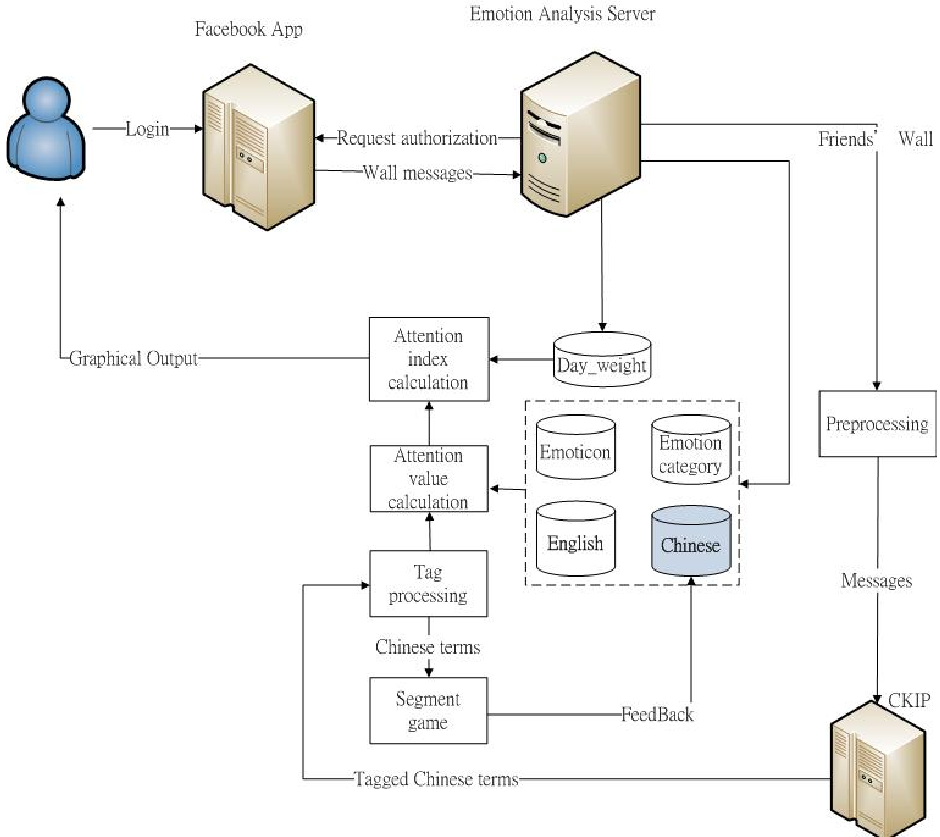
The system follows a sophisticated pipeline to transform raw text into a prioritized list of friends.
1. Multi-Source Semantic Analysis
The system doesn't rely on a single dictionary. It breaks down posts into three distinct streams:
- Chinese: Processed via CKIP (Academia Sinica) to handle the complexities of Mandarin segmentation.
- English: Mapped against WorldNet-Affect.
- Emoticons: Evaluated using a custom database of social media symbols (MSN, Plurk, Yahoo).
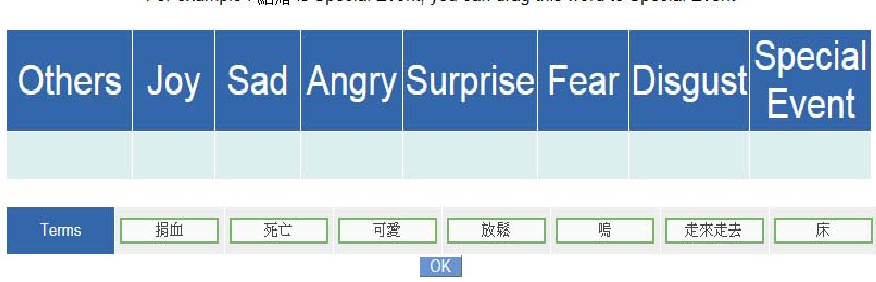
2. Crowdsourced Intelligence (The Segment-Game)
To handle "controversial terms"—words that might mean different things to different people—the authors developed a Facebook game. Users help classify terms, and the system uses a weighted formula to determine the Attention Value ( ).
3. Calculating the Attention Index
The core innovation is the Attention Index. It isn't just a sum of emotions; it’s a time-sensitive metric. The formula applies a weighting factor () that decays as the post gets older (e.g., today = 1.0, 6 days ago = 0.4).
Experimental Results & Insights
The system was evaluated against 1,160 real-world messages. One of the most fascinating findings was the Confusion Matrix of Emotions.
- Joy is easy to detect: The system achieved its highest accuracy (81.4%) in the "Joy" category for Chinese terms.
- The Sarcasm/Context Gap: "Surprise" was often confused with other emotions because markers like "!" (exclamation points) are used ambiguously in digital speech.
- The Hierarchy of Care: The authors discovered that "Special Events" (weddings, funerals) warrant an of 1.0, higher than general "Joy" or "Sadness," acknowledging the societal importance of these milestones.
Critical Perspective: Why This Matters
While modern AI uses Transformers (like BERT or GPT) to solve these problems today, this paper's hybrid approach (Lexical Analysis + Crowdsourcing + Time-Decay) offers a highly transparent and interpretable way to model social care.
Limitations: The system relies heavily on explicit keywords. It might miss "quiet desperation"—users who stop posting entirely when depressed. Furthermore, as social media shifts toward ephemeral content (Stories) and encrypted messaging, "Wall-scraping" becomes a more limited window into a friend's soul.
Conclusion
Friends_Smile reminds us that the goal of social technology shouldn't just be more communication, but better communication. By quantifying the "Need for Care," we can use technology to reinforce our human bonds rather than dilute them.
Keywords: Social Networks, Emotion Analysis, Semantic Analysis, Crowdsourcing, Attention Index.