
Beyond the Peak: Enhancing Emotion Categorization with Sequential Voting
Emotion Categorization from Video-Frame Images Using a Novel Sequential Voting Technique
This paper introduces a novel sequential voting technique integrated with a more inclusive training strategy for emotion categorization from video-frame images. Evaluated on the CK+ dataset using Random Forest (RF) and K-Nearest Neighbors (KNN), it achieves a SOTA accuracy of up to 96.5% by leveraging mid-sequence frames and temporal consistency.
TL;DR
Most emotion recognition systems are "peak-obsessed"—they train only on the most intense moments of an expression. This paper shifts the paradigm by training on the full transition from mid-level to peak expressions and introduces Sequential Voting (SV) to fix "label flickering." The result? A robust system achieving 96.5% accuracy on the CK+ dataset with minimal computational cost.
Problem & Motivation: The "Peak Intensity" Bias
In facial expression research, the gold standard has long been the CK+ (Cohn-Kanade) database. However, a significant flaw exists in how researchers use it: they typically only extract the final 1-3 "peak" frames of a sequence.
From an academic standpoint, this creates a massive distribution shift when the model encounters real-world data where emotions are subtle or developing. Furthermore, frame-by-frame classification often suffers from Label Flickering—where a single sequence of a "Happy" face might momentarily be misclassified as "Neutral" or "Sad" due to minor pixel variations, destroying the temporal logic of the video.
Methodology: Training on Transitions and Voting for Consistency
The authors' insight is two-fold:
- Increased Training Breadth: Instead of just using the final frames, they categorize the entire second half of a sequence (from mid-intensity to peak) as the target emotion. This teaches the model the process of an expression.
- Sequential Voting (SV): This is a post-processing logic. Since a single video sequence represents one emotion, the algorithm calculates the mode (most frequent prediction) of all frames in that sequence. If the majority says "Sad," the entire sequence is corrected to "Sad."
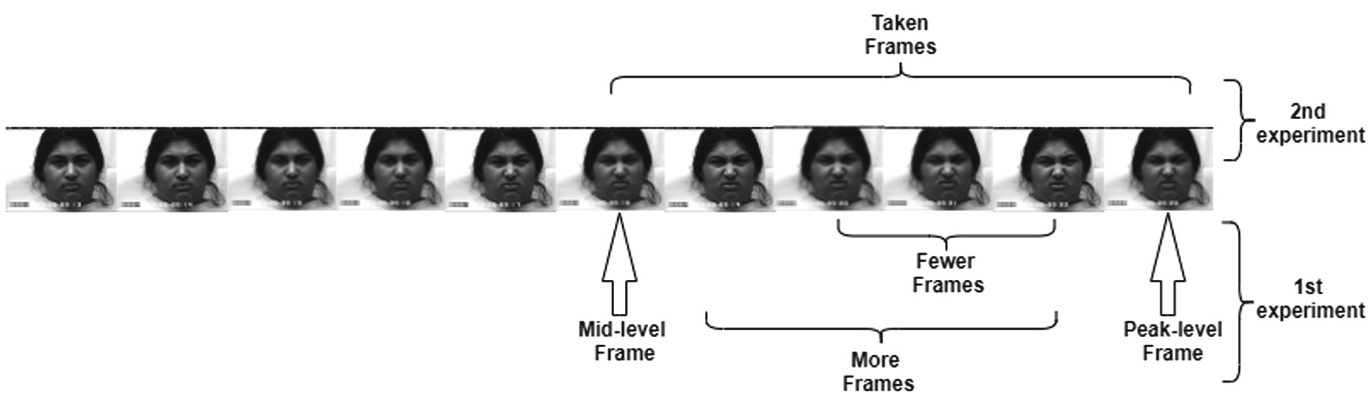
Feature Extraction Simplification
While modern SOTA often relies on massive ResNets, this paper goes back to basics to prioritize speed. They use RGB channel separation, focusing on the Mean and Standard Deviation of the Red channel (often the most descriptive for skin/facial changes) to feed into Random Forest (RF) and K-Nearest Neighbor (KNN) classifiers.
Experiments & Results: Efficiency Meets Accuracy
The authors compared their "More Frames" approach against the traditional "Peak Frames" approach.
1. Mid-level Performance Boost
When tested on mid-intensity frames, the model trained on more frames achieved 85.9% accuracy, compared to only 73.4% for the peak-only model. This proves that exposure to lower-intensity expressions during training is vital.
2. The Power of the Vote
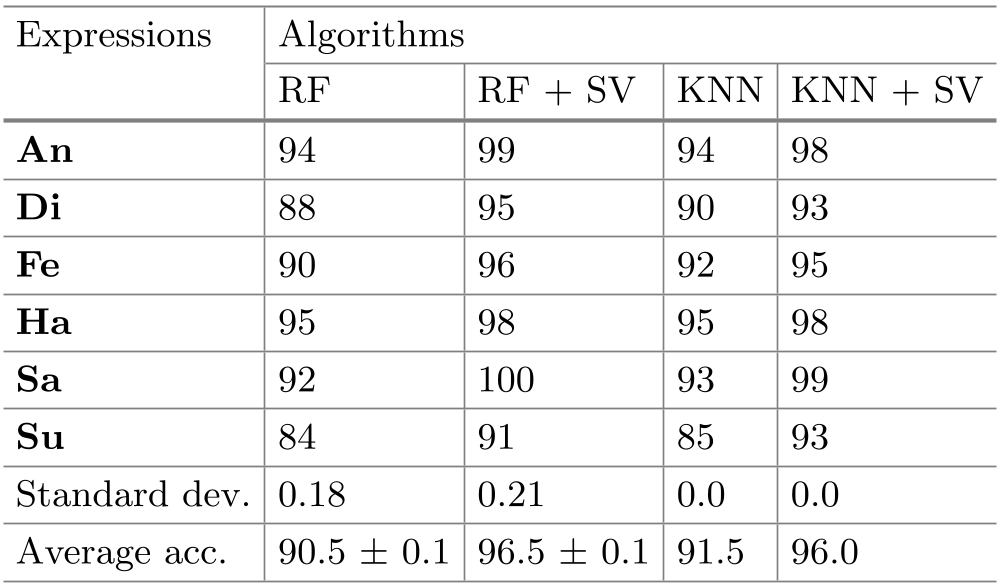
Sequential Voting provided a significant "correction" effect. For the "Sad" category, accuracy jumped from 92% to 100% because the SV algorithm effectively wiped out individual frame misclassifications (label flickering).
3. Speed Advantage
Unlike Deep Learning models that take hours to train (even on GPUs), this implementation takes approx. 5 seconds on a standard CPU. This makes it an ideal candidate for real-time edge computing applications.
| Case | Algorithm | Accuracy (Before SV) | Accuracy (After SV) |
|---|---|---|---|
| 6 Basic Emotions | Random Forest | 90.5% | 96.5% |
| 6 Basic Emotions | KNN | 91.5% | 96.0% |
Critical Analysis & Conclusion
Takeaways
The core value of this work is the reminder that Temporal Consistency is a powerful prior. In video data, frames are not independent and identically distributed (i.i.d.). By treating the sequence as a single logical unit through Sequential Voting, we can achieve ResNet-level accuracy using much simpler, faster algorithms like Random Forest.
Limitations
- Posed Data: The CK+ database consists of participants "acting" emotions. Whether Sequential Voting holds up in "In-the-wild" (spontaneous) videos where emotions fluctuate rapidly remains to be seen.
- Simple Features: While R-channel mean/std is fast, it might lose subtle micro-expressions that a CNN would capture.
Future Outlook
This approach sets a "sub-standard" (as the authors humoursly put it) for using the full temporal range of video frames. Future research could combine this Sequential Voting logic with Attention-based Transformers to weight peak frames higher while still maintaining sequence-wide consistency.
Final Verdict: A masterclass in "Smart Data" over "Big Models." By understanding the nature of video sequences, the authors achieved SOTA results with 1990s-era computational requirements.