
ISA-ICI: Bridging the Information Gap in Emotion Cause Extraction via Sentiment Knowledge and Structural Consistency
Emotion Cause Extraction by Combining Intra-clause Sentiment-enhanced Attention and Inter-clause Consistency Interaction
The paper introduces ISA-ICI, a hierarchical neural network for Emotion Cause Extraction (ECE) that combines sentiment lexicons, syntactic dependency trees, and inter-clause consistency. By integrating intra-clause sentiment-enhanced attention with inter-clause interaction, the model achieves a new SOTA F1-score of 0.7797 on the benchmark Sina city news dataset.
TL;DR
Extracting the "Why" behind an emotion is significantly harder than identifying the emotion itself. The proposed ISA-ICI model tackles this by injecting external sentiment lexicons and syntactic dependency into an attention mechanism, while simultaneously modeling the positional consistency of causes in a document. It achieves SOTA performance (0.7797 F1) by turning linguistic intuition into architectural constraints.
Problem & Motivation: Beyond the Raw Text
In Emotion Cause Extraction (ECE), the primary challenge is the Information Deficiency Issue. Most deep learning models treat clauses as independent sequences, missing out on three vital dimensions:
- Sentiment Cues: Certain words (e.g., "debt", "hardship") are strong indicators of a cause but aren't always weighted correctly by standard attention.
- Syntactic Logic: The cause of an emotion is often tied to the subject or object of a sentiment word, necessitating a graph-based understanding of the sentence.
- Discourse Habit: Human writers typically place causes on the same side of an emotion clause (the "consistency principle").
Methodology: The Core Architecture
The ISA-ICI framework operates on a hierarchical principle, moving from word-level syntax to document-level interaction.
1. Sentiment-Enhanced Clause Encoding
Instead of letting the model learn attention from scratch, the authors use HowNet and NTUSD lexicons to create a "gold" sentiment distribution. They then use Cross-Entropy loss () to supervise the attention weights, ensuring the model looks at sentiment-bearing words.
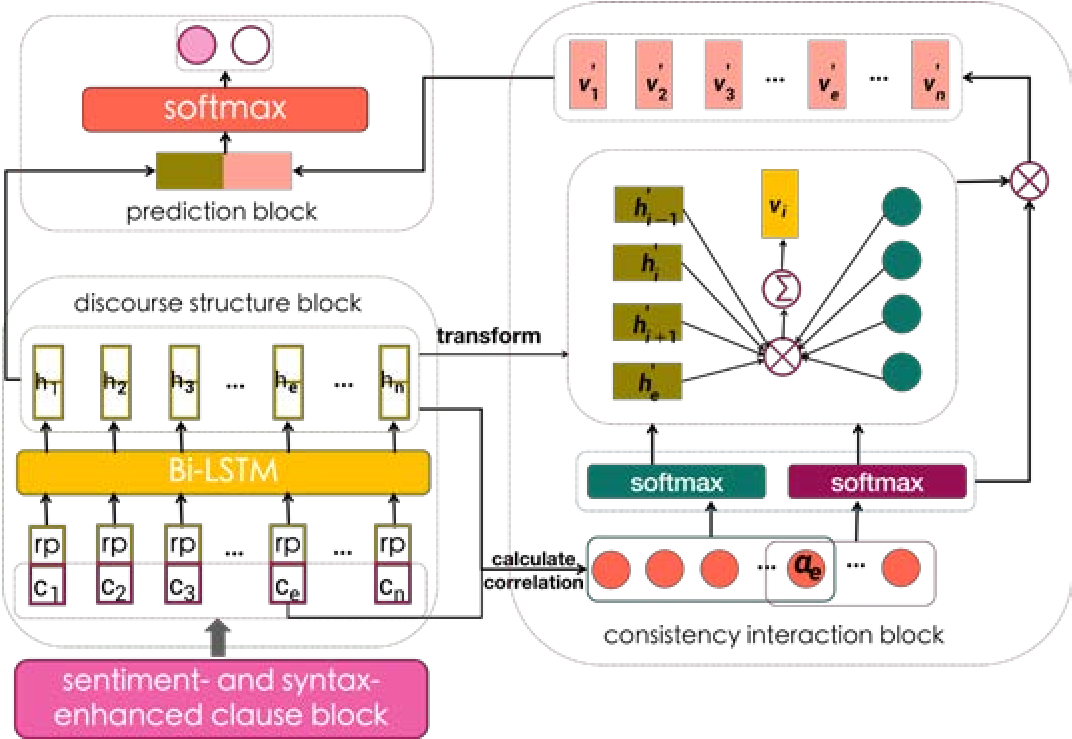
To capture the local context, a Graph Convolutional Network (GCN) processes the syntactic dependency tree of each clause. This allows the model to propagate the importance of a sentiment word to its syntactically related neighbors.
2. Consistency Interaction Block
This is the most "intuitive" part of the model. Recognizing that causes tend to appear together on one side of the emotion clause (), the model splits the document into "front-side" and "back-side" segments. It then calculates a side-specific consistency vector ( and ), allowing candidate clauses to "interact" with their neighbors to verify if they collectively form a logical cause.
Experiments & Results: Setting a New Benchmark
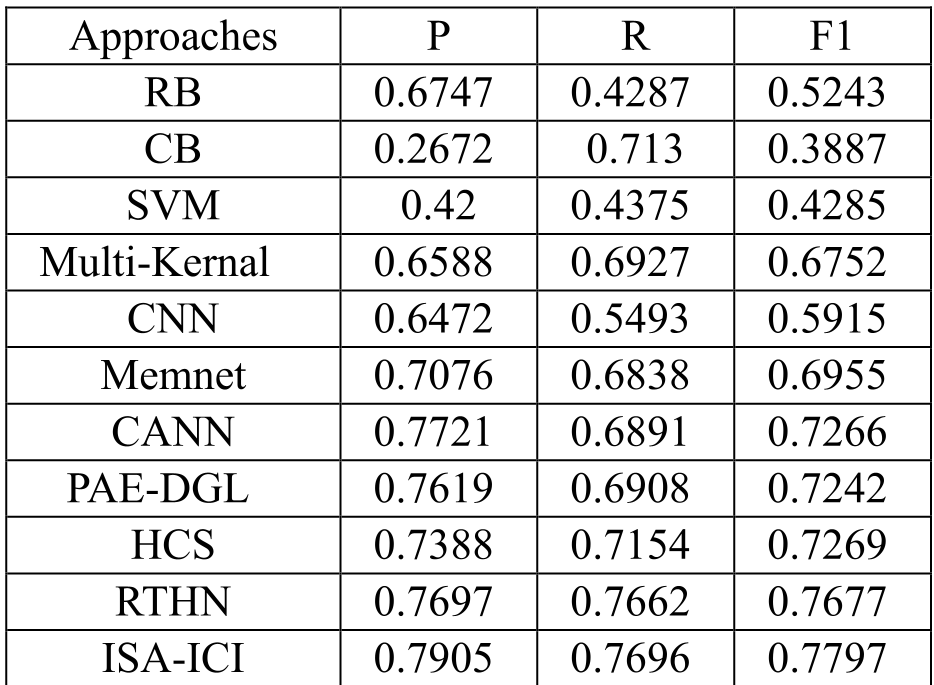
The model was tested against 10 baselines, ranging from traditional SVMs to modern Transformers.
Performance Gains
ISA-ICI achieved the highest F1-score of 0.7797. Notably:
- It outperformed RTHN (RNN-Transformer), which was the previous leader, by showing better precision and recall balance.
- The gap between ISA-ICI and standard CNN/RNN models is massive (>15% F1), proving that simple sequence modeling is insufficient for ECE.
Ablation Insights
The ablation study reveals a balanced contribution from all modules:
- No-Sentiment: F1 drops to 0.7715.
- No-Syntax: F1 drops to 0.7752.
- No-Consistency: F1 drops to 0.7702.
The most significant drop occurs when removing Consistency Interaction, suggesting that the global discourse structure is arguably more important than local syntax for identifying causes.
Critical Analysis & Conclusion
Takeaway
ISA-ICI proves that supervised attention (using external lexicons) and structural priors (consistency interaction) are powerful tools for niche NLP tasks where data might be sparse or the signal-to-noise ratio is low.
Limitations & Future Work
The model currently relies on pyltp for Chinese syntactic parsing. Any errors in the dependency tree will ripple through the GCN and sentiment-enhanced attention. Future iterations could benefit from Joint Learning, where the dependency parsing and cause extraction are optimized simultaneously, or by leveraging the zero-shot reasoning capabilities of LLMs to augment the sentiment knowledge base.