
Precise Emotion: Revolutionizing Sign Language Avatars with 4D Trajectories
Classification and Synthesis of Emotion in Sign Languages Using Neutral Expression Deviation Factor and 4D Trajectories
The paper introduces a novel parametric model for synthesizing emotional facial expressions in 3D avatars for Sign Language using the Neutral Expression Deviation Factor (NEDeF) and 4D spatio-temporal trajectories. By integrating these non-manual markers (NMM) into the CORE-SL framework, the system achieves a high classification accuracy of 72.2% for base emotions.
TL;DR
Communication in Sign Language isn't just about the hands; it’s about the face. This paper presents a breakthrough in 3D avatar animation by introducing a parametric model for Non-Manual Markers (NMM). By treating facial regions as independent 4D trajectories (3D space + time) and measuring deviations from a "neutral" state (NEDeF), the researchers have created a system that synthesizes realistic emotions with high accuracy and low computational overhead.
The Missing Piece: Why Hands Aren't Enough
In Sign Language, the face provides the syntax and emotional framing—irony, sarcasm, and grammatical structure are often carried by the eyebrows or the mouth. Most current 3D interpreters focus heavily on finger tracking and arm positioning but leave the face static or "uncanny."
The core challenge is balancing realism with computational cost. Simulating every facial muscle is too heavy for real-time systems, while simple "emojis" lack the linguistic precision needed for serious communication. The authors argue that we need a model that understands the relationship between facial regions and specific emotions over time.
Methodology: The 4D Centroid Approach
The researchers moved away from global face morphing toward a sectorized model.
1. Neutral Expression Deviation Factor (NEDeF)
The heart of the paper is the NEDeF metric. It calculates how much a specific facial region (like the forehead or mouth) deviates from its neutral position during an emotion.
- Insight: Not all parts of the face contribute equally to every emotion. Joy lives in the cheeks and mouth; sadness is defined by the forehead.
- Optimization: By using PCA (Principal Component Analysis), the authors identified which "vertices" matter most, allowing the system to ignore low-impact movements and save processing power.
2. 4D Trajectories and B-Splines
Instead of just static snapshots, the system treats facial movement as a trajectory.
- Each region has a "Centroid" (a central point).
- As an emotion forms, the centroid moves along a path defined by B-Splines (smooth mathematical curves).
- This creates "4D objects"—3D spatial regions observed over a temporal window.
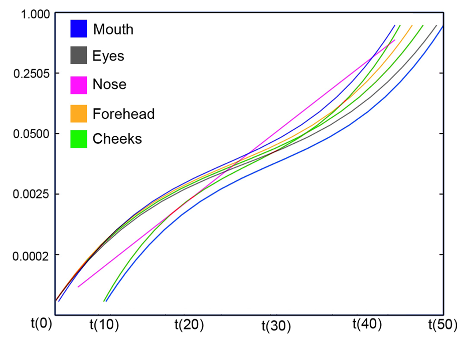 Figure 1: Spatio-temporal Centroid trajectories for base expressions (Joy, Anger, Surprise, etc.). The curves visualize how different regions "travel" from neutral to full expression.
Experiments: Proving the Precision
The authors validated their synthesis through two main lenses: Machine Learning Classification and Human Evaluation.
Machine Learning Validation
The researchers used SVM (Support Vector Machine) and KNN algorithms to see if a computer could correctly "read" the synthesized avatar's face.
- Result: The system achieved an average accuracy of 72.2%, significantly outperforming traditional methods like MSTF.
- Finding: Anger and Joy were the most recognizable (84.2% and 87.2%), while Disgust remained a challenge—likely due to its subtle geometric complexity.
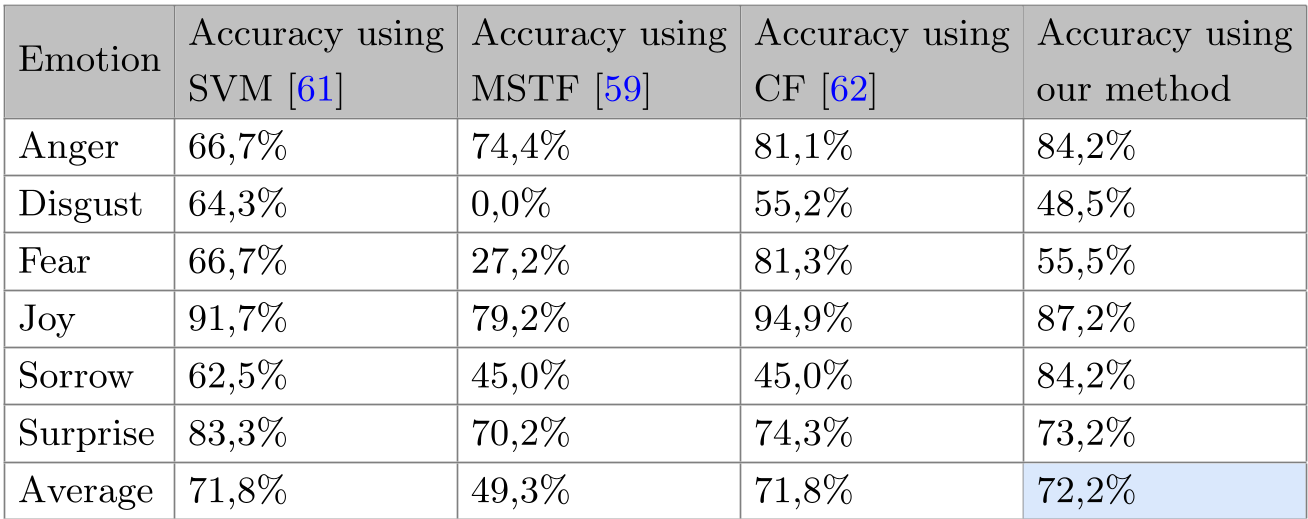 Table: Comparison of the proposed method against other state-of-the-art spatio-temporal feature learning models.
The Human Element
30 members of the deaf community evaluated the outputs. The correlation between the intended "Base Expressions" and user "Hits" was a remarkable 0.91, indicating that the mathematical NEDeF model successfully translates into human-readable emotion.
Critical Insight & Future Outlook
The beauty of this research lies in its modularity. By treating the face as five independent regions (forehead, eyes, cheeks, nose, mouth), the system can "mix and match" movements to create complex, interpolated emotions (like "bittersweet" or "cautious surprise") without needing a custom animation for every single variation.
Limitations: The model still struggles with cultural variations in expression and the specific morpho-syntactic markers unique to different regional sign languages (e.g., LIBRAS vs. ASL).
Next Steps: Integrating these facial 4D trajectories with the CORE-SL hierarchy means we are one step closer to 3D avatars that don't just "sign," but truly communicate with the depth and nuance of a human interpreter.
Conclusion
This work marks a significant shift from "visualizing" sign language to "simulating" the linguistic reality of non-manual markers. By leveraging 4D geometry, we can create more empathetic and accurate virtual assistants for the deaf community.