
Beyond the Smile: Classifying "Unfakeable" Emotions via Remote Cardiac Pulse Estimation
Classification of Emotions from Video Based Cardiac Pulse Estimation
The paper introduces a method for emotion classification (Comedy vs. Horror) using remote video-based cardiac pulse estimation. By applying Independent Component Analysis (ICA) and Delaunay Triangulation to conventional RGB video, the authors extract Photoplethysmographic (PPG) signals to differentiate emotional states without physical contact.
TL;DR
Researchers have developed a way to "read" your heart through a standard webcam to tell if you are genuinely scared or amused. By extracting subtle skin color changes (remote PPG) and analyzing the resulting pulse patterns with Machine Learning, this study achieves a 67.3% accuracy in distinguishing between reactions to horror and comedy movies—without the subject wearing a single sensor.
The "Fake Smile" Problem: Why Facial Recognition Isn't Enough
In the world of Affective Computing, facial expression analysis is king. However, it has a glaring weakness: humans are experts at masking their feelings. We can smile when we are frustrated or maintain a "poker face" while terrified. Physiological signals—heart rate, skin conductance, and pulse—are much harder to fake because they are governed by the autonomic nervous system.
Traditionally, capturing these signals required bulky chest straps or finger clips. This paper explores the "Holy Grail" of emotion sensing: obtaining these internal physiological truths using nothing but a standard RGB camera.
Methodology: Turning a Webcam into a Heart Monitor
1. The Physics of Skin Color
The core insight is based on Photoplethysmography (PPG). Every time your heart beats, a pressure wave travels to your skin, momentarily increasing the volume of blood (hemoglobin). This changes how much light the skin absorbs. While invisible to the naked eye, a high-quality camera sensor can pick up these minute fluctuations.
2. Separating Signal from Noise
The authors utilized an advanced model that treats the observed skin color as a mixture of two signals:
- Melanin/Pigment: Constant over short periods.
- Hemoglobin: Rhythmic changes driven by the heart.
By using Independent Component Analysis (ICA) on random pairs of facial patches (triangulated via Delaunay Triangulation to handle head movement), the system isolates the "cardiac pulse" from lighting changes and skin tone.
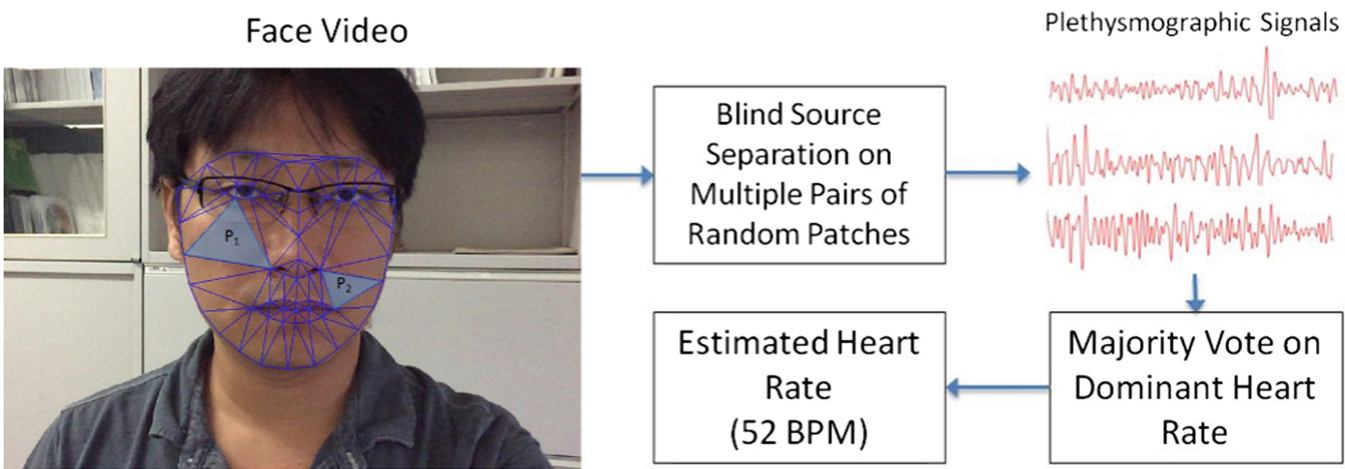 Figure 1: The algorithm workflow—from facial landmark tracking to averaged PPG signal extraction.
Experiments: Comedy vs. Horror
The study involved 26 subjects watching 10 minutes of video (5m Comedy, 5m Horror). The researchers focused on 30-second "peak" emotional segments.
From these clips, they extracted a 900-dimensional vector representing the pulse signal. They then compared Two Modalities:
- Video PPG: The raw physiological pulse.
- Facial Action Units (FAU): Measurements of muscle movements (e.g., pulling mouth corners).
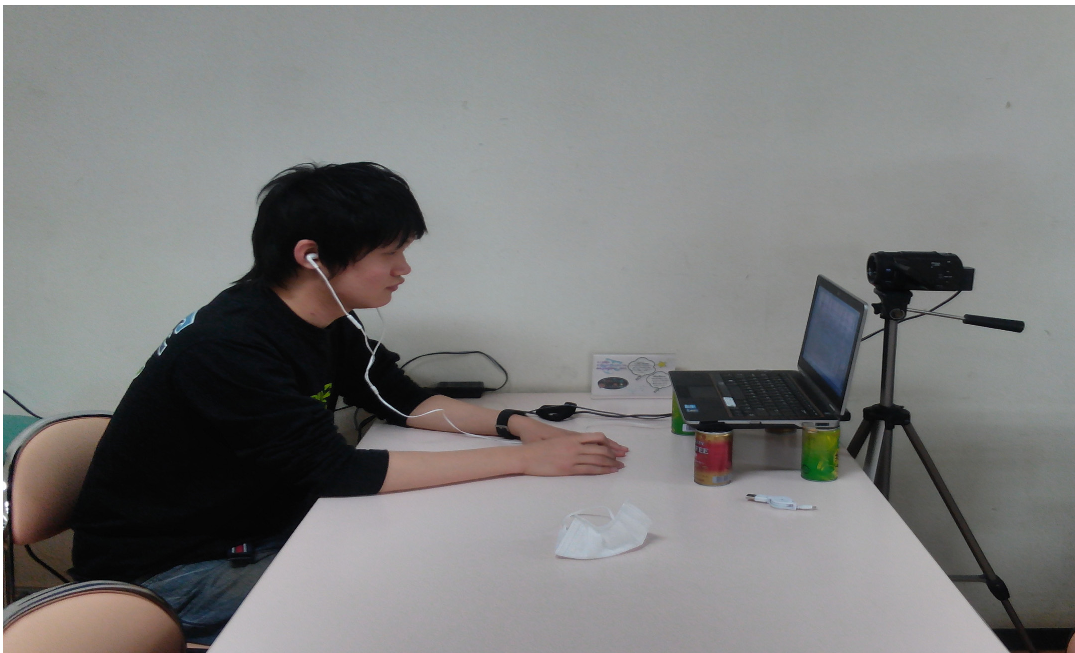 Figure 2: Tracking the subject's face while they experience different stimuli. Note the extracted pulse waves at the bottom.
Results and SOTA Comparison
The findings, summarized in the table below, show that while Facial Action Units currently lead in accuracy, the Video PPG (with PCA) is a strong contender.
| Feature Type | Accuracy |
|---|---|
| Linear SVM with Video PPG | 65.4% |
| Linear SVM with Video PPG (PCA) | 67.3% |
| Linear SVM with Facial Action Units | 76.9% |
| Linear SVM with Facial Action Units (PCA) | 78.8% |
The authors argue that the higher accuracy of facial units in this specific study is due to the subjects being "honest" with their expressions. In a real-world scenario where a user might try to hide their fear, the 67.3% accuracy of the heart-pulse method would be far more reliable because physiological responses cannot be easily suppressed.
Critical Insight: The Future of "Authentic" AI
This research proves that the "shimmer" in our skin carries enough information to categorize complex emotions.
Limitations
- Data Diversity: The study used 26 subjects, all of Asian descent. Generalizing across different skin types (Fitzpatrick scale) remains a challenge for rPPG.
- Baseline Comparison: The "Comedy vs. Horror" task is binary. Moving to a more granular "Wheel of Emotions" (Plutchik) will require more sophisticated feature extraction than just raw pulse vectors.
The Roadmap Ahead
The next step for this tech isn't just better accuracy—it's Multi-modal Fusion. By combining the "what we show" (Facial Units) with "what we feel" (Video PPG), AI systems could identify the discrepancy between the two, potentially detecting high-stress levels, cognitive load, or even deception in high-stakes environments like remote medical consultations or automated security screenings.
Takeaway: Your heart doesn't lie, and now, your webcam is starting to listen.