
Emotion Correlation Mining: Deciphering the "Why" Behind Affective Confusion
Emotion Correlation Mining Through Deep Learning Models on Natural Language Text
This paper introduces a novel framework for Emotion Correlation Mining (ECM) in natural language text, moving beyond simple recognition to analyze "why" emotions are confused or how they evolve. Using CNN-LSTM architectures and multi-level features (character, implicit, and explicit), it successfully quantifies inter-emotion relationships across diverse news datasets.
TL;DR
Most AI models try to tell you what emotion a text contains. This paper asks why models (and humans) get it wrong. By combining deep learning with Principal Component Analysis (PCA), the authors map the "distance" between emotions like Love, Anger, and Fear, revealing that our digital emotions don't exist in silos—they evolve and circulate in predictable, often "confused" patterns.
Background Positioning
In the landscape of Affective Computing, we have reached a plateau where recognition accuracy is high, but our understanding of Emotion Correlation is low. This work acts as a bridge between engineering-centric emotion classification and psychology-centric cognitive bias. It is a refinement and analytical expansion of SOTA deep learning, shifting the focus from "Labels" to "Relationships."
The Core Insight: Why Do We Confuse Emotions?
The authors identify three primary sources of error in emotion analysis:
- Emotion Complexity: Individual backgrounds and instant moods create cognitive bias.
- Social Event Complexity: A single news story (e.g., a terrorist attack) triggers a mixture of Anger, Sadness, and Love simultaneously.
- Model/Dataset Bias: Technical limitations in how we represent language.
To solve this, they treat the errors of the model not as failures, but as data points indicating the proximity of different emotional states in the human psyche.
Methodology: The Hybrid Architecture
The researchers utilized two deep learning models to ensure the findings weren't just artifacts of a single architecture:
- M1 (CNN-LSTM2): A standard feature processor followed by sequential logic.
- M2 (CNN-LSTM2-STACK): Adds an "Original Feature Attention" mechanism to mitigate the vanishing gradient problem and keep the model focused on the raw input signals.
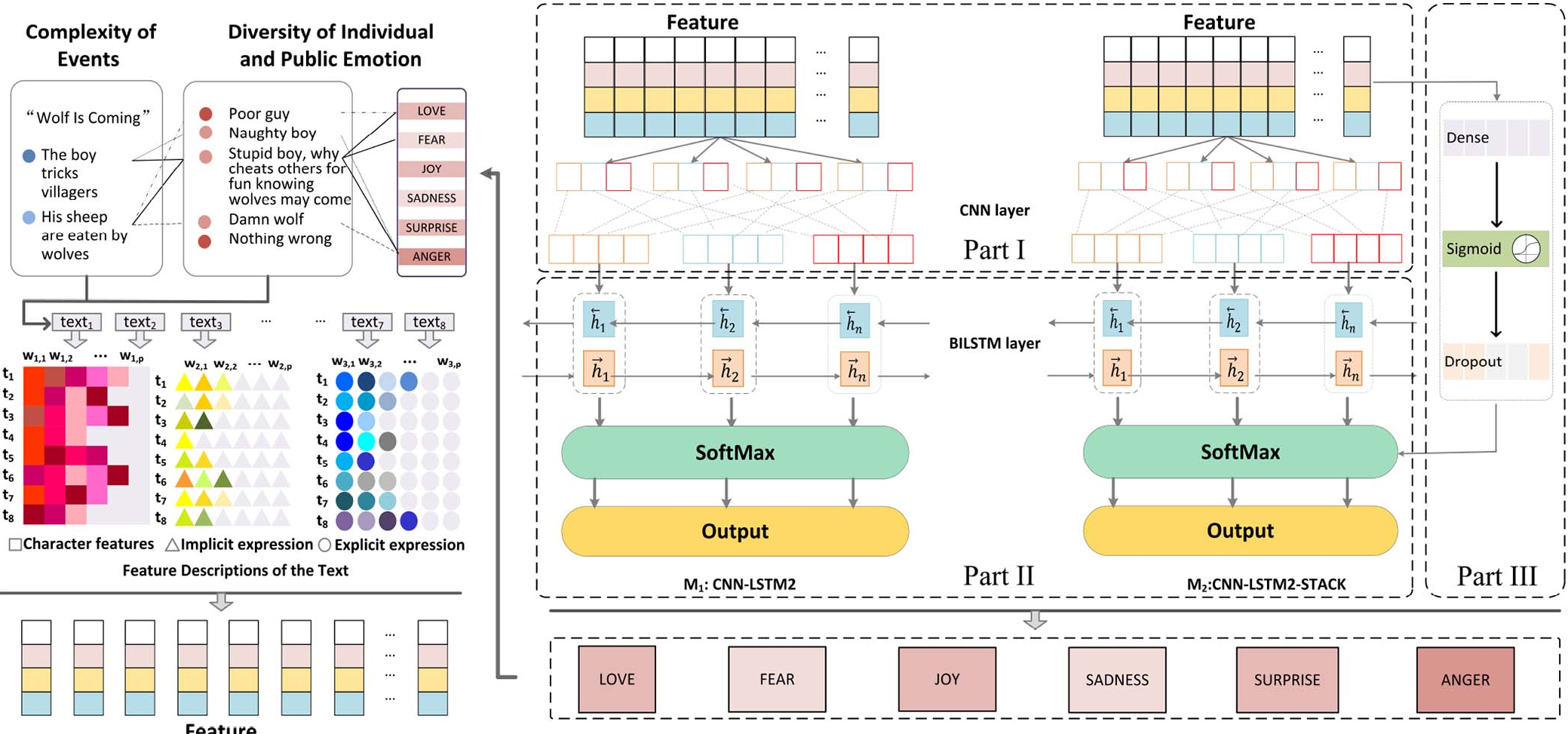
They didn't just look at words (Explicit). They looked at:
- Characters: The smallest units of language.
- Implicit Expression: Using synonym tags from the HIT dictionary to group related concepts.
- Explicit Expression: The raw word embeddings.
Key Findings: The Laws of Confusion and Evolution
1. The Confusion Law
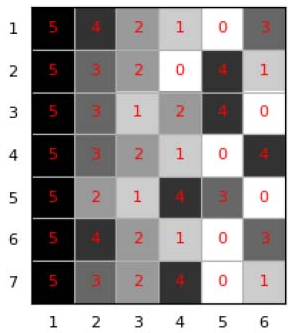
By projecting the model's classification results onto an orthonormal basis using PCA, the authors calculated the "Distance" between emotions.
- Anger as an Anchor: In subjective comments, Anger is the least likely to be confused with others, yet it acts as a "sink"—many other emotions (like Sadness) are frequently misclassified as Anger.
- Love in Objective Text: In news bodies, Love is the most distinct emotion, whereas Joy is highly confused.
2. The Evolution and Circulation Law
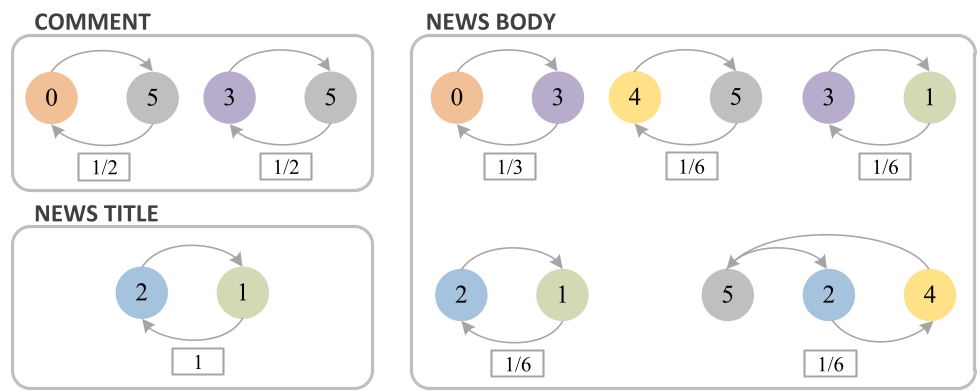
The paper introduces the concept of "Emotion Circulation." Through limited-step shift analysis, they found that emotions often move in loops:
- Comment Trajectories: Love ↔ Anger and Sadness ↔ Anger. This suggests that online discussions often polarize toward anger.
- News Trajectories: Fear ↔ Joy. This "Fear-Joy Circulation" is typical in objective reporting where suspenseful or high-stakes events are described.
Experimental Results
The models achieved impressive accuracy (up to 85% on comments), but the real value lies in the Entropy Analysis. It showed that the "chaos" or uncertainty of emotional recognition is highest in news bodies (long objective text) and lowest in news comments (short subjective text), likely because commenters are more direct in their emotional expression.
Critical Analysis & Future Outlook
Takeaway: This research proves that "misclassification" is actually a feature, not a bug. By analyzing where models fail, we can map the manifold of human emotion.
Limitations: The study uses Sina News (Chinese), and the authors rightly note that culture plays a massive role in emotion. A Western dataset might yield a "Guilt-Sadness" circulation rather than "Love-Anger."
Future Work: This framework could revolutionize Human-Computer Interaction (HCI). Imagine a social robot that doesn't just know you are "Sad," but understands that your sadness is currently "evolving" toward "Anger" and intervenes accordingly.