
Seq-CNN: Bridging the Context Gap in Textual Emotion Detection
An effective approach for emotion detection in multimedia text data using sequence based convolutional neural network
This paper introduces a sequence-based Convolutional Neural Network (CNN) framework with an integrated attention mechanism for fine-grained emotion detection in multimedia text. Tested on a newly curated dataset from TV show transcripts, the method achieves a significant accuracy of 80.41%, outperforming traditional LSTM and Random Forest baselines.
TL;DR
Researchers have developed a Sequence-Based Convolutional Neural Network (CNN) equipped with an Attention Mechanism to detect fine-grained human emotions in dialogue. By training on a custom-annotated corpus of TV show transcripts, the model significantly outperforms traditional LSTM and Random Forest classifiers, achieving over 80% accuracy in identifying complex emotions like disgust, fear, and surprise.
Perspective: Why Emotion Detection in Text is Hard
In the era of multimedia, we have become proficient at detecting emotions through facial recognition and vocal tone. However, text remains the most ambiguous medium. A sentence like "Wow, you told him" could represent joy, sarcasm, or pure terror depending on the preceding context.
Existing SOTA methods often suffer from:
- Data Scarcity: Lack of annotated datasets for fine-grained emotions beyond "Positive/Negative".
- Vanishing Context: Traditional keyword-based or shallow ML models ignore the "flow" of conversation.
- Class Imbalance: In natural speech, "Neutral" remarks far outnumber "Anger" or "Disgust," leading to biased models.
The Proposed Methodology: Sequence-Based CNN with Attention
The authors argue that emotions are not isolated events but sequential ones. Their framework treats text not just as a bag of words, but as a temporal sequence.
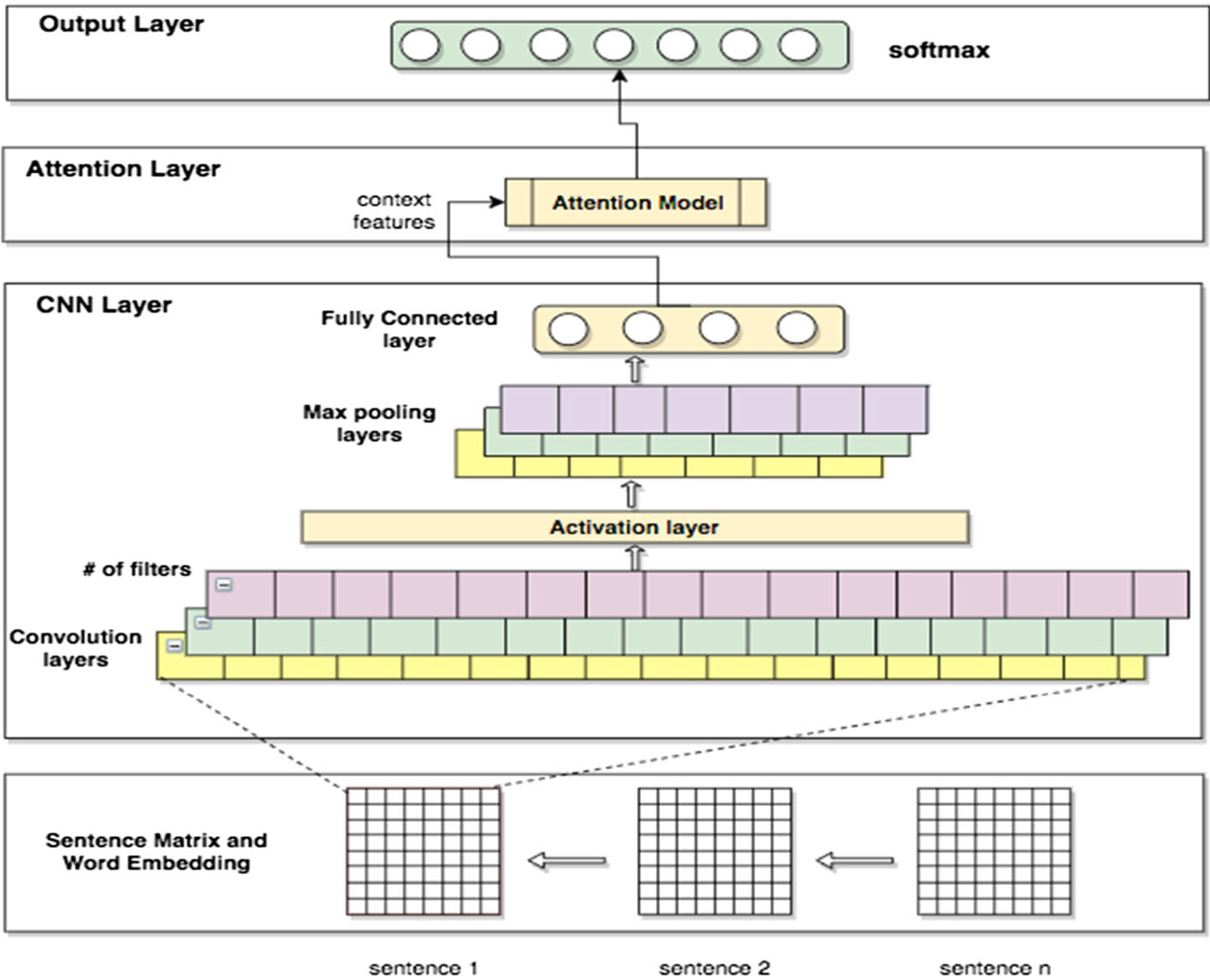
1. The Architecture
The core of the system is a 5-layer CNN. Unlike standard text CNNs that look at isolated sentences, this model utilizes previous sentence features to inform the current classification.
2. The Weight of a Word (Attention)
Not all words are created equal. In the sentence "Oh my God, this could be very dangerous," the attention mechanism identifies "dangerous" as a high-weight feature for the "Fear" category.
This formula allows the model to calculate a "relevance score" for each feature vector, ensuring that the CNN focuses on the semantic "heart" of the utterance.
Experimental Results: SOTA Performance
The researchers benchmarked their model against Random Forest (RF) and Long Short-Term Memory (LSTM) networks using the "Charmed" dataset—a corpus of 13,354 utterances.
Performance Metrics
| Model | Fine-Grained Accuracy (7 Classes) | Coarse-Grained Accuracy (3 Classes) |
|---|---|---|
| Random Forest | 51.22% | N/A |
| LSTM | 72.15% | N/A |
| Proposed CNN | 80.41% | 83.32% |
The use of SMOTE (Synthetic Minority Over-sampling Technique) was critical. By mathematically generating "synthetic" examples of under-represented emotions like "Anger," the authors prevented the model from simply defaulting to a "Neutral" prediction.
Critical Insight: The "Ambiguity" Challenge
Despite the high accuracy, the paper honestly addresses the "Confusion Matrix" of human emotion. "Anger" is frequently confused with "Disgust," and "Happiness" with "Surprise." This mirrors the human experience—where the physical and linguistic markers of these emotions often overlap.
Conclusion and Future Outlook
This work pushes the boundaries of how AI interprets the "subjective experience" of text. By moving from simple sentiment towards fine-grained emotion, businesses can better monitor social media and improve recommendation systems.
Future Work will likely involve:
- Integrating hybrid CNN-LSTM architectures to capture even longer-term dependencies.
- Incorporating emoticons and emojis as formal linguistic features.
- Expanding the dataset to multi-label scenarios where an utterance can be both "Sad" and "Angry" simultaneously.
Editor's Note: This paper is a significant step in Natural Language Understanding (NLU), proving that even with "noisy" multimedia data, structural innovations in CNNs can yield high-precision emotional intelligence.