
Culturally-Aware Affective Computing: Designing an Emotion Framework for the Arab World
Design of an Emotion Elicitation Framework for Arabic Speakers
This paper proposes a specialized framework for emotion elicitation tailored for Arabic speakers, addressing the cultural and linguistic gaps in affective computing. It introduces a multi-stage process involving culturally sensitive clip selection, subjective rating, and physiological validation (EEG, skin conductance, eye-tracking) to create a standardized Arabic emotion database.
TL;DR
To bridge the gap in affective computing for non-Western populations, this research presents a pioneering framework specifically designed for Arabic speakers. By combining culturally filtered movie clips with "priming" interviews and multi-channel physiological monitoring (EEG, Eye-tracking), the authors provide a roadmap for creating localized, high-fidelity emotional databases.
Contextualizing Affect: Why "One Size" Does Not Fit All
In the world of Emotion AI, we often assume that high-quality datasets like those used for Llama or Sora are universally applicable. However, when it comes to Affective Computing—the study of systems that can recognize and process human emotions—culture is a dominant variable.
Current SOTA methods for emotion elicitation largely rely on a handful of validated film clip sets in English, French, and Spanish. The authors argue that these materials are often culturally "tone-deaf" when applied to the Arab world. For instance:
- Religious Sensitivities: Clips using religious figures as comedy material are considered offensive rather than amusing.
- Gender Norms: A scene showing a woman being flirted with might elicit fear in an Arabic female viewer but rage in an Arabic male viewer due to the cultural value of honor.
- Media Consumption: In the Arab world, television dramas have a 99.7% viewing rate, making them a more potent elicitation tool than traditional Western cinema clips.
Methodology: A Two-Stage Validation Framework
The researchers proposed a robust workflow to ensure that the stimuli used actually trigger the intended emotions (Anger, Fear, Sadness, Disgust, Amusement, Surprise, and Neutral).
1. Selection & Cultural Filtering
Instead of just dubbing Hollywood movies, the framework suggests using Arabic Television Dramas and social expert reviews to ensure clips are short, context-independent, and culturally acceptable.
2. The Hybrid Elicitation Protocol
The core of the methodology is a unique hybrid approach summarized in the architecture below:
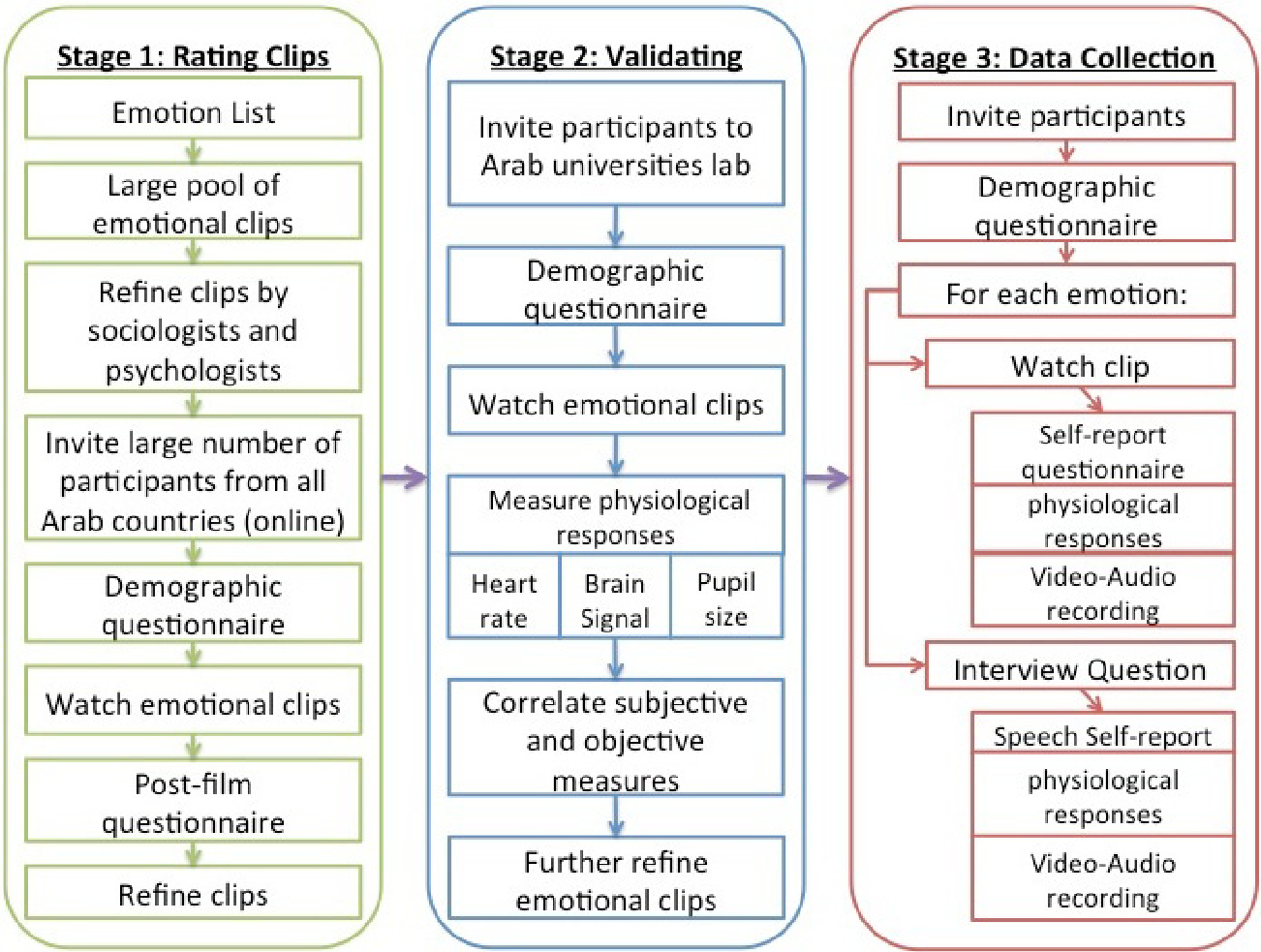
The process involves:
- Baseline Normalization: Starting with a neutral clip to reset the subject's state.
- Induced Emotion: Watching a short, high-impact validated clip.
- Spontaneous Emotion (The "Priming" Interview): Immediately after the clip, an interviewer asks the participant about a similar event in their own life. This uses the clip as an emotional "lubricant," making the participant's recall more vivid and authentic.
Experimental Insights: The Power of Spontaneous Recall
The pilot study conducted in Saudi Arabia provided a fascinating validation of the "priming" theory. The researchers used classic Arabic-dubbed animations (Heidi and Remi) to induce joy and sadness.
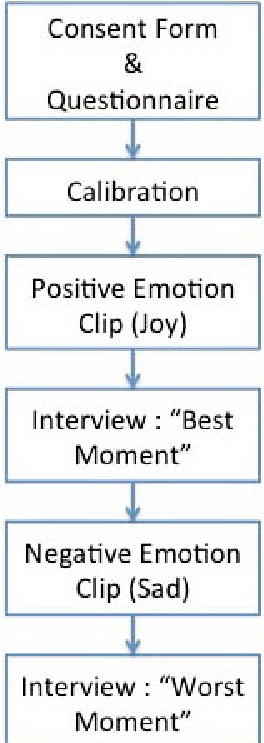
Key Findings:
- Elicitation Gap: Only 1% of participants cried while watching a sad clip. However, when asked to discuss a personal loss after watching the clip, 70% cried. This confirms that video clips are excellent for setting the "mood," but personal storytelling is required for high-intensity spontaneous emotion.
- Physiological Markers: Using eye-tracking, the team found significant differences in pupil dilation and fixation duration between positive and negative states. Specifically, sadness was associated with increased pupil size and significant eye-contact avoidance.
- Classification Accuracy: Even with a limited feature set (eye activity only), the system achieved a 66% accuracy rate in distinguishing between positive and negative states.
Critical Analysis & Conclusion
Takeaway
The study proves that emotion recognition systems cannot be merely "imported." A framework that respects the conservative values and unique media habits of the Arab population is not just a matter of ethics; it is a requirement for data accuracy.
Limitations & Future Work
The pilot study was heavily skewed toward female participants (65 vs 6 males) due to institutional restrictions in Saudi Arabia. Future iterations require:
- Gender Balancing: To better understand the divergent emotional triggers between men and women in the region.
- Multi-modal Scale: Integrating the proposed EEG and skin conductance sensors to move beyond eye-tracking.
- Geographic Diversity: Expanding the study across different Arab nations (from the Maghreb to the Levant) to account for regional sub-cultures.
This framework represents a vital step toward Localized AI, ensuring that the future of Human-Computer Interaction is inclusive of the 400+ million Arabic speakers worldwide.