
Emotion Entrainment: Decoding the Pulse of U.S. Immigration Security on Social Media
Emotion extraction and entrainment in social media: The case of U.S. immigration and border security
This paper presents a social media analytics framework for extracting emotions and measuring "emotion entrainment" in the context of U.S. immigration and border security. Using a dataset of over 180,000 tweets from November 2014, the authors compare traditional social network metrics (Betweenness Centrality) against a novel entropy-based entrainment model to identify influential users and emotional contagion patterns.
TL;DR
Researchers have developed a method to track "Emotion Entrainment"—the rhythmic convergence of feelings—within political social media. By analyzing 189,012 tweets regarding U.S. immigration policy, they discovered that high-influence users don't just have more followers; they possess a unique ability to synchronize the negative emotions (fear, anger) of the community, serving as emotional "conductors" in highly polarized debates.
Background: Beyond Simple Links
In the realm of Security Informatics, we often look at who follows whom. However, structural influence (Betweenness Centrality) doesn't always capture the psychological impact of a message. This paper shifts the focus from network topology to emotional dynamics, exploring how the intensity of public concern over border security evolves into a collective, synchronized state.
Methodology: The Mechanics of Influence
The authors' approach is two-fold, combining psychological theory with information theory.
1. Emotion Extraction
Using a lexicon of over 13,000 terms, the system categorizes tweets into eight primary emotions: anger, anticipation, disgust, fear, joy, sadness, surprise, and trust.
2. The Entrainment Model
This is the core innovation. Instead of just counting retweets, the authors model user emotions as Markov Processes. Influence is defined by how much information about User A's future emotional state can be derived from User B's emotional history.

In equation (2), the entrainment strength is calculated through the entropy (H) of probability distributions, identifying the causal flow of emotion from one user to another.
Experiments & Results: The Power of Negative Affect
The findings from the November 2014 data (centered around President Obama’s executive actions on immigration) are striking:
- The Anatomy of an Influencer: Top influencers are disproportionately associated with emotions of fear, disgust, and anger.
- The Trust Paradox: As user influence increases, the "Trust" ratio expressed in their content actually decreases. This suggests that skepticism or adversarial stances are more effective at driving community engagement in security debates.
- Connectivity vs. Entrainment: The paper compares traditional influencers (like specialized news writers) with "Entrainment leaders." While top structural leaders acts as bridges, entrainment leaders act as the "heartbeat" of the network, driving the emotional rhythm.
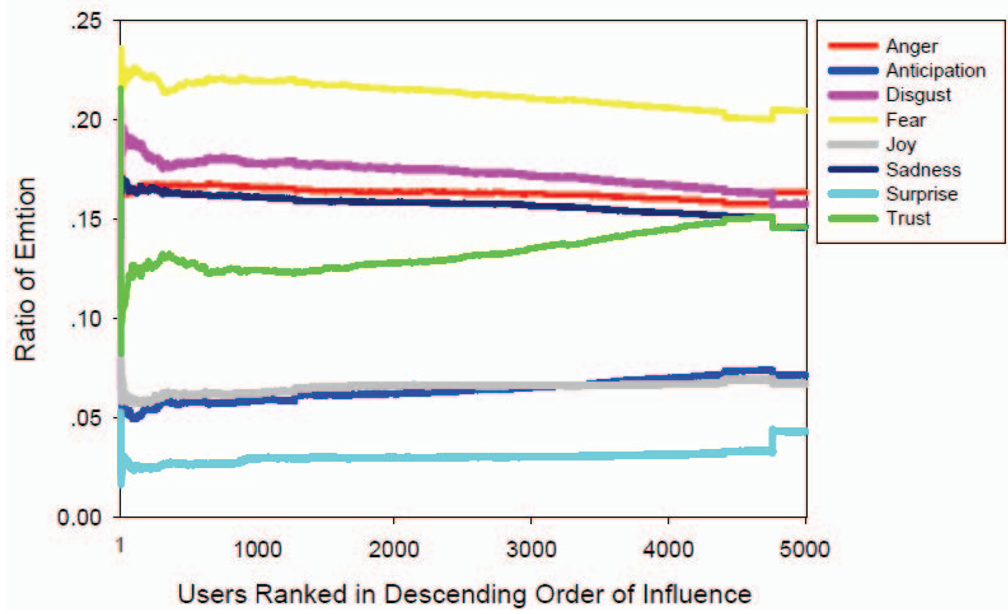
Figure 1 demonstrates that fear is the dominant emotion in the immigration debate, while surprise remains the lowest.
Entrainment Visualizations
The researchers visualized "Entrainment Networks," where the thickness of the edges represents the strength of emotional synchronization.
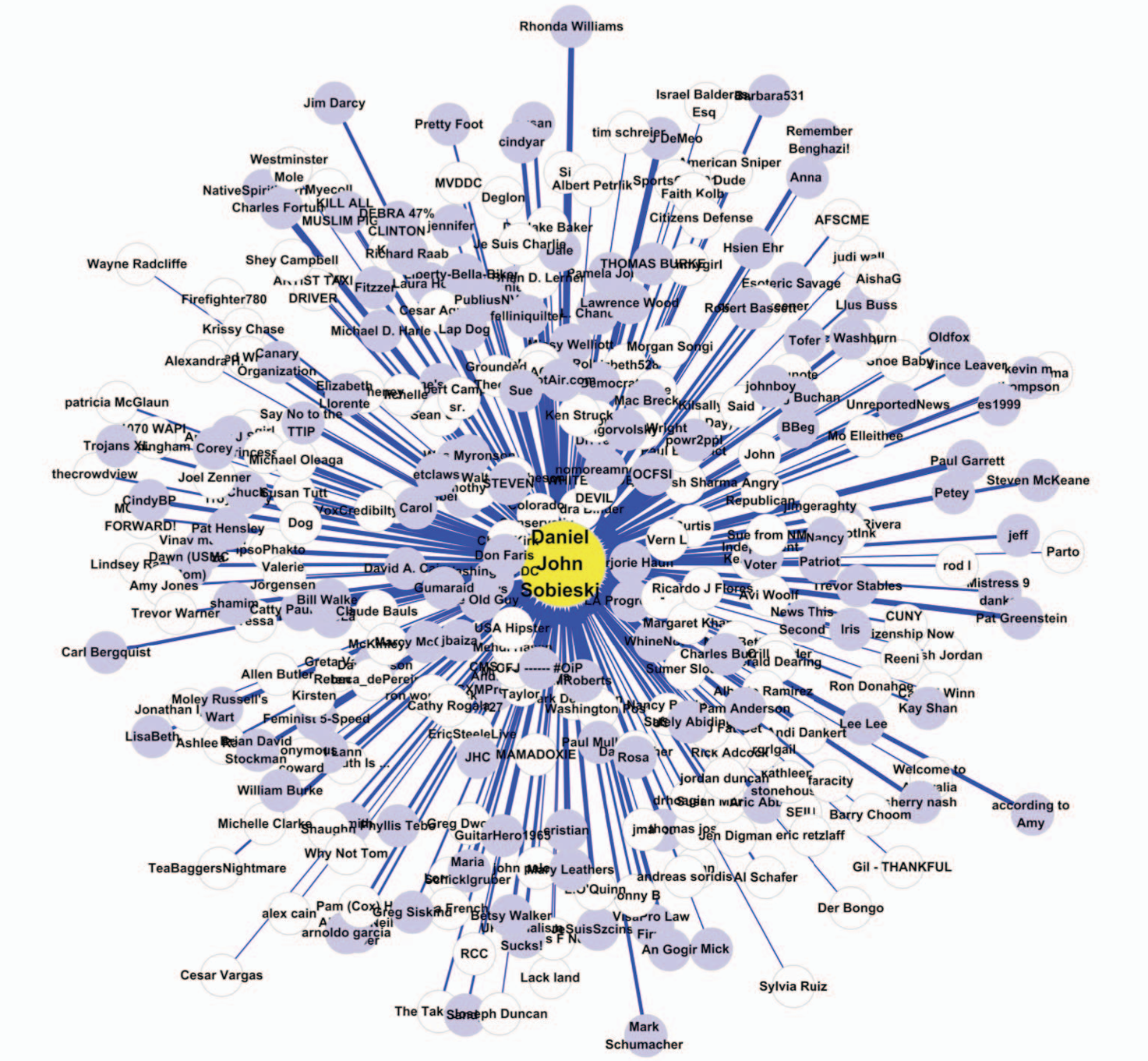
Users like Daniel John Sobieski (an influential writer in the dataset) show a high ratio of followers who synchronize with their emotional output at an "above-average" strength (41.53%), highlighting their role as emotional catalysts.
Critical Insight & Future Directions
The primary value of this work lies in its predictive potential. By monitoring entrainment strengths, security personnel could theoretically predict "social actions" or flashpoints before they manifest physically.
Limitations:
- Lexicon Rigidity: The study uses a general-purpose emotion lexicon. In political discourse, sarcasm and domain-specific slang (e.g., "amnesty") might carry emotional weights not captured by a standard dictionary.
- Platform Bias: The study is limited to Twitter.
Future Work: Moving toward Deep Learning (LLMs) to extract nuanced sentiment while maintaining the rigorous entropy-based entrainment math would likely provide a even more granular view of social intelligence.
Conclusion
This research confirms that in the digital age, security informatics is as much about psychology as it is about technology. Understanding how emotions spread and sync—especially negative ones—is crucial for developing strategies to mitigate radicalization and manage public crises.