
Emotify: Bridging the Emotional Gap for ASD Children through Machine Learning
Emotify: emotional game for children with autism spectrum disorder based-on machine learning
Emotify is an interactive, multilingual educational game designed for children with Autism Spectrum Disorder (ASD) to improve emotion recognition and expression. It utilizes a Random Forest Classifier trained on acoustic features (MFCCs) to provide real-time feedback on the user's vocal pitch, achieving a classification accuracy of 72% across four primary emotional states.
TL;DR
Emotify is a specialized web-based game designed to help children with Autism Spectrum Disorder (ASD) understand and express emotions. By leveraging a Random Forest Classifier to analyze the pitch and MFCCs of a child's voice, the system provides real-time feedback on emotional delivery. It bridges the gap between digital interaction and social-emotional learning, achieving a 72% accuracy rate in identifying four key emotional states.
The Challenge: Decoding the Social "Black Box"
For children with ASD, the subtle nuances of human emotion—a slightly raised pitch for happiness or a lower tone for sadness—can often feel like a "black box." Existing research highlights that while these children face significant social communication barriers, they often show a high affinity for technology.
Prior interventions like FaceSay or LIFEisGAME focused predominantly on facial expressions. However, vocal prosody (the rhythm and pitch of speech) is equally vital for social integration. Emotify addresses this by focusing on the "Spoken Channel," transforming emotional therapy into an engaging, low-anxiety digital experience.
Methodology: How Emotify "Hears" Emotion
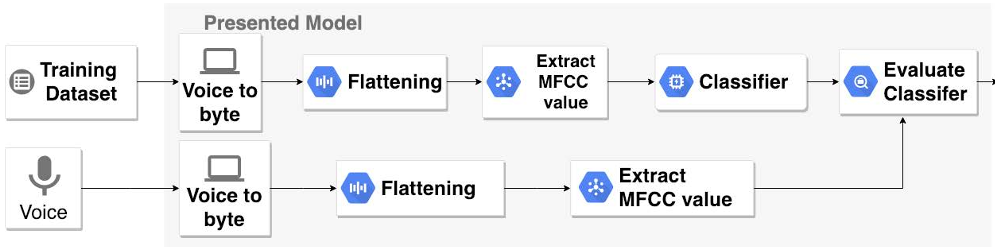
Emotify operates through a structured two-part workflow: Learning and Testing.
- Acoustic Feature Extraction: The system records the child's voice and extracts MFCC (Mel-Frequency Cepstral Coefficients) values. MFCCs are crucial because they represent the short-term power spectrum of sound, mimicking how the human ear perceives frequency.
- The Classifier: The heart of the system is a Random Forest Classifier (RFC). The authors chose 30 decision trees to maintain a balance: enough for robust categorization, but few enough to ensure the game remains responsive (low latency) on web platforms.
- Cross-Lingual Learning: By training on both English and German datasets, the model learns universal acoustic markers of emotion rather than language-specific phonemes.
Designing for Neurodiversity: The Game Loop
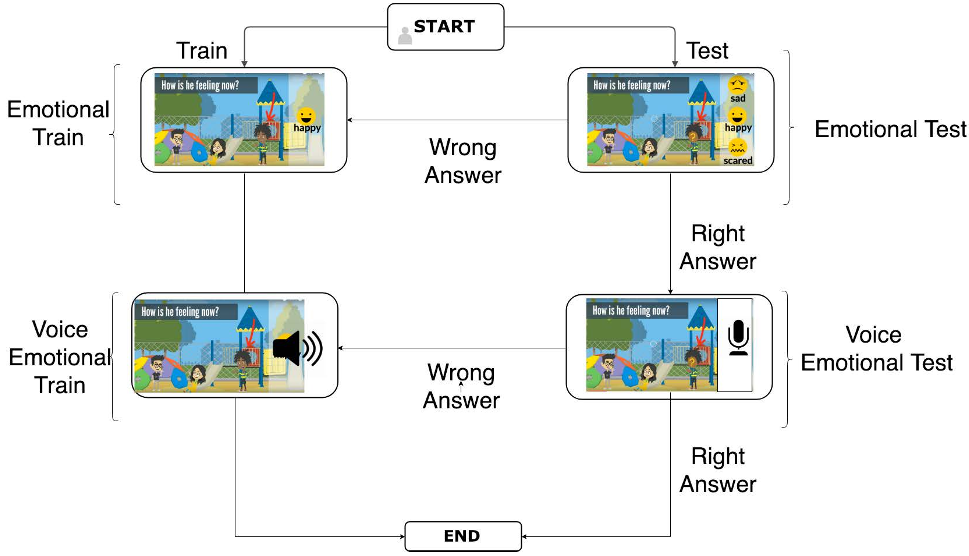
The application is intentionally designed with a specific pedagogical flowchart to prevent cognitive overload:
- Training Phase: Users watch silent animations paired with real faces to learn recognition, followed by audio examples to learn expression through emulation.
- Testing Phase: The child must identify emotions in others and then "perform" an emotion using their own voice. The machine learning model acts as a "neutral judge," providing objective feedback.
Results and Critical Insights
With an average accuracy of 72%, the Random Forest model proves that localized acoustic features are strong indicators of emotion, even in diverse speech datasets.
Key Takeaways from the Experiment:
- Performance vs. Latency: The choice of 30 trees in the RFC is a strategic "Inductive Bias" for real-world application, ensuring the game feels interactive rather than sluggish.
- Generalization: The inclusion of multiple languages suggests the system could be deployed globally with minimal retraining.
Critical Analysis & Future Outlook
While the 72% accuracy is promising for a short-paper pilot, the authors identify a critical path for future work: Multi-modal Fusion. The current model relies solely on pitch. In social reality, humans use a combination of facial cues and vocal tones.
Future Work involves:
- Integrating real-time facial expression analysis alongside voice.
- Conducting field experiments with psychologists to measure the actual therapeutic transference—whether skills learned in the game translate to real-world social scenarios.
Emotify represents a significant step toward Affective Computing for Healthcare, turning complex machine learning algorithms into a supportive tool that empowers children to better navigate the social world.