
Can You Hear the Anger in 8kbps? Decoding Emotion Intelligibility in Compressed Speech
Emotion Intelligibility within Codec-Compressed and Reduced Bandwidth Speech
The paper evaluates "Emotion Intelligibility" in speech subjected to lossy compression (MP3, Speex) and reduced bandwidth. Using the Berlin Database of Emotional Speech (emoDB), the authors compare human recognition performance (UAR and Krippendorff’s alpha) against the ITU-standard POLQA objective quality measure.
TL;DR
As AI moves into mobile and real-time communication (Siri, Alexa, VoIP), speech is rarely transmitted in its raw high-fidelity form. This study investigates whether the "emotional payload" of a voice survives lossy compression. The findings reveal a fascinating gap: while standard quality metrics (POLQA) might rate a low-bitrate voice as "poor," humans can still correctly identify emotions with over 90% accuracy until the bitrate drops to extreme lows.
Context: The Gap Between Quality and Meaning
In the world of signal processing, we have long used POLQA (Perceptual Objective Listening Quality Assessment) to tell us if a codec is "good." But "good" in this context usually means "can I understand the words?" It doesn't necessarily mean "can I feel the speaker's frustration?"
The authors argue that human-computer interaction (HCI) needs to move beyond semantic understanding to Affective Computing. If we label data for emotion recognition using compressed audio, we need to know if the compression itself acts as a filter that strips away the very data we are trying to train on.
Methodology: Codecs vs. Human Perception
The study utilized the Berlin Database of Emotional Speech (emoDB), a gold-standard dataset of actors expressing seven emotions (Anger, Boredom, Disgust, Fear, Happiness, Sadness, and Neutral).
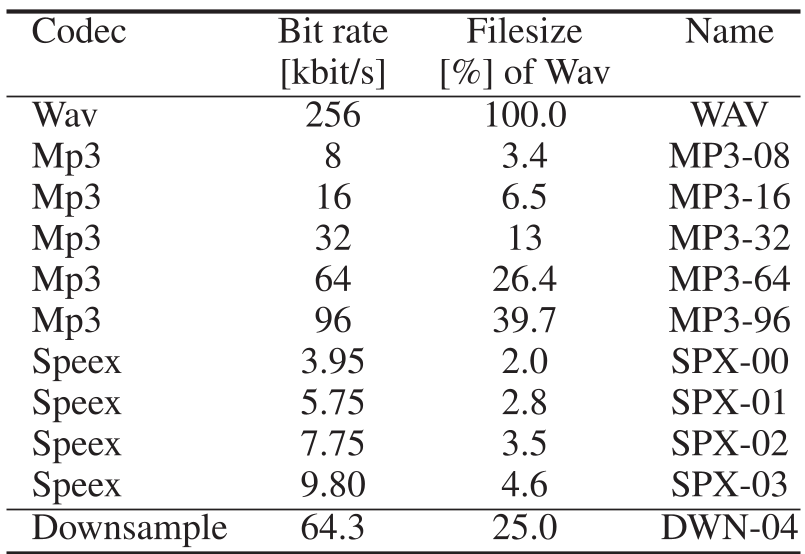
To test the limits of intelligibility, the researchers subjected these samples to:
- MP3: Perceptual coding that discards sounds supposedly "unheard" by the human ear.
- Speex: A CELP (Code-Excited Linear Prediction) codec specifically optimized for human speech.
- Downsampling: Reducing the sample rate to 4kHz to simulate narrow-band telephone quality.
Key Insights: Why Your AI Might Still "Feel" You
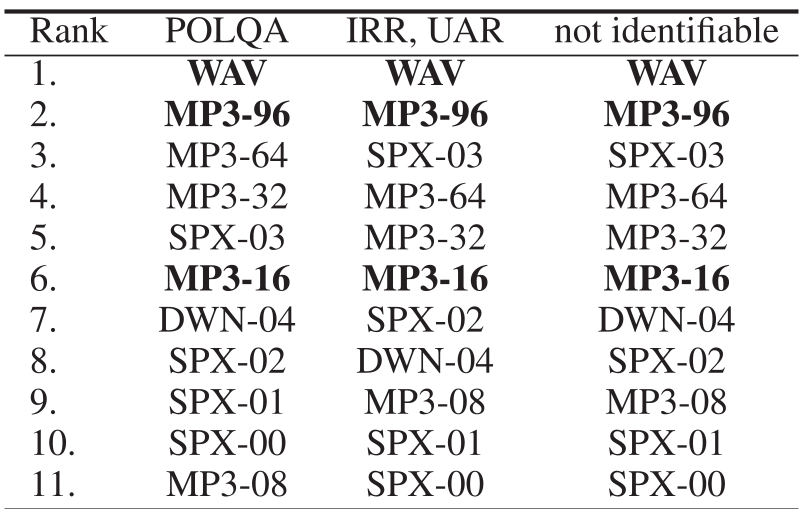
The experiment produced three critical rankings based on POLQA (objective), IRR/UAR (human agreement/correctness), and "not identifiable" rates (uncertainty).
1. Humans are better than the math suggests
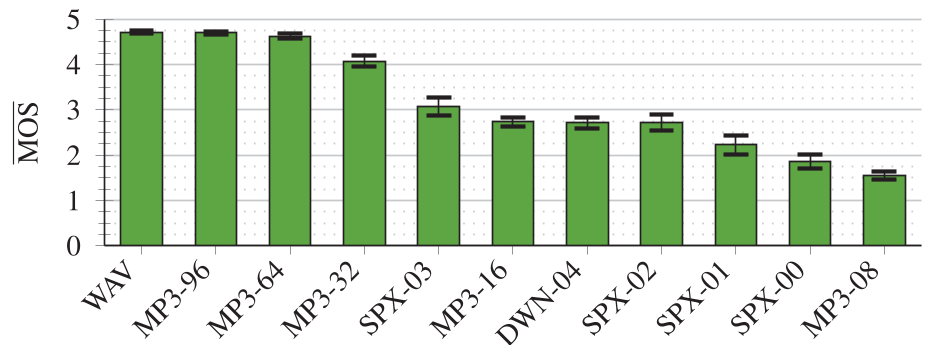
The most striking result is found in the lower bitrates. For example, while POLQA gave MP3-08 (8 kbit/s) a abysmal score, humans still achieved a Unweighted Averaged Recall (UAR) of nearly 90%. This suggests that "emotional features" (like prosody and pitch variations) are significantly more robust to lossy compression than the spectral details required for "high-fidelity" listening.
2. The Speex Advantage
The study highlights that Speex (designed for speech) outperforms MP3 (designed for music/audio) in preserving emotional cues at low bitrates. Even when Speex was compressed to 7.75 kbit/s, human inter-rater reliability (IRR) remained "very good" (>0.80).
3. The "Cliff" of Uncertainty
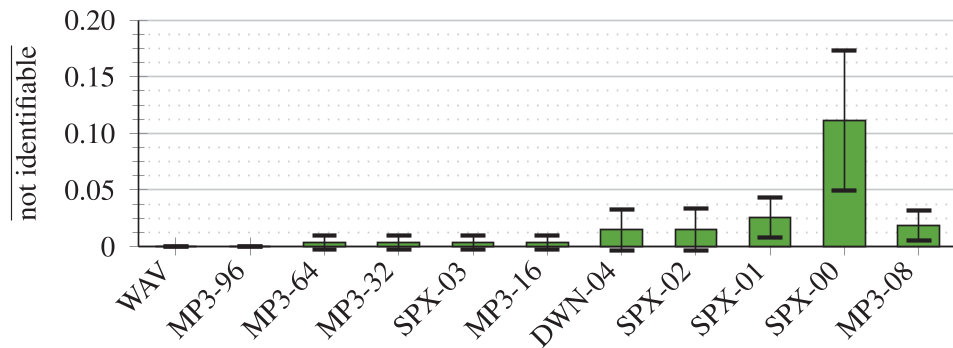
There is, however, a breaking point. At 3.95 kbit/s (SPX-00), the UAR dropped to 78.2%, and the reliability fell to "poor." Most tellingly, the number of times human raters checked the "not identifiable" box quadrupled.
Critical Analysis: POLQA vs. Reality
The ranking table below reveals the misalignment between standard industry metrics and emotional perception. POLQA consistently underestimated high-quality Speex and overestimated low-quality MP3 compared to actual human performance.
What does this mean for the industry? If you are building an Emotion Recognition system for a mobile app:
- Don't rely solely on MOS scores to select your codec; they don't capture the survival of affective cues.
- CELP-based codecs (like Speex or modern Opus/EVS) are superior for maintaining emotional richness even at "telephone" bitrates.
- Training Awareness: If your model is trained on uncompressed audio but deployed via a 16kbps stream, you likely have a significant "mismatch" in features that simple MOS metrics won't warn you about.
Conclusion & Future Work
The study concludes that humans are surprisingly adept at extracting emotion from mangled, compressed audio, but there is a clear "intelligibility floor." The next frontier in this research will likely involve identifying the specific acoustic features (e.g., certain formants or harmonic-to-noise ratios) that are destroyed by compression, allowing for the design of "emotion-aware" codecs that prioritize affective metadata over spectral perfection.