
Emotion Interaction in Cities: How Population Growth Shapes Our Collective Feelings
Emotion Interaction in Cities
This paper investigates "emotion interaction" in urban environments by applying urban scaling laws to 3.8 million geo-tagged tweets from major USA and UK cities. Using a contextualized emotion classifier, the study establishes that emotional expression scales superlinearly with population size, particularly during the COVID-19 pandemic.
TL;DR
Does living in a bigger city make you angrier or more fearful? This study applies Urban Scaling Laws to millions of tweets to prove that as city populations grow, "emotion interaction"—the exchange of emotional states—increases superlinearly. Crucially, negative emotions like disgust and anger grow faster than joy, but the COVID-19 pandemic uniquely "decelerated" the growth of fear relative to city size by unifying public anxiety around a single topic.
Background: The Science of Cities
For decades, the "Science of Cities" has treated urban centers as biological organisms. Just as an animal's metabolism scales with its mass, city metrics like GDP, crime, and innovation scale with population. Historically, most research focused on physical infrastructure or economic output. This paper moves the needle into the Human-Centered realm, exploring the "Urban Emotions" paradigm—asking how the sheer volume of humanity affects the way we feel and interact.
Problem & Motivation: The Urban Stressor
Prior work has shown mixed results: do crowded cities foster "social synergy" or "psychological stress"? The authors hypothesize that social interaction is the conduit for emotion. If social interactions scale superlinearly (), then emotion interactions should follow suit. The arrival of COVID-19 provided a "natural experiment" to see how a massive external shock alters these fundamental scaling behaviors in high-density environments.
Methodology: Detecting Feelings in the Noise
The researchers utilized a three-stage workflow:
- Emotion Detection: Using a semi-supervised, graph-based classifier, they mapped tweets to Plutchik’s eight primary emotions (Anger, Disgust, Fear, etc.).
- Urban Scaling: They applied the power-law formula . If , the emotion grows faster than the population (superlinear).
- Topic Modeling: To explain anomalies (like the fear paradox), they used TF-IDF to extract what people were actually talking about.
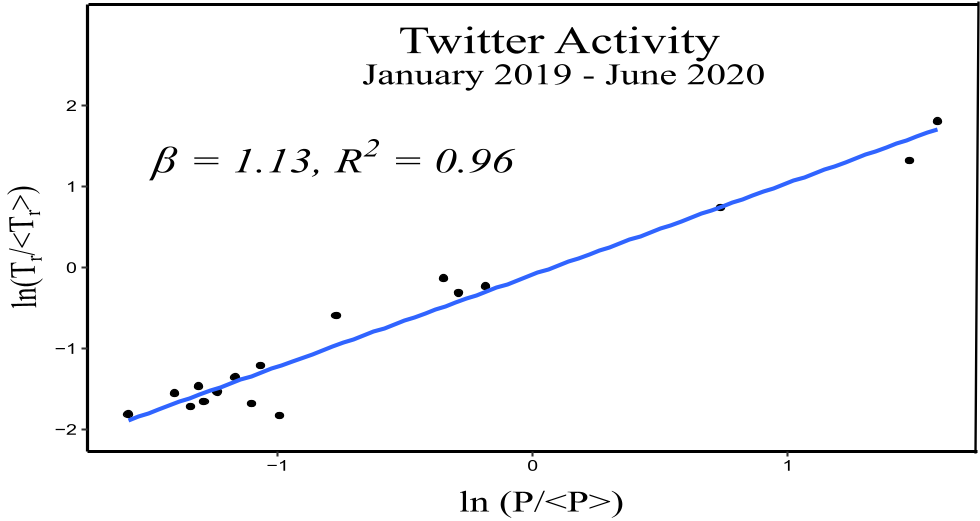 Fig 1: The superlinear scaling of Twitter activity relative to city population.
Key Insights and Results
1. The "Negative Emotion" Penalty
The study found that while all emotions scale superlinearly, negative emotions are more sensitive to population growth. Disgust () and Anger () showed the highest exponents. This suggests that larger cities don't just have more interaction; they have more intense negative social friction.
2. The COVID-19 Fear Paradox
During the pandemic, overall Twitter activity surged by 7%. However, the scaling exponent for fear actually decreased compared to the previous year.
- Before COVID: Fear was fragmented across many topics (crime, economy, personal health).
- During COVID: Fear became "unanimous."
The authors suggest that when everyone faces the same threat, the "individual fear" dispersed across various urban stressors consolidates. This unified experience might actually dampen the expected surge of fear interactions in populous cities.
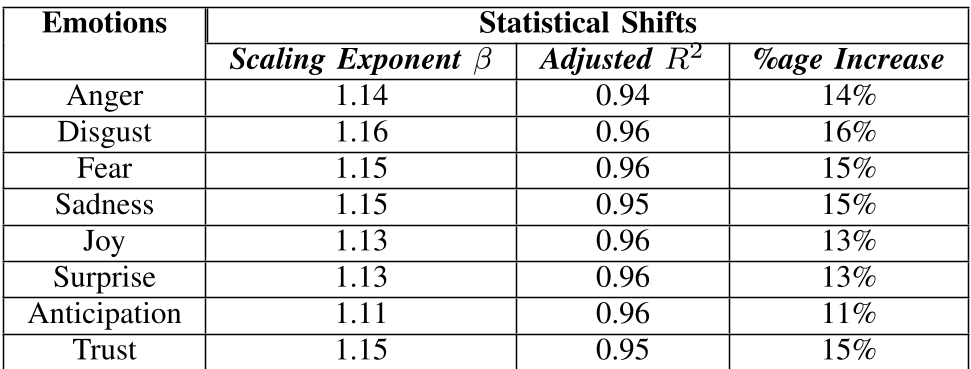 Table 1: Negative emotions showing higher scaling exponents () compared to positive emotions.
3. Joy in the Lockdown
Unforeseen shifts were also seen in Joy and Anticipation. The authors theorize that lockdowns forced family reunions and forced "breaks" from high-stress urban commutes, which actually enhanced positive interactions in digitial spaces during the crisis.
Critical Analysis & Future Outlook
Takeaway: This work proves that digital social media data can serve as a "real-time pulse" for urban planning. If planners know that specific population thresholds lead to a spike in "disgust" or "anger" interactions, they can design better public spaces to mitigate density-induced stress.
Limitations: The study relies on geo-tagged tweets, which represent a specific demographic subset (Twitter users) and may not capture the total emotional reality of a city’s non-digital population.
Future Work: The next step in this field is integrating these "emotional maps" with physical architecture—using AI to predict how a new urban development will change the "emotional scaling" of a neighborhood.
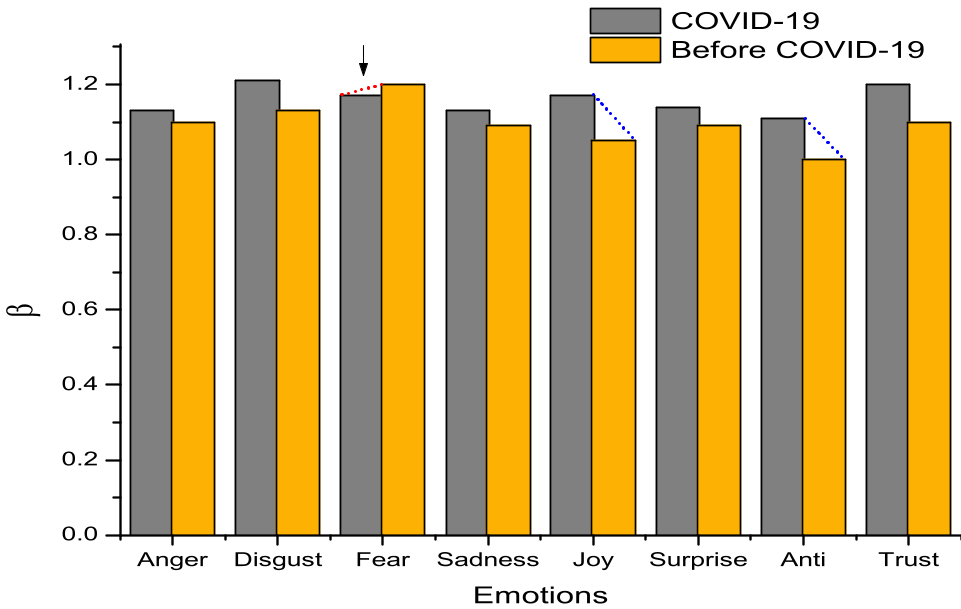 Fig 2: Comparative scaling coefficients for all eight emotions before and during the pandemic.