
Harmonizing Geostatistics and Machine Learning: A New Frontier for Emotion Prediction
Emotion predictions in geo-textual data using spatial statistics and recommendation systems
This paper introduces a hybrid emotion prediction framework that combines spatial statistics (Kriging) with recommendation system techniques (Matrix Factorization via SVD). By integrating millions of geotagged tweets and Yelp reviews, the system predicts emotional responses to specific topics across diverse geographic locations, achieving a significant improvement in accuracy over single-model baselines.
TL;DR
Researchers from George Mason University have developed a way to "read the room" of entire cities. By combining Kriging (a staple of geostatistics) with SVD (the engine behind Netflix-style recommendations), they’ve created a hybrid model that predicts how people in specific locations feel about specific topics. Their approach reduces prediction errors by up to 10% compared to traditional machine learning methods.
The Challenge: The Sparsity of Local Sentiment
In an era of global connectivity, public sentiment is highly localized. People in Chicago might react to a "government shutdown" with different emotional intensities than those in San Francisco.
However, data is stubbornly sparse. We might have millions of tweets about a topic in New York, but virtually nothing from a smaller city like Fairfax. Traditional models face a fork in the road:
- Spatial Models (Kriging): They assume a city will feel like its neighbors, but they don't understand that "joy" regarding a coffee brand might be linked to latent consumer preferences across disparate regions.
- Recommendation Models (SVD): They find hidden patterns across topics and users but are "geography-blind," ignoring the physical proximity that often dictates shared social experiences.
Methodology: The Best of Both Worlds
The authors argue that spatial auto-correlation and latent feature correlation are orthogonal strengths. They propose a workflow that transforms geo-textual data into a multi-mode tensor (City × Topic × Emotion) and then predicts missing values using a two-pronged attack.
1. The Geostatistical Pillar: Ordinary Kriging
Kriging calculates an unknown value as a weighted average of nearby observed points. It doesn't just give a prediction; it provides a variance (), which acts as a "uncertainty gauge."
2. The Collaborative Pillar: Truncated SVD
Matrix factorization (SVD) decomposes the emotion-topic-location matrix into lower-rank components. This allows the model to learn that certain emotions (like "joy" and "trust") or certain topics (like "Starbucks" and "Whole Foods") are fundamentally related.
3. The Hybrid Fusion: HLR and HNN
The breakthrough lies in the fusion. The Hybrid Neural Network (HNN) ingests the Kriging estimate, the SVD estimate, and the Kriging variance. This allows the network to say: "If Kriging is uncertain (high variance), rely more on the SVD's latent features."
 Figure 1: The dual-pathway approach for integrating spatial and latent features.
Experimental Insights: Why Hybrid Wins
The team tested their models on a massive dataset of 2.5 million documents. The results were clear:
- Kriging alone performed the worst, as it couldn't handle the complexity of non-spatial topic relationships.
- SVD alone was a strong baseline, but lacked local nuance.
- The Hybrid Models (HNN/HLR) consistently achieved the lowest Root Mean Square Error (RMSE).
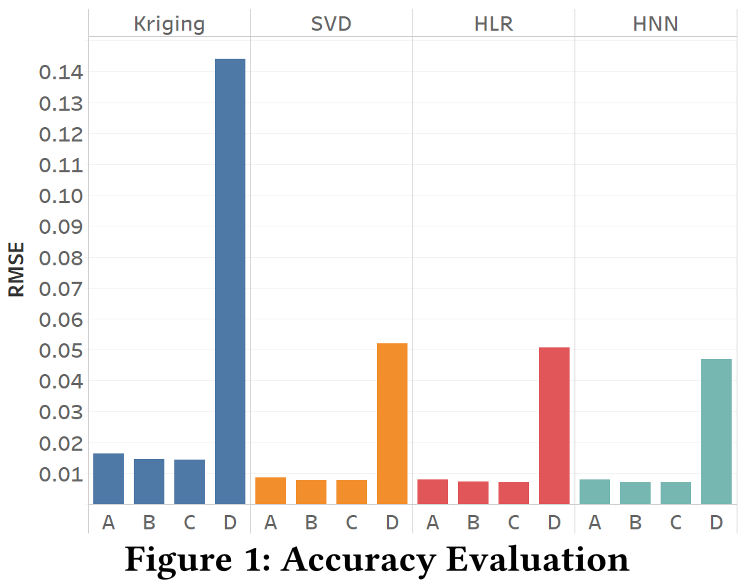 Figure 2: Performance across different dataset sizes (A, B, C, D). As data grows, the hybrid advantage remains stable.
A 10% improvement in RMSE is the "Gold Standard" in recommendation systems—famously the target of the million-dollar Netflix Prize. By reaching this threshold, the authors prove that spatial statistics isn't just a visualization tool; it’s a critical feature for predictive accuracy.
Critical Analysis & Future Outlook
The beauty of this research is its predictive confidence. By using the Kriging variance in a neural network, the model effectively learns its own limitations.
Limitations: The reliance on the NRC Lexicon means the model is only as good as its dictionary. Sarcasm or evolving slang might still evade detection. Additionally, the computational cost of Kriging can be high for global-scale datasets.
The Road Ahead: The authors suggest this logic can be ported to the real estate market. Just as "joy" is spatially and topically correlated, house prices are a mix of nearby sales (spatial) and latent property features (size, amenities). This hybrid approach could soon be powering the next generation of real estate valuation algorithms.
Conclusion
This paper serves as a vital reminder for AI practitioners: don't ignore traditional statistics. In the rush to build deeper networks, we often overlook the physical reality of our data—the fact that geography matters. By anchoring latent features in spatial statistics, we get models that aren't just smarter, but more grounded in the real world.