
Dynamic Grid-based HoG: Outperforming the Baseline in Emotion Recognition
Emotion recognition using dynamic grid-based HoG features
The paper introduces a facial emotion recognition framework using Histograms of Oriented Gradients (HoG) extracted from a size-adaptive dense grid. By combining these dynamic descriptors with a multi-class Support Vector Machine (SVM), the system achieved a 70% accuracy rate on the FERA2011 challenge dataset, significantly outperforming the official LBP-based baseline.
TL;DR
In the quest to make machines understand human feelings, researchers Mohamed Dahmane and Jean Meunier have developed a framework that pushes the boundaries of the FERA2011 challenge. By shifting from static texture descriptors (LBP) to dynamic, scale-adaptive edge descriptors (HoG) and utilizing an optimized SVM classifier, they boosted emotion recognition accuracy from 56% to a solid 70%, all while drastically reducing computational complexity.
Problem & Motivation: The Variability Trap
Automated Facial Expression Analysis (AFEA) is notoriously difficult because "happiness" doesn't look the same on everyone. Environmental lighting, head pose, and individual physiognomy create "noise" that confuses standard algorithms.
The Baseline Method for the FERA2011 challenge relied on Local Binary Patterns (LBP). While LBP is good for texture, it often struggles with:
- Fixed Grids: Using 10x10 squares regardless of the actual face size or position within the crop.
- Sensitivity: Small errors in eye detection lead to massive misalignment in a static coordinate system.
- High Dimensionality: Generating a massive 5900-dimensional vector that requires heavy PCA intervention.
Methodology: Precision through Adaptation
The authors' core insight was twofold: descriptors should focus on gradient orientations (which are more robust to lighting) and the sampling grid must be dynamic.
1. Dynamic Size-Adaptive Grid
Instead of a one-size-fits-all 20x20 pixel block, the authors defined the cell size as a function of the distance between the eyes (): This ensures that the feature extraction grid scales naturally with the subject's distance from the camera, maintaining a consistent relationship with facial landmarks.
2. HoG Over LBP
By using Histograms of Oriented Gradients (HoG), the model captures the "shape" of an expression through edge distributions. The face is divided into 48 cells (8 rows, 6 columns), and histograms are normalized over 2x2 overlapping blocks to ensure local contrast invariance.
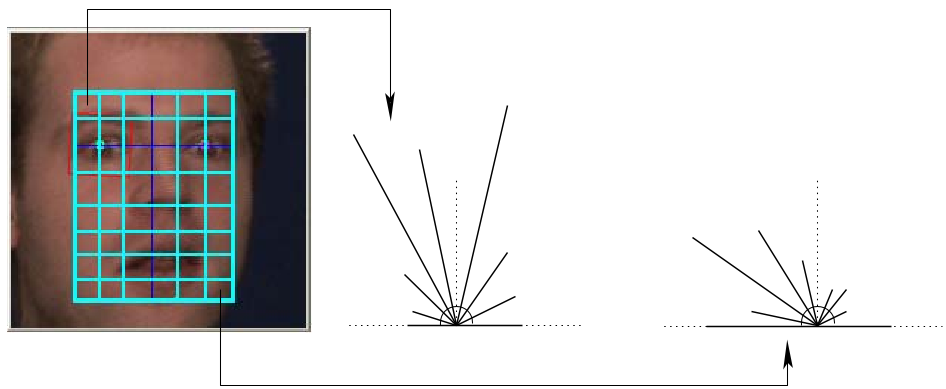 Fig 1: The hierarchical extraction of HoG features from cells to blocks.
3. Smart SVM Optimization
Rather than traditional (and often slow) N-fold cross-validation, the authors proposed an empirical epoch-based strategy to find the optimal RBF kernel parameters ( and ), balancing accuracy with the number of Support Vectors to prevent overfitting.
Experiments & Results: Shaking Up the Leaderboard
The results were clear: the HoG-based approach dominated the LBP baseline across almost every emotional category.
Key Performance Metrics:
- Overall Accuracy: Increased from 56% to 70%.
- Feature Efficiency: Reduced dimensionality from 5900 to just 432 features (a 13x reduction).
- Category Wins: "Relief" recognition jumped from 0.46 to 0.77. Even the most difficult emotion, "Fear," saw improvements in person-specific contexts (reaching 0.90).
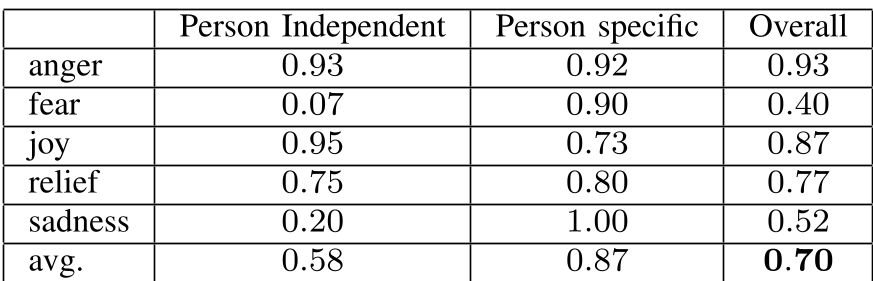 Table 1: Final results showing superior performance in both Person Independent and Person Specific tasks.
Critical Analysis & Conclusion
Takeaway
The success of this method proves that context-aware feature extraction (the adaptive grid) is often more valuable than simply increasing model complexity. By grounding the geometry of the feature set in the actual anatomy of the face, the model becomes naturally invariant to many pre-processing errors.
Limitations & Future Work
While 70% is a significant leap, the "Person Independent" scores (0.58) still lag behind "Person Specific" (0.87). This suggests that "General Expression Models" still struggle to generalize across the vast diversity of human faces. Future work could involve integrating Integral Images to make this HoG pipeline run in ultra-low-latency real-time environments, or combining these handcrafted features with temporal modeling (like RNNs/LSTMs) to capture the "flow" of an emotion over time.