
Optimized EEG Emotion Recognition: The Power of Dynamic Channel Selection
Emotion recognition based on EEG features in movie clips with channel selection
This study presents a dynamic EEG-based emotion recognition framework using Discrete Wavelet Transform (DWT) for feature extraction and machine learning for classification. By implementing a novel channel selection preprocessing step on the DEAP dataset, the researchers achieved a state-of-the-art average accuracy of 77.14% using Multilayer Perceptron Neural Networks (MLPNN).
TL;DR
Recognizing human emotions through Brain-Computer Interfaces (BCI) has long been a "holy grail" for affective computing. This paper introduces a sophisticated pipeline using Discrete Wavelet Transform (DWT) and dynamic channel selection to filter 32 EEG channels down to the most relevant five. Testing on the DEAP dataset, the researchers achieved an average accuracy of 77.14% with an MLPNN, proving that when it comes to brain data, "less is more" if you select the right "less."
The Challenge: Noise vs. Nuance
Most BCI research faces a fundamental conflict: the brain is an incredibly noisy environment. While recording from 32 or 64 channels captures comprehensive data, much of it is redundant or unrelated to the emotional task at hand. Previous studies either used a fixed, small set of electrodes (like F3/F4) which ignored personal differences, or used the full array, which invited overfitting and high computational costs. The authors asked: Can we dynamically find the "sweet spot" of electrodes for every individual?
Methodology: Precision over Volume
The researchers' workflow is a masterclass in signal processing refinement:
- Frequency Isolation: Using DWT (specifically the Daubechies 2 mother wavelet), they decomposed signals into sub-bands. They focused on the Theta band (4-8 Hz), which neurology identifies as a key correlate for emotional processing.
- Statistical Dimensionality Reduction: Instead of raw coefficients, they extracted five key metrics: Max absolute value, Mean absolute value, Standard Deviation, Power, and Energy.
- The "Tournament" (Channel Selection): Before the final classification, an MLPNN was used to rank each channel's performance. For most participants, the top performers clustered around P3, FC2, AF3, O1, and Fp1.
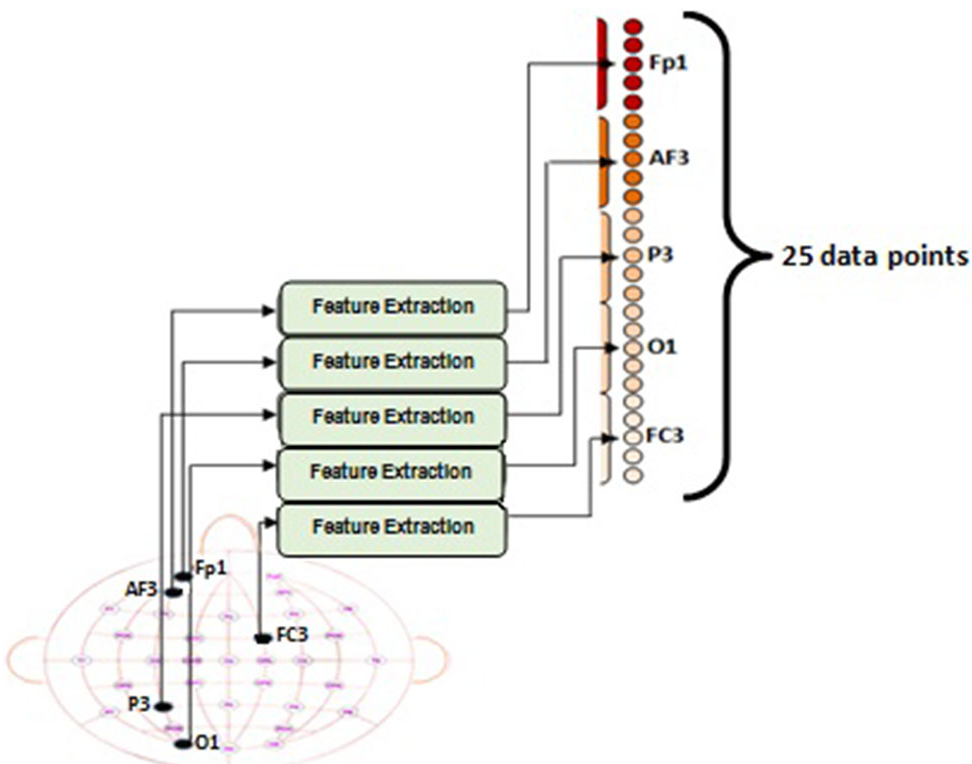 The workflow highlights how individual channel testing leads to the formation of the final feature vector.
Turning Signals into Sentiment
The study compared two classic machine learning heavyweights: Multilayer Perceptron Neural Network (MLPNN) and k-Nearest Neighbor (kNN).
- MLPNN Highs: Achieved a 90% peak accuracy for specific subjects. The back-propagation algorithm excelled at finding non-linear patterns in the fused feature vectors of the five chosen channels.
- kNN Consistency: While slightly lower in average accuracy (72.92%), kNN provided a robust baseline that validated the feature extraction's reliability.
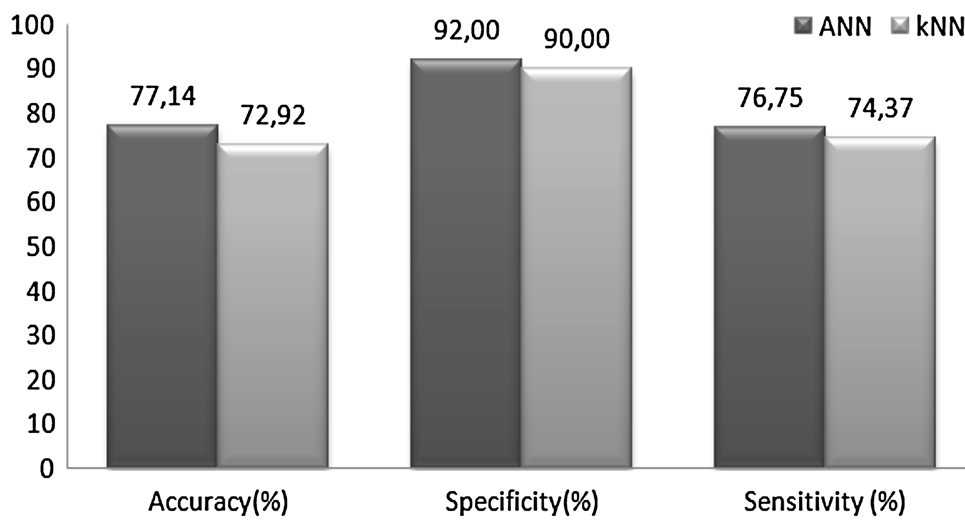 Overall comparison showing MLPNN's edge over kNN in Accuracy, Specificity, and Sensitivity.
Academic Insight: Why it Works
The selection of the Theta band is the theoretical backbone of this work. Theta waves are traditionally associated with internal focus and emotional processing. By paring down the data to these specific waves from the Frontal (AF3, Fp1) and Parietal (P3) regions, the model avoids the "muscular artifacts" (like eye blinks or jaw clenching) that often contaminate Alpha and Beta bands.
Critical Analysis & Future Outlook
While the results are impressive for the Valence dimension (Positive vs. Negative), the study focuses less on the Arousal (Calm vs. Excited) dimension.
Takeaway for Practitioners: If you are building an emotion-aware system, prioritizing electrodes in the Frontal and Parietal lobes while filtering for Theta dynamics is your fastest route to high accuracy. The future of this field lies in "Multimodal Fusion"—combining these refined EEG features with heart rate (ECG) and skin conductance (GSR) to create a truly holistic emotional sensor.
Conclusion
By moving away from static channel configurations toward a data-driven dynamic selection model, Ozerdem and Polat have demonstrated that BCI systems can be both efficient and highly accurate. Their average accuracy of 77.14% represents a significant step toward seamless human-computer emotional interaction.