
Exploring Brain Dynamics: Enhancing EEG Emotion Recognition via RASM and LSTM
Emotion Recognition from EEG Using RASM and LSTM
This paper introduces a novel EEG-based emotion recognition framework integrating Rational Asymmetry (RASM) features with Long Short-Term Memory (LSTM) networks. Evaluated on the DEAP dataset, the method achieves a state-of-the-art trial-level mean accuracy of 76.67% by capturing frequency-spatial characteristics alongside temporal dependencies.
TL;DR
Automatic emotion recognition is a cornerstone of next-generation Human-Computer Interaction (HCI). This paper presents a specialized pipeline that extracts Rational Asymmetry (RASM)—a feature capturing the power balance between brain hemispheres—and processes it via LSTM networks. By unifying spatial, frequency, and temporal dimensions, the authors achieved an industry-leading 76.67% accuracy on the DEAP benchmark.
Problem & Motivation
The human brain is a complex system where emotions are neither localized to a single point nor instantaneous. Existing literature identifies three critical dimensions of EEG signals:
- Frequency: Distinct bands (Alpha, Beta, etc.) correlate with different mental states.
- Spatial: Active brain regions shift depending on emotional valence and arousal.
- Temporal: Emotions are continuous; our current state is fundamentally influenced by the immediate past.
Previous methods often ignored the temporal "flow." For instance, SVMs treat EEG segments as independent snapshots, while Hidden Markov Models (HMMs) struggle with the long-range dependencies of a 60-second trial. The authors' insight was to use RASM to lock in the spatial-frequency data and LSTM to capture the "emotional narrative" over time.
Methodology: The Core Architecture
The authors proposed a two-staged approach: Feature Engineering and Sequential Classification.
1. Feature Extraction (The "What" and "Where")
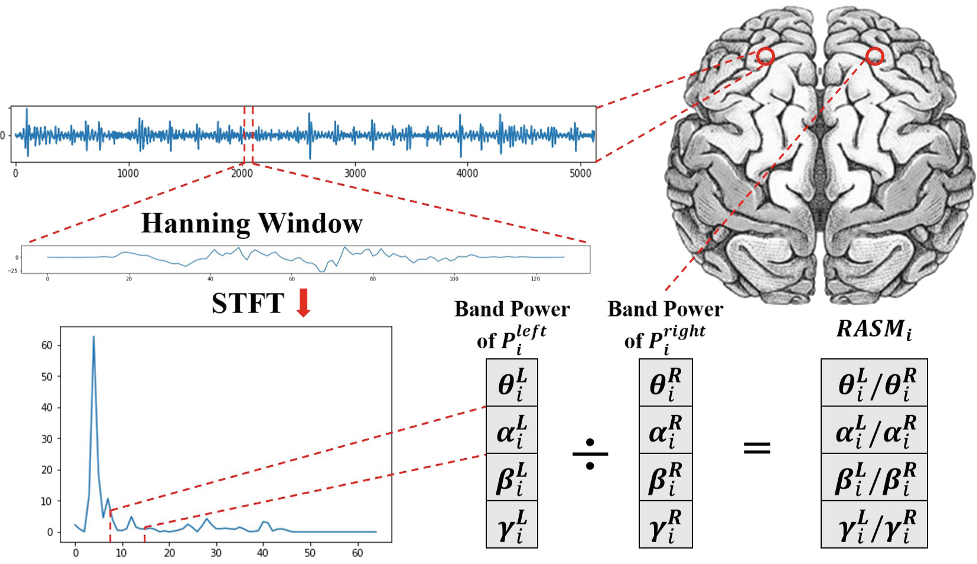
Using a Short-Time Fourier Transform (STFT), the signal is decomposed into four frequency bands. Crucially, they calculate the Rational Asymmetry (RASM). Instead of looking at absolute power, RASM looks at the ratio of power between symmetric electrode pairs (e.g., Fp1 vs. Fp2). This effectively captures the lateralization of brain activity—a known biological marker for emotion.
2. LSTM Classification (The "When")
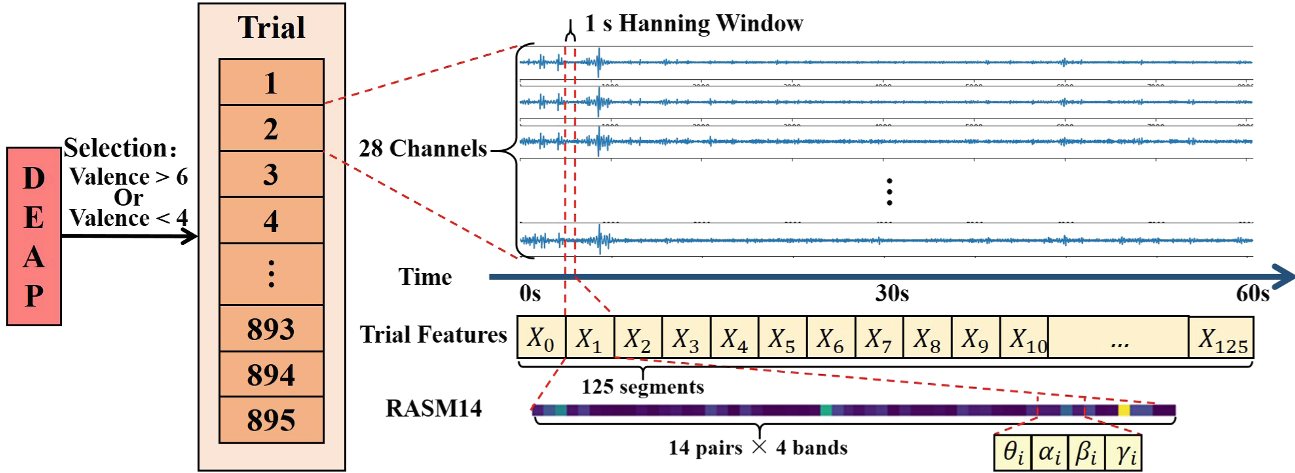
Human emotions don't flip like a switch. The LSTM (Long Short-Term Memory) network is uniquely suited here because its internal "gates" decide what information to keep from previous time steps. This allows the model to maintain a context of the user's emotional state throughout the duration of a video trial.
Experiments & Results
The model was validated on the DEAP dataset (32 subjects, 40 trials each).
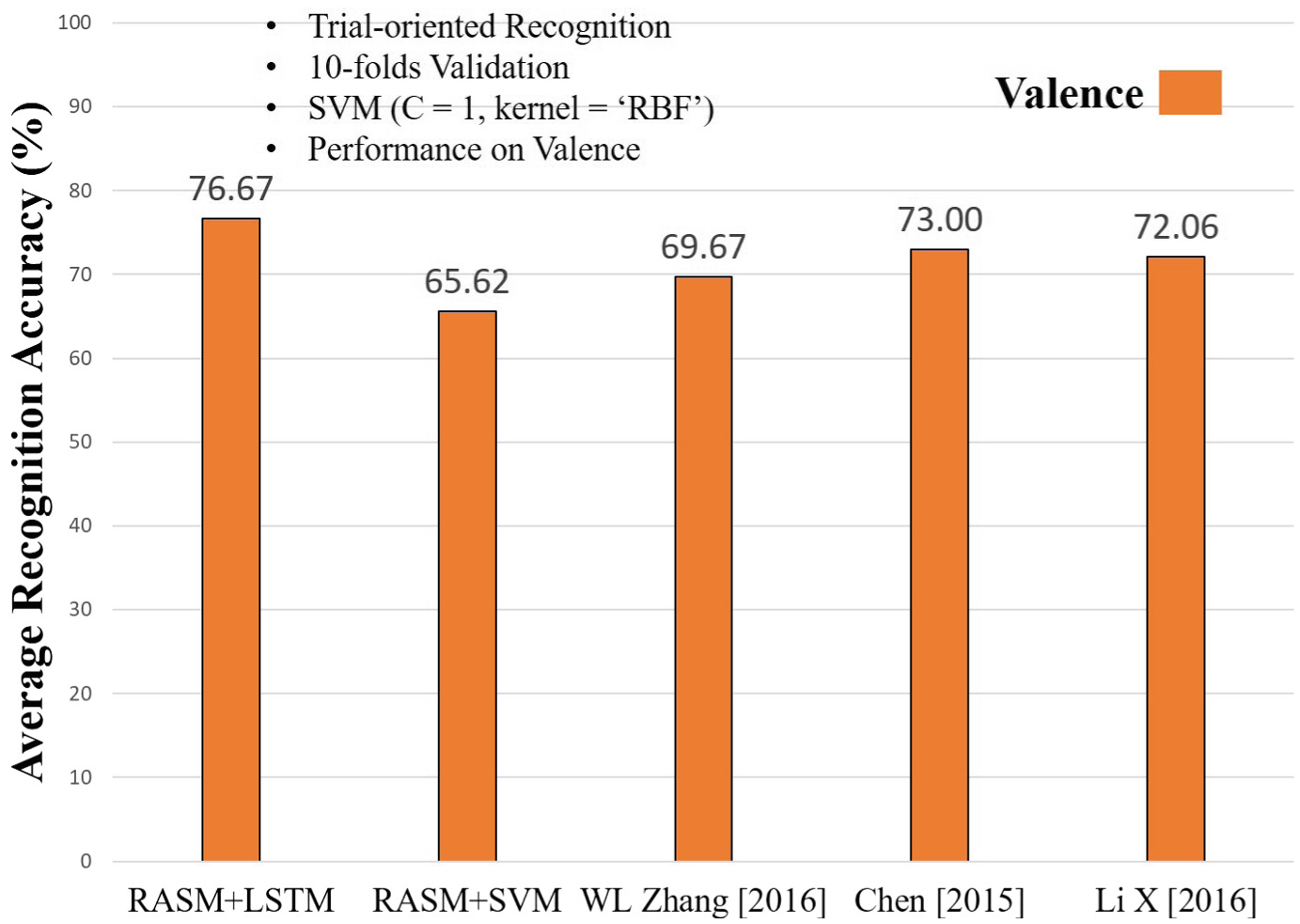
- Trial-Level Performance: The RASM+LSTM combo reached 76.67%, surpassing the SVM baseline and other complex models like CRNN (Convolutional Recurrent Neural Networks).
- Why it worked: The authors argue that while CRNNs are powerful, they require massive datasets that EEG studies often lack. By using a physically meaningful feature like RASM as input, the LSTM doesn't have to "learn" spatial physics from scratch, leading to better performance on smaller datasets.
Critical Analysis & Conclusion
The Takeaway
The synergy between domain-specific feature engineering (RASM) and sequence-aware deep learning (LSTM) is more effective for physiological signals than brute-force end-to-end deep learning.
Limitations & Future Work
- Time Resolution: The model shines in "trial-level" (1-minute) recognition but drops to ~71% for "segment-level" (1-second) tasks. This suggests that the signal-to-noise ratio in very short EEG windows remains a challenge.
- Subject Dependency: Future iterations could benefit from Transfer Learning to handle the high variability between different people's brain patterns.
In conclusion, this research provides a robust blueprint for researchers aiming to decode the "language of the brain" for more empathetic AI systems.