
Towards Affective Robotics: Decoding Emotions via Forehead EEG
Towards emotion recognition from electroencephalographic signals
This paper presents a subject-dependent emotion recognition system using EEG signals to classify three emotional states: pleasant, neutral, and unpleasant. The researchers utilize a custom-designed, four-electrode headband and a Support Vector Machine (SVM) classifier, achieving a maximum individual recognition rate of 66.7%.
TL;DR
Researchers from the University of Karlsruhe developed a portable EEG headband to help robots "feel" user emotions. By targeting the forehead with just four electrodes and using specialized alpha-band features, they achieved up to 66.7% accuracy in distinguishing pleasant, neutral, and unpleasant states, proving that wearable brain-computer interfaces (BCIs) are moving closer to everyday reality.
Background: The Empathic Robot
In the realm of human-robot interaction (HRI), a robot must be more than a cold, logical machine; it needs social intelligence. Most current systems track faces or voices, but these are easily masked. EEG signals, however, offer a "direct link" to the user's internal state. The challenge? Wearing a 64-channel medical EEG cap is hardly "social" or convenient. This paper addresses the gap by moving from bulky caps to a minimal forehead headband.
Problem & Motivation: Beyond the Lab
Standard BCI research often ignores the "User Experience" of the sensor. The authors identify three main pain points:
- Intrusiveness: Conductive gels and heavy wiring prevent natural movement.
- Reliability: Facial expressions can be faked; brain waves (mostly) cannot.
- Context: Previous methods focused on high-complexity setups that aren't mobile-ready for robots.
Their goal was to validate whether a low-density, forehead-only setup could still capture the nuances of human emotion induced by the International Affective Picture System (IAPS).
Methodology: Feature Engineering vs. Raw Data
The authors explored two distinct paths for the Support Vector Machine (SVM) classifier:
1. The Global Spectrum (Approach I)
This involved a standard Fast Fourier Transform (FFT) across the 5-40 Hz range, compressed into 136 components. It represents a "brute force" spectral look at the data.
2. The Bio-Intuitive Set (Approach II)
This approach leveraged neurological insights:
- Peak Alpha Frequency: Correlating emotional shifts with the dominant 8-13 Hz frequency.
- Alpha Power Asymmetry: Measuring the energy difference between left and right hemispheres (Fp1 vs Fp2).
- Cross-correlation: Examining how different areas of the prefrontal cortex "sync up" during emotional processing.
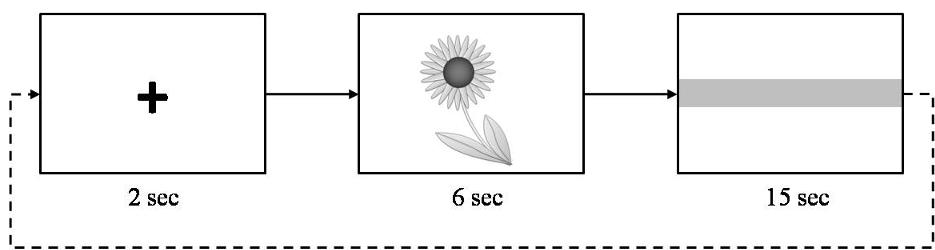 The protocol used a rigorous timing sequence to isolate emotional response from stimulus artifacts.
Experiments & Results
The study recorded data from five subjects while they viewed images of varying valence (e.g., family photos vs. physical threats).
Key Findings:
- Feature Superiority: Approach II (Bio-intuitive features) consistently outperformed raw spectral data, raising mean accuracy by nearly 5%.
- The 66% Milestone: While the mean was ~49%, the system reached 66.67% for the best-performing subject. This highlights the "subject-dependent" nature of EEG—every brain has a unique emotional "signature."
- Comfort vs. Signal: The headband proved successful in data acquisition without the mess of conductive gels, though subject ratings suggested that "pleasant" stimuli in a lab setting were often perceived as less intense than expected.
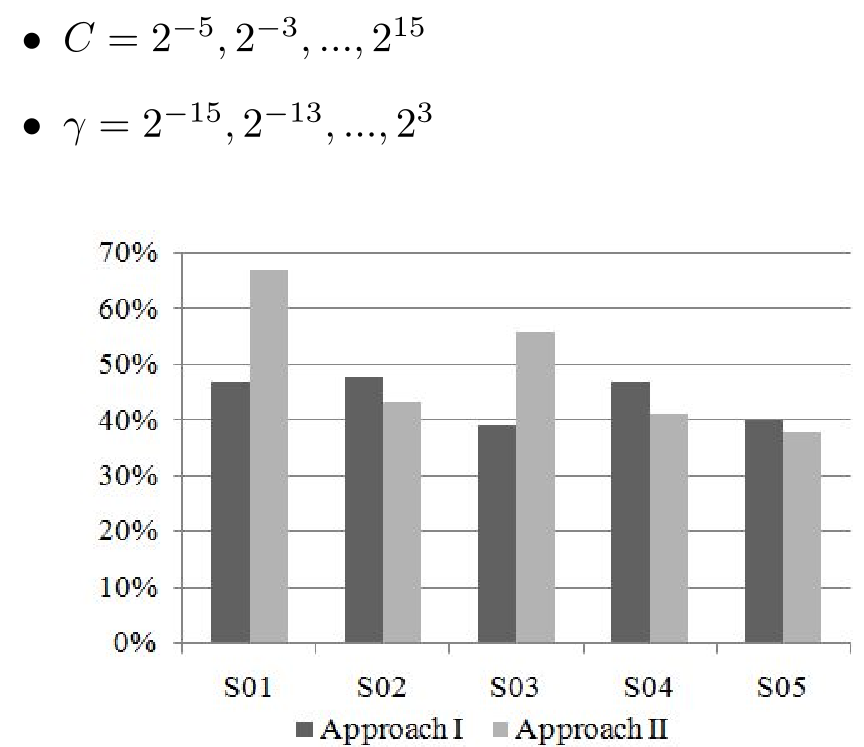 As shown above, Approach II (Dark Bars) generally yields higher classification accuracy across different individuals.
Critical Analysis & Conclusion
Takeaway
The study demonstrates that a minimalist, four-sensor forehead setup is sufficient for 3-class emotion recognition. This is a massive win for mobile affective computing, as the forehead is hair-free and easily accessible for wearable tech.
Limitations
- Small Sample Size: With only 5 subjects, the findings are a "proof of concept" rather than a universal law.
- Artifact Sensitivity: Being on the forehead, the electrodes are highly susceptible to EOG (eye blink) artifacts, which can mimic or mask brain signals.
Future Outlook
The next step for this tech is moving from Offline to Real-Time. Integrating this sensor data into the control loop of a humanoid robot would allow the robot to adjust its behavior (e.g., slowing down or speaking softly) the moment it detects a "distressed" or "unpleasant" EEG signature from the user.