
Beyond the Scalp: Elevating Emotion Recognition via High-Resolution EEG Source Reconstruction
Emotion Recognition Based on High-Resolution EEG Recordings and Reconstructed Brain Sources
This paper introduces a high-resolution 257-channel EEG database for valence (emotion) recognition and proposes a novel feature extraction framework based on brain source reconstruction. By applying the Weighted Minimum Norm Estimation (WMNE) algorithm to map sensor signals back to the cortical surface, the authors achieve SOTA-level classification performance, particularly when using functional connectivity features.
TL;DR
Researchers have moved beyond simple scalp-level EEG analysis to "look inside" the brain for emotion. By utilizing a massive 257-channel EEG array and mathematical source localization, this study demonstrates that reconstructing activity directly on the cortical surface improves emotion classification accuracy by 5%, reaching up to 75% for positive vs. negative valence.
Context & Positioning
In the landscape of Affective Computing, EEG is the "gold standard" for objective emotion measurement. However, most studies are stuck in Sensor Space, treating the scalp as the primary data source. This paper acts as a bridge between clinical neuroimaging and machine learning, proving that the Source Space (the actual cortical surface) holds more discriminative power for emotional states than the raw electrode signals.
The Problem: The "Blurry" Scalp
Why is EEG emotion recognition so hard?
- Volume Conduction: Each electrode picks up a mixture of signals from all over the brain. It’s like trying to listen to one person in a crowded stadium using a microphone outside the building.
- Low Resolution: Most datasets (like DEAP or MAHNOB-HCI) use 32-62 channels, which provides a very grainy spatial map of brain activity.
- Anatomical Blindness: Sensor-space analysis ignores where in the brain an emotion (like sadness or joy) actually originates.
Methodology: From Volts to Sources
The authors created a new HR-EEG database with 40 subjects using 257 electrodes—the highest density used in public emotion research to date.
1. Source Localization (The "Inverse Problem")
The core innovation is solving the Inverse Problem. Using the WMNE (Weighted Minimum Norm Estimation) algorithm, the researchers mapped the voltage recorded at the 257 sensors back to 549 specific clusters on the cortical surface.
2. Feature Powerhouse
They didn't just look at signal strength. They tested:
- Functional Connectivity (PSI): How different brain regions "sync up."
- Higher Order Crossings (HOC): Signal complexity.
- Spectral Crest Factor (SCF): The "peakiness" of the frequency spectrum.
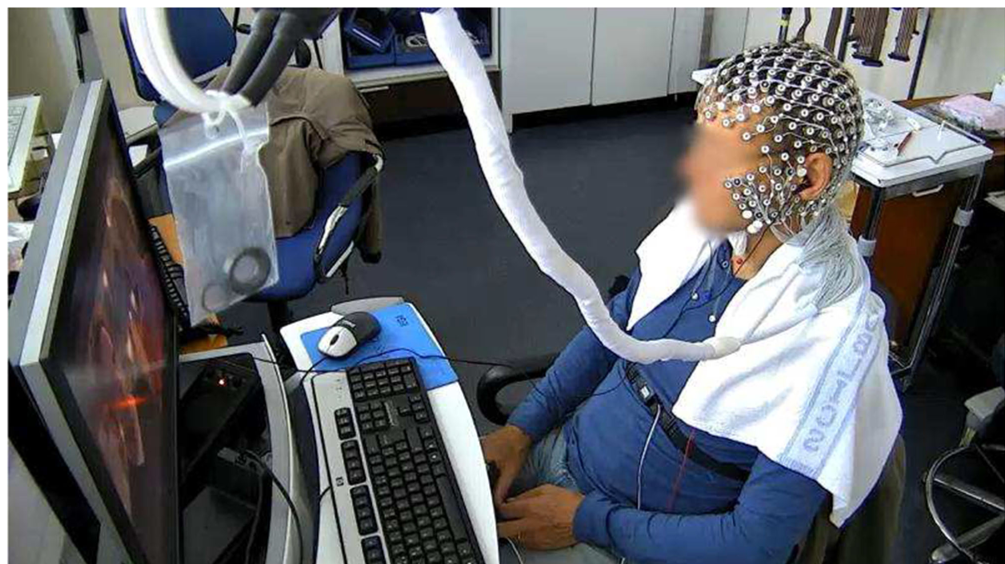 Figure: The pipeline involves mapping 257 sensors to a cortical mesh and selecting regions (highlighted) known for emotional processing.
Experimental Battle: Source vs. Sensor
The results were clear: Source space is superior.
- The SOTA Leap: Using Phase Synchronization (PSI) in the Gamma band (30-80 Hz) provided the best results. On average, source-reconstructed features provided a 5% absolute gain over raw sensor features.
- Density Matters: Moving from 14 channels (consumer grade) to 257 channels (research grade) boosted accuracy by 10%.
- Frequency Insights: High-frequency bands (Beta and Gamma) were confirmed as the most discriminative for distinguishes positive from negative valence.
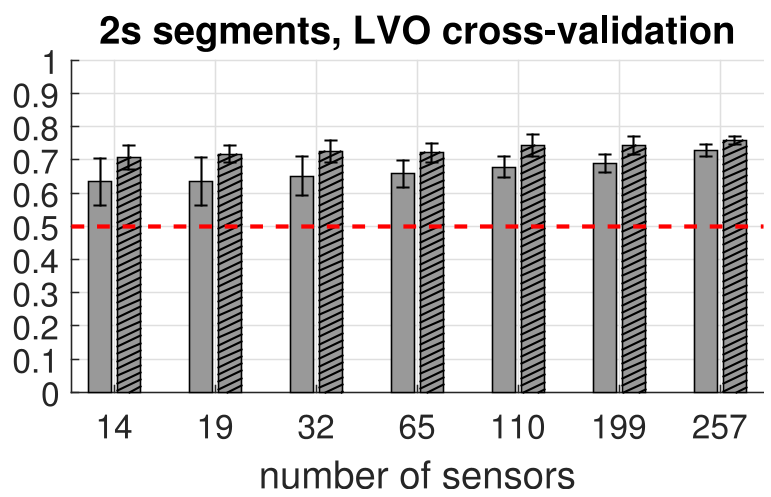 Figure: Average performance across various electrode configurations. Source-space features (hatched bars) consistently outperform sensor-space features (plain bars).
Critical Insights: The Muscle Artifact "Elephant in the Room"
A fascinating (and honest) finding in this study is the role of Electromyography (EMG). The authors noted that the electrodes on the cheeks and temples—often picks up small facial muscle movements (smiles, frowns)—were among the most "useful" for the classifier.
While this initially seems like "cheating" (detecting a smile rather than a "happy brain"), the authors argue that source localization helps concentrate the true neuronal activity, thus explaining why source-space features still outperformed sensor-space ones even when muscle noise was present.
Takeaways & Future Work
This paper serves as an invitation to the AI community to incorporate anatomical priors into models.
- For Devs: Don't just throw a CNN at raw EEG. Consider a Graph Neural Network (GNN) where the nodes are the 274 emotional brain regions identified here.
- For Researchers: The dataset is public, providing a rare opportunity to work with 257-channel data.
Conclusion: By mapping EEG back to its origin, we move closer to a "transparent" brain model where emotions aren't just patterns of noise, but interactions between specific functional networks.
Disclaimer: This research utilized the FilmStim database for elicitation; data quality remains highly subject-dependent.