
Efficient Emotion Recognition: Balancing Data and Temporal Dynamics in the Wild
Emotion Recognition on large video dataset based on Convolutional Feature Extractor and Recurrent Neural Network
This paper presents a hybrid deep learning framework for video-based emotion recognition using a Convolutional Neural Network (CNN) as a feature extractor coupled with a Recurrent Neural Network (RNN/GRU) to capture temporal dynamics. The model achieves state-of-the-art performance on the Aff-Wild2 dataset by addressing class imbalance through strategic downsampling.
TL;DR
Recognizing human emotions from video isn't just about identifying a smile; it's about understanding the continuous flow of intensity (Arousal) and sentiment (Valence). This paper proposes a decoupled CNN-RNN architecture that prioritizes data balancing over model complexity. By reducing the training data by 36% through smart downsampling, the authors actually improved performance, surpassing the Aff-Wild2 challenge baselines.
Problem & Motivation: The Imbalance Trap
Most emotion recognition research happens in controlled labs. However, "in-the-wild" data like the Aff-Wild2 dataset (over 60 hours of video) presents a chaotic reality: facial expressions are often subtle, and the distribution is heavily skewed. In nature, "Neutral" or "Positive" expressions far outnumber "Fear" or "Disgust."
The authors observed that complex models often overfit to these majority classes or specific subjects. Their intuition was twofold:
- Simplicity is Robustness: A lighter CNN architecture reduces the risk of overfitting on a per-frame basis.
- Temporal Context Matters: Emotions aren't static; the transition between frames holds the key to true affective state.
Methodology: Decoupling Features and Time
The architecture follows a two-stage pipeline designed for computational efficiency and memory optimization.
1. The CNN Feature Extractor
Instead of training the whole system end-to-end (which is memory-intensive for video), the authors used a CNN with three convolutional layers (64, 128, and 256 filters) and Quadrant Pooling. This model was trained to solve a regression task: predicting a coordinate in the 2D Valence-Arousal space.
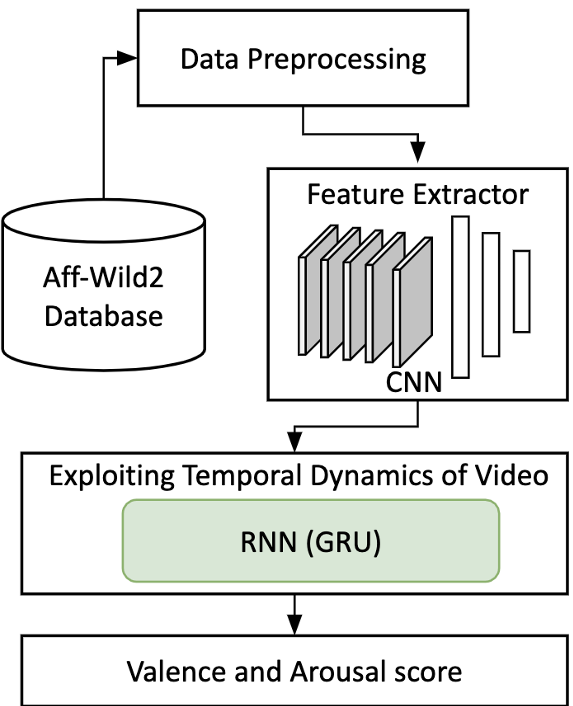 Fig 1. Schematic of the decoupled framework: Image -> CNN Features -> RNN Temporal Modeling.
2. The Data Balancing "Magic"
The core contribution lies in Probability-based Downsampling. The authors divided the Valence-Arousal space into a 40x40 grid. If a grid cell (bin) was too "crowded" (e.g., many Neutral frames), frames from that bin were sampled with lower probability. This forced the model to "pay more attention" to rare emotional states.
3. Explaining Temporal Dynamics (GRU)
To capture the flow of emotion, the authors fed sequences of 100 frames of CNN features into a Gated Recurrent Unit (GRU). GRUs were chosen specifically for their ability to capture long-term patterns better than simple RNNs, which was validated in their experiments.
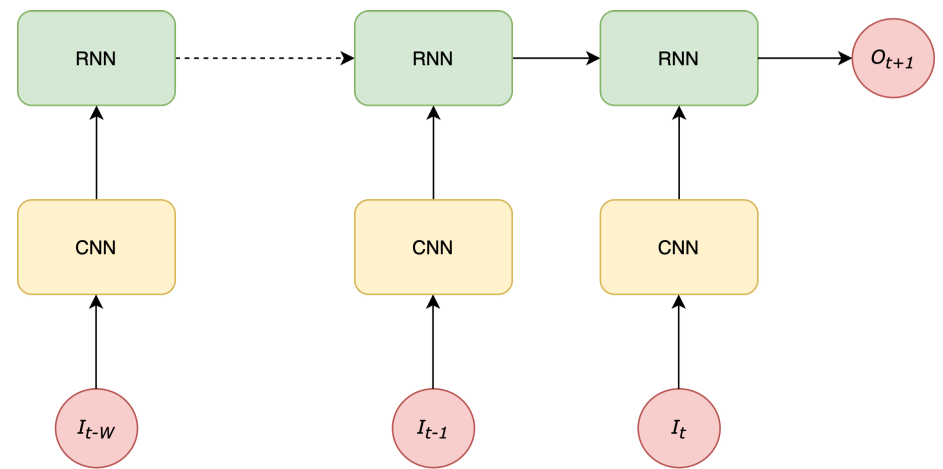 Fig 2. The temporal window approach: using a sliding window of 100 frames to predict the next state.
Experiments & Results: Less Data, Better Results
The model was evaluated using the Concordance Correlation Coefficient (CCC), which measures the agreement between predicted and ground-truth continuous values.
- The Downsampling Paradox: Using "Subset 3" (approx. 1M frames) yielded higher CCC scores than using the "Whole Dataset" (1.6M frames). This proves that redundant, imbalanced data acts as noise for deep learning models.
- RNN vs. GRU: The 3-layer GRU significantly outperformed the 1-layer version and simple RNNs, particularly in predicting Arousal, which is more dependent on temporal change.
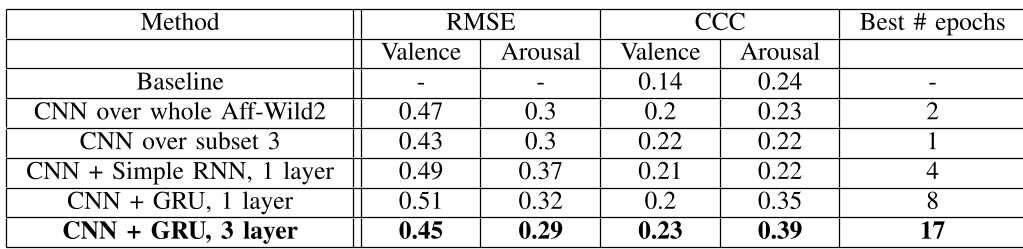 Table 1. Experimental comparison: Note how CNN+GRU 3rd layer achieves the highest CCC for both metrics.
Critical Analysis & Conclusion
Takeaway
The success of this work highlights a shifting trend in AI: Data-Centric AI. By focusing on the distribution of the labels in the Valence-Arousal manifold, the authors achieved SOTA results without requiring monstrously large Transformers or Attention mechanisms.
Limitations
- Interpolation: The authors used linear interpolation for frames where faces weren't detected. In highly dynamic videos, this might introduce "hallucinated" emotional transitions.
- Single-Modality: The study ignores audio and text, which are crucial components of human emotion.
Future Outlook
The authors aim to move toward Multitask Learning (MTL). The next frontier is a single model that can simultaneously identify "Action Units" (specific muscle movements), "Discrete Emotions" (anger, joy), and "Dimensional Affect" (V-A) in a unified affective representation.