
Efficient Affective Computing: Optimizing Emotion Recognition for Low-Resource Hardware
Emotion recognition in low-resource settings: An evaluation of automatic feature selection methods
The paper evaluates state-of-the-art feature selection methods—specifically Infinite Latent Feature Selection (ILFS), ReliefF, and Generalized Fisher Score—alongside a novel "Active Feature Selection" (AFS) method for speech-based emotion recognition. The study demonstrates that reducing high-dimensional acoustic feature sets (eGeMAPs and emobase) can maintain or even improve Unweighted Average Recall (UAR) while significantly lowering computational overhead.
TL;DR
Researchers have demonstrated that achieving State-of-the-Art (SOTA) emotion recognition from speech doesn't require massive computational power. By applying sophisticated feature selection methods—including a novel Active Feature Selection (AFS) approach—models can achieve comparable or superior accuracy while discarding up to 90% of redundant acoustic data. This is a game-changer for wearable health monitors and ambient intelligence devices.
The "Brute-Force" Bottleneck in Affective Computing
Current speech analysis systems typically adopt a "more is better" philosophy, extracting thousands of features (MFCCs, spectral flux, shimmer, etc.) over short intervals. While effective, this creates a Curse of Dimensionality. In many cases, only 4% of these features actually contribute to the classification task. For low-power devices used in elderly care or cognitive health monitoring, processing this redundant "bloat" drains battery and increases latency.
Methodology: Beyond Simple Ranking
The paper benchmarks four sophisticated selection strategies:
- ILFS (Infinite Latent Feature Selection): A graph-based approach that evaluates feature redundancy within all possible subsets.
- ReliefF: Weights features based on how well they distinguish between nearest neighbors of the same vs. different classes.
- Generalized Fisher Score: Maximizes the lower bound of the Fisher score while accounting for feature combinations.
- Active Feature Selection (AFS): The authors' contribution. Unlike standard methods that rank features individually, AFS uses Self-Organizing Maps (SOM) to cluster similar dimensions. It identifies a specific "cluster" of features that synergistically provide the best predictive power.
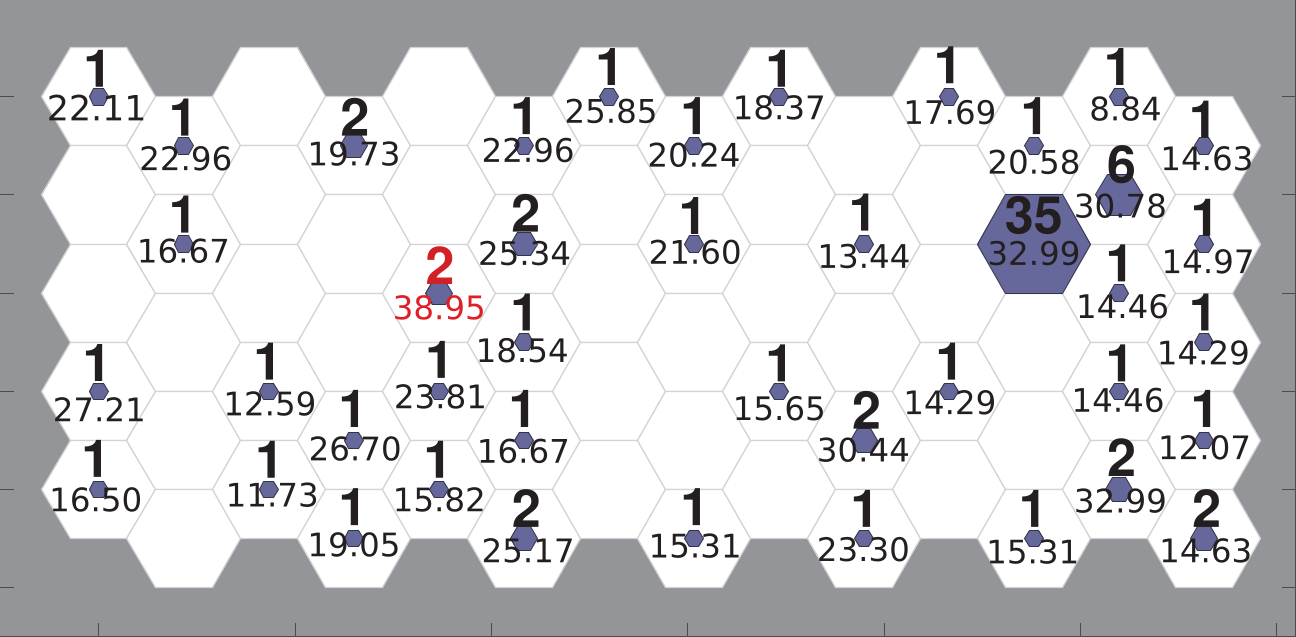 Fig 1: Visualization of AFS clusters. Each hexagon represents a neuron/cluster; the labels show the number of features and the resulting UAR accuracy.
Experimental Showdown: Results across Languages
The methods were tested on EmoDB (German), SAVEE (English), and EMOVO (Italian).
- The Efficiency Winner: The Generalized Fisher score provided the best overall results in most scenarios.
- The AFS Surprise: On the EMOVO dataset, AFS achieved 39.0% UAR using just 2 features, outperforming the full 88-feature baseline (37.4%).
- Cross-Language Robustness: When datasets were combined to create a harder 8-class problem, ReliefF emerged as the most robust choice, suggesting it handles linguistic diversity better than more aggressive selectors.
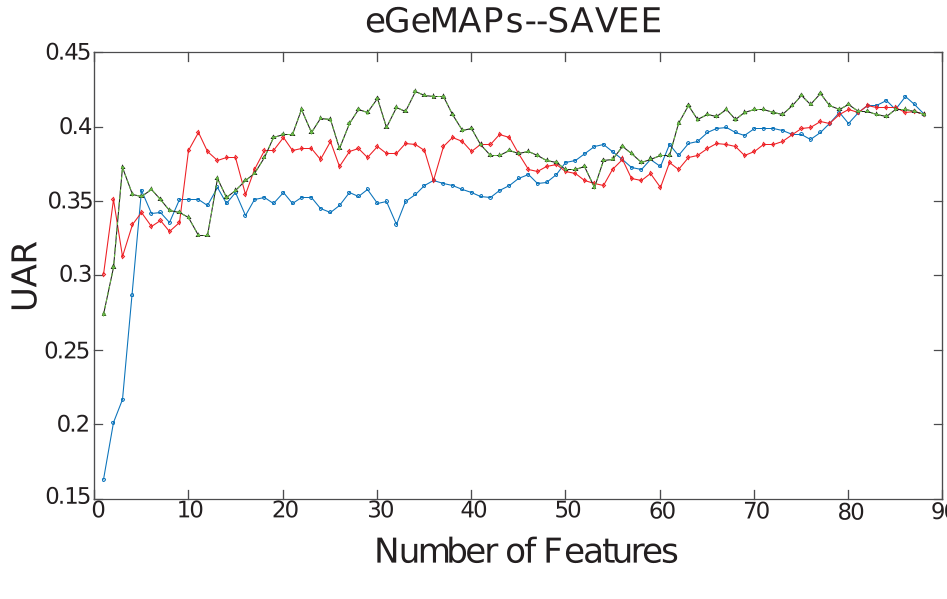 Fig 2: Performance (UAR) vs. Number of features. Note how accuracy peaks early and plateaus, proving that extra features often add more noise than signal.
Critical Insight: Why Does Selection Improve Accuracy?
Counter-intuitively, fewer features often lead to better results. High-dimensional sets like emobase (988 features) include variables with near-zero standard deviation or high collinearity. By stripping these away, the SVM classifier learns a more robust decision boundary that generalizes better to unseen speakers.
Conclusion & Future Outlook
This work shifts the focus of Affective Computing from "Big Data" to "Smart Data." The ability to run high-fidelity emotion recognition on a device as small as a Raspberry Pi Zero opens new doors for:
- Continuous Health Monitoring: Non-invasive tracking of depression or anxiety.
- Ambient Intelligence: Smart homes that adjust lighting or music based on vocal mood without sending huge amounts of audio data to the cloud.
Future research will likely focus on Cluster Fusion (combining the best subsets from AFS) and extending these selection techniques to deep learning latents.
Academic Reference
Haider, F., Pollak, S., Albert, P., & Luz, S. (2020). Emotion recognition in low-resource settings: An evaluation of automatic feature selection methods. Applied Soft Computing.