
PCRNN: Dominating EEG Emotion Recognition via Baseline Normalization and Spatio-Temporal Fusion
Emotion recognition from multi-channel EEG through parallel convolutional recurrent neural network
The paper introduces a Parallel Convolutional Recurrent Neural Network (PCRNN) for multi-channel EEG emotion recognition. By combining 2D-CNNs for spatial feature extraction and LSTMs for temporal dynamics, along with a novel baseline-removal pre-processing step, the model achieves SOTA mean accuracies of 90.80% on Valence and 91.03% on Arousal using the DEAP dataset.
TL;DR
Recognizing human emotions from brainwaves is notoriously difficult due to "noisy" signals and individual variability. This paper introduces a Parallel Convolutional Recurrent Neural Network (PCRNN) coupled with a simple yet transformative baseline-subtraction pre-processing technique. By mapping EEG electrodes to a 2D grid and removing neutral brain activity "noise," the researchers achieved over 90% accuracy on the DEAP dataset—a massive leap over prior SOTA methods.
Problem & Motivation: The Noise in the Machine
The human brain is never truly "silent." When we record EEG signals during an emotional stimulus (like watching a video), the data we gather is a mixture of the stimulus response and the subject's intrinsic neutral state.
Most prior works (using SVMs or standard CNNs) treat raw EEG as an absolute measurement. However, the authors argue that emotion is a relative change. Without subtracting the "baseline" (the 3 seconds of brain activity before the video starts), the model struggles to distinguish between a person's natural brain rhythm and their emotional reaction. Furthermore, 1D EEG processing loses the spatial context—the fact that certain brain regions (like the frontal lobe) communicate in specific patterns during emotional shifts.
Methodology: Mapping the Brain as a Video
The authors tackle these challenges through two core innovations:
1. Baseline-Removed 2D Frames
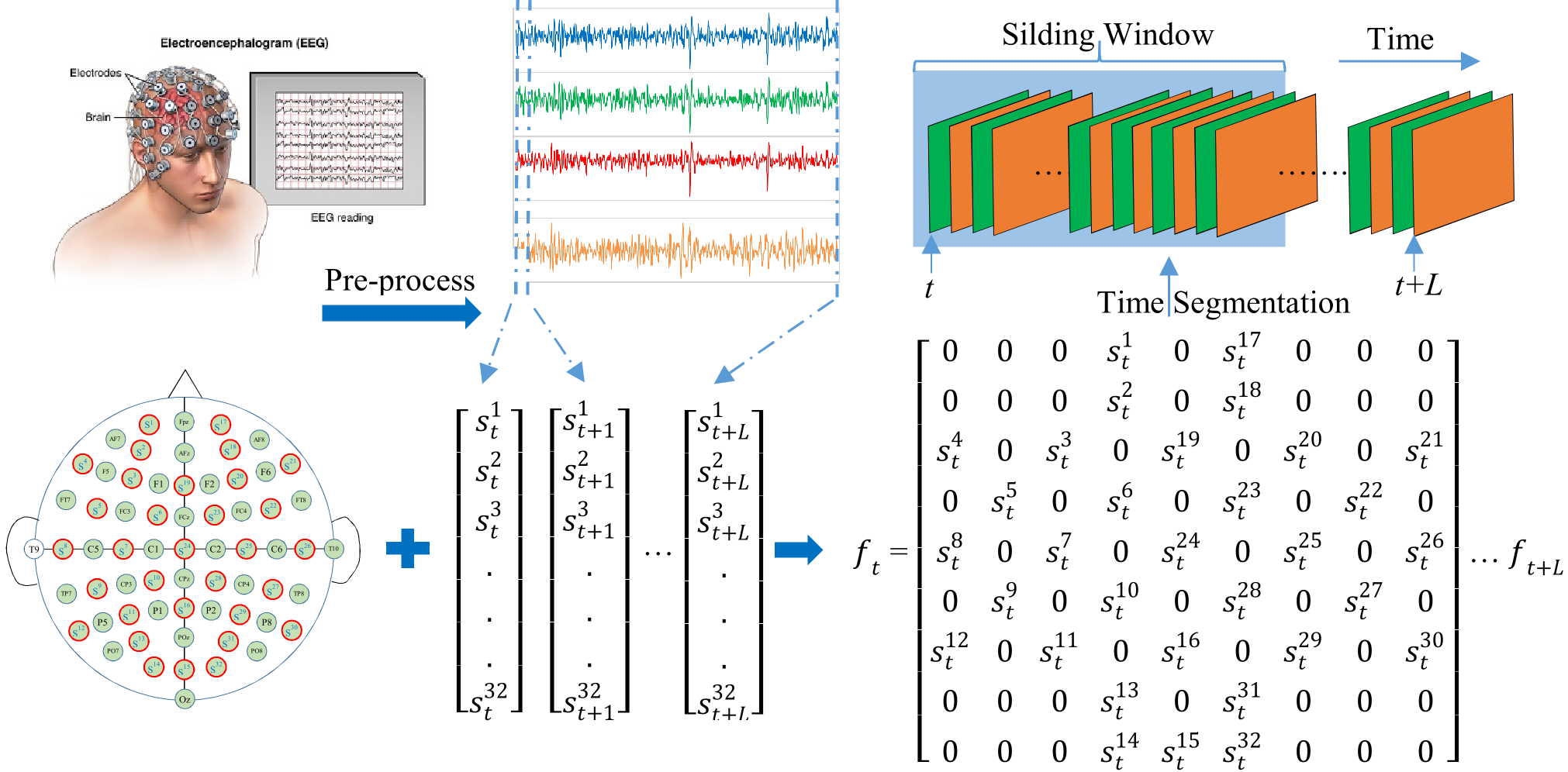
Instead of using raw voltages, the system calculates a BaseMean from pre-trial data and subtracts it from the stimulated EEG. These signals are then mapped into a 9×9 grid based on the International 10-20 System.
- Insight: By placing physically adjacent electrodes next to each other in a 2D matrix, the CNN can "see" spatial patterns just like it sees objects in an image.
2. The Hybrid PCRNN Architecture
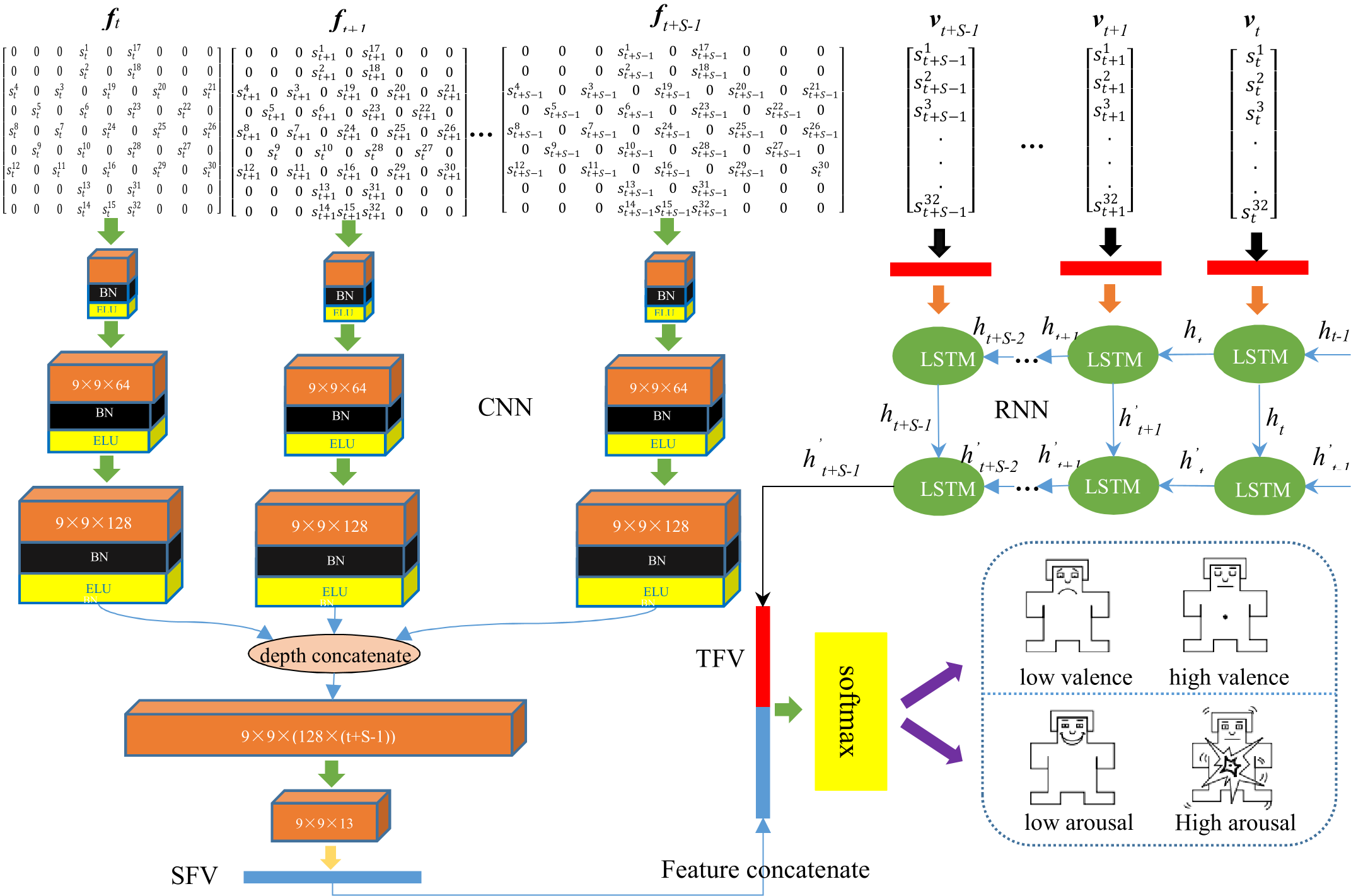
The model processes the data through two parallel paths:
- CNN Branch: Uses three convolutional layers (4x4 kernels) to mine inter-channel correlations. Unlike ImageNet CNNs, it avoids pooling layers to prevent losing the fine-grained information present in small 9x9 EEG frames.
- RNN (LSTM) Branch: While the CNN looks at the "image" of the brain, a stacked LSTM processes the raw 1D sequences to capture how these signals evolve over a 1-second window.
- Fusion: The spatial and temporal vectors are concatenated into a single joint representation before the final Softmax classification.
Experiments & Results: A 32% Breakthrough
The most striking result from the experiments on the DEAP dataset was the impact of the pre-processing.
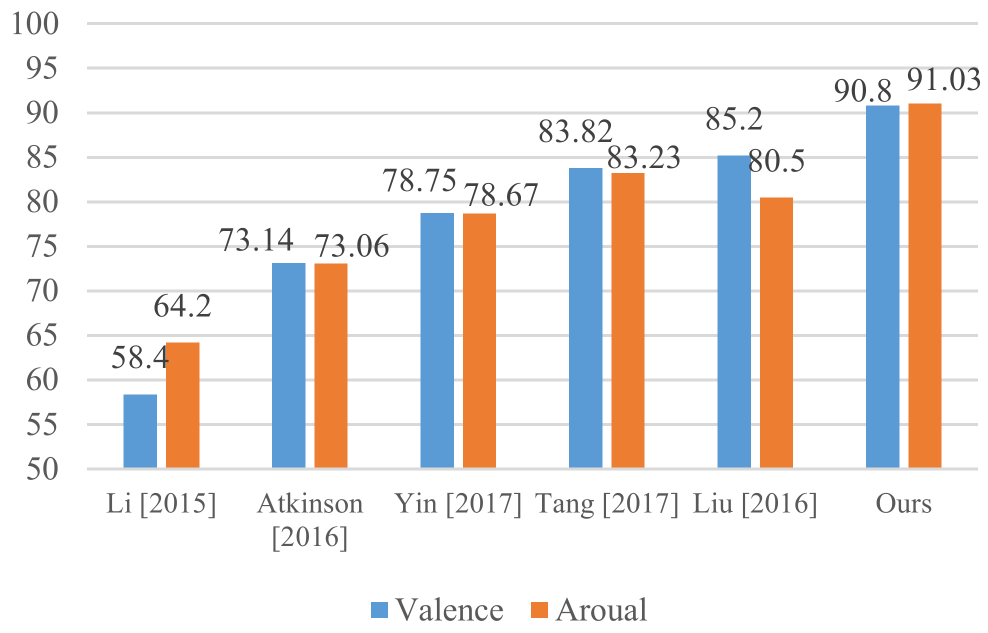
- The Power of Baseline: Without the baseline-subtraction, the model achieved only ~57-61% accuracy. With it, accuracy skyrocketed to 90.80% (Valence) and 91.03% (Arousal).
- SOTA Comparison: The PCRNN significantly outperformed Bimodal-LSTMs and SVM-based approaches, even though it used less data (only EEG, whereas others often required eye-tracking data).
Critical Analysis & Conclusion
Takeaway
The success of this paper lies in its physical intuition. By acknowledging that EEG data is spatially distributed and relative to a baseline, the authors simplified the learning task for the neural network.
Limitations & Future Work
- Zero-Padding: The 9x9 grid is relatively sparse (many zeros where electrodes don't exist). Future work might explore Graph Convolutional Networks (GCNs) to better model the non-Euclidean connectivity of the scalp without needing a square grid.
- Computation: While the pre-processing is "cheap," running parallel CNN and RNN branches increases inference latency, which may be a hurdle for real-time mobile BCI applications.
In conclusion, the PCRNN framework proves that in the realm of biosignals, how you represent the data (spatial-temporal context) is just as important as the depth of the network.