
Deciphering the Mind: A Deep Dive into Multi-Modal Emotion Recognition and EEG
Emotion recognition using multi-modal data and machine learning techniques: A tutorial and review
This paper provides a comprehensive tutorial and review of multi-modal emotion recognition, focusing on physiological signals like EEG as more objective alternatives to potentially deceptive facial or vocal cues. It details a standardized pipeline involving the DEAP benchmark dataset, advanced feature extraction (Wavelet Transform, Nonlinear Dynamics), and machine learning (SVM, Random Forest) to achieve state-of-the-art performance in affective computing.
TL;DR
Current AI systems often struggle to understand human emotions because we are experts at hiding them—a phenomenon known as "social masking." This paper provides a masterclass on bypassing the "poker face" by leveraging multi-modal physiological signals, primarily Electroencephalogram (EEG). By combining Wavelet analysis, nonlinear entropy, and machine learning, researchers can now decode emotional states directly from brain activity with surprising accuracy.
The Motivation: Why Your Face Lies, but Your Brain Doesn't
Most human-computer interaction (HCI) today is "emotionally deaf." While facial recognition and voice analysis are common, they are easily manipulated. The core research intuition here is that the Autonomic Nervous System (ANS) and Central Nervous System (CNS) respond to affective stimuli involuntarily.
The challenge? EEG signals are a chaotic mess of noise, artifacts (like eye blinks), and non-stationary waves. This paper explores how to transform these "noisy" signals into a reliable input for intelligent machines.
Methodology: From Raw Waves to Emotional Insights
1. The EEG Pipeline
The authors detail a standard pipeline that serves as the gold standard for affective computing:
- Stimulus: Using music videos (e.g., the DEAP dataset) to evoke sustained emotions.
- Preprocessing: Down-sampling and filtering out EOG (eye) artifacts.
- Baseline Correction: Subtracting "resting" brain activity from "active" emotional activity—a crucial step for personalization.
2. Feature Extraction: The Secret Sauce
The paper emphasizes two main technical approaches to feature extraction:
- Wavelet Transform (WT): Unlike Fourier transforms, WT handles non-stationary signals. It decomposes EEG into specific rhythms. Gamma waves (>30 Hz) were found to be the "smoking gun" for emotional shifts.
- Nonlinear Dynamics: Using Approximate Entropy (ApEn) and Sample Entropy (SampEn) to measure the complexity and irregularity of brain signals. Higher complexity often correlates with higher emotional arousal.
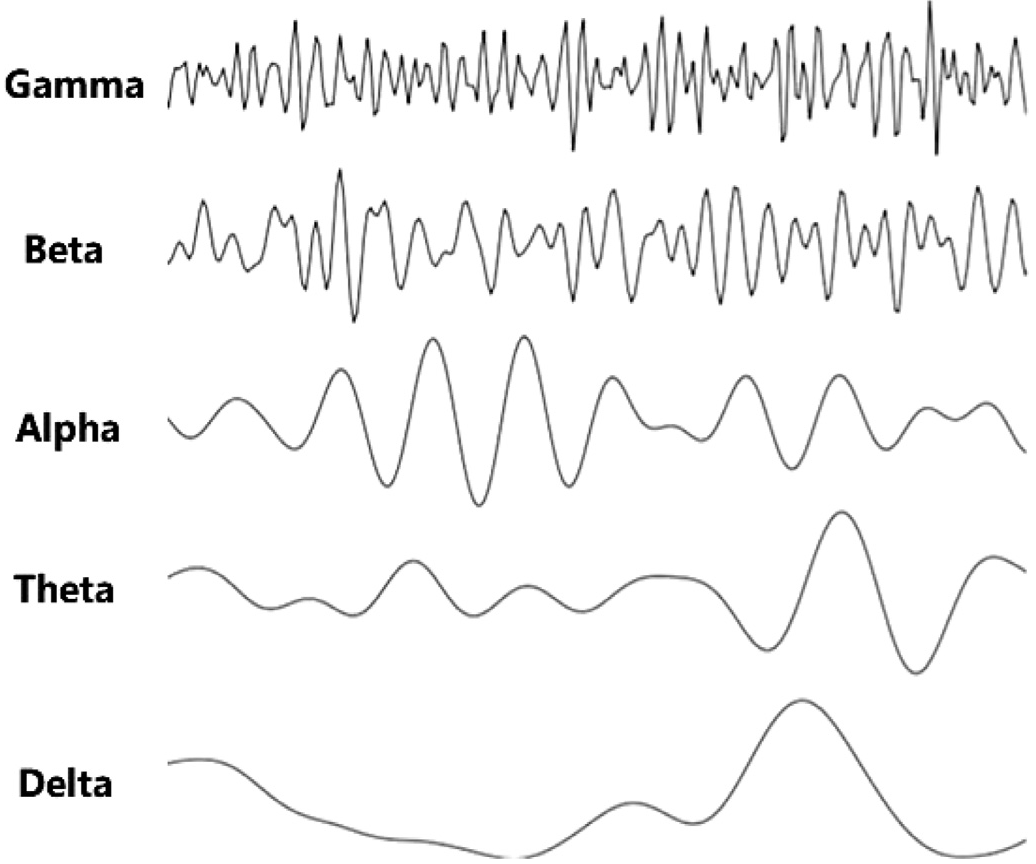 Above: The five typical EEG rhythms (Delta, Theta, Alpha, Beta, Gamma) used to map cognitive and emotional states.
3. Dimensionality Reduction
With 32 or more channels of EEG, the "curse of dimensionality" is real. The paper reviews techniques like Spectral Regression Kernel Discriminant Analysis (SRKDA) and mRMR to filter out redundant data, ensuring the classifier doesn't overfit to noise.
Experiments: Where the Brain Maps Emotion
One of the most profound insights from the experiments is the localization of emotion. The authors demonstrate that the Frontal Lobe is the powerhouse of emotional regulation.
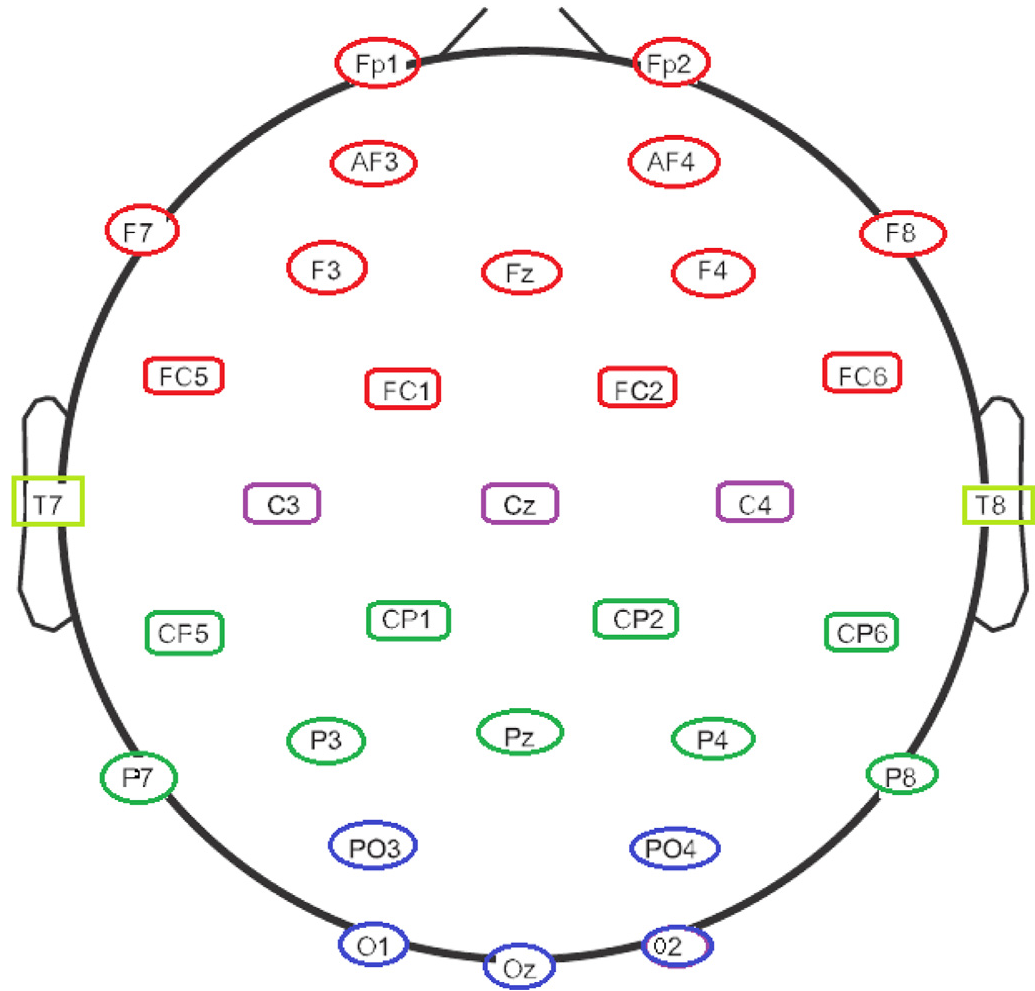 Figure: Grouping EEG electrodes by lobe. The frontal lobe (red) alone provides enough data to achieve >90% accuracy in certain tasks.
Comparison of Classifiers
The study pits traditional models against each other:
- SVM (Support Vector Machine) and Random Forest (RF) consistently outperformed the simpler k-Nearest Neighbor (kNN) models.
- Deep Learning (DL): The paper highlights a shift toward Deep Belief Networks (DBN) and CNNs, which automate feature learning and can reach accuracies near 99% when paired with massive audio-visual datasets.
Critical Analysis & Future Outlook
While the technical results are impressive, the paper remains grounded in reality, noting several hurdles:
- Subject Dependency: A model trained on Participant A rarely works perfectly for Participant B. Future research must focus on Transfer Learning.
- Hardware Constraints: Nobody wants to wear a wet-electrode EEG cap in a smart home. The future lies in wearable, dry-electrode sensors integrated into headbands or glasses.
- The 3rd Dimension: Most models use a 2D "Valence-Arousal" space. The authors suggest moving to a 3D model that includes "Stance" (the urge to "fight or flight") to better capture behavioral intentions.
Conclusion
This review serves as a roadmap for the next generation of HCI. By moving away from subjective self-reports and toward objective neurophysiological data, we are entering an era where machines might understand our feelings better than we do ourselves.
Takeaway: The Gamma frequency band and the Frontal Lobe are the keys to unlocking EEG-based emotion recognition. The next frontier? Combining this with Deep Learning to create generic, subject-independent models.