
Beyond Prosody: Enhancing Speech Emotion Recognition with LS-SVM and Spectral Entropy
Emotion Recognition Using Novel Speech Signal Features
This paper presents a speaker-independent Automatic Emotion Recognition (AER) system using a novel set of acoustic features and Least Square-Support Vector Machines (LS-SVMs). It classifies six discrete emotional states (happiness, sadness, anger, surprise, fear, and disgust) and achieves a state-of-the-art accuracy of 81.3% using a fuzzy-pairwise LS-SVM framework with forward feature selection.
TL;DR
This research tackles the challenge of Speaker-Independent Automatic Emotion Recognition (AER) by moving beyond simple prosodic features. By introducing novel spectral domain features and employing Least Square-Support Vector Machines (LS-SVM) with a fuzzy-pairwise multi-class strategy, the authors achieved a robust 81.3% accuracy across six emotional states, proving that spectral richness and optimized classification are key to crossing the speaker-dependency barrier.
The Challenge: Why is Emotion Recognition Hard?
Human emotion is a high-dimensional construct. Most existing AER systems suffer from two major flaws:
- Speaker Dependency: They often require retraining for new users to maintain accuracy.
- Feature Inadequacy: Relying solely on pitch or volume (prosody) misses the subtle "texture" of speech provided by spectral distributions.
The authors argue that a truly "intelligent" machine should recognize how something is said regardless of who says it or what the specific words are.
Methodology: The LS-SVM Advantage
The core of the system lies in its sophisticated processing pipeline:
1. Novel Feature Engineering
While MFCCs and Zero Crossing Rates (ZCR) are standard, this paper introduces:
- Shannon and Renyi Entropy: To measure the complexity/uncertainty of the signal.
- Spectral Flux and Roll-off: To capture the rate of change and the high-frequency content of the spectrum.
2. High-Efficiency Classification (LS-SVM)
Instead of standard SVMs that require solving complex Quadratic Programming (QP) problems, the authors use LS-SVM.
- Insight: LS-SVM replaces inequality constraints with equality constraints, transforming the optimization into a set of linear equations. This significantly reduces computational overhead without sacrificing the "Max-Margin" benefit of SVMs.
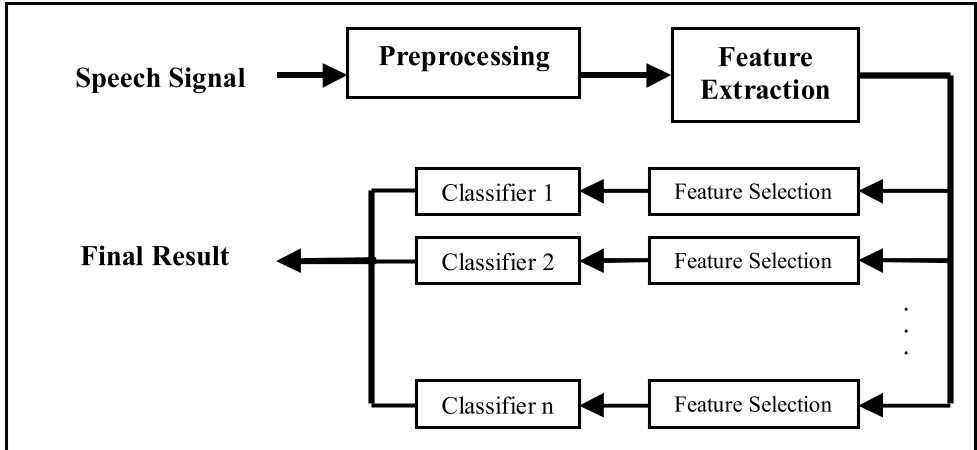 Figure 1: The overarching workflow from preprocessing and wavelet de-noising to final multi-class classification.
3. Fuzzy-Pairwise Strategy
Multi-class classification is notoriously difficult for binary classifiers like SVM. The authors found that a fuzzy-pairwise approach (comparing classes in pairs and applying fuzzy logic to handle boundaries) provided the best resolution compared to simple "One-Vs-All" methods.
Experimental Insights
The system was tested on the eNTERFACE’05 audio-visual database (42 subjects, 14 nationalities).
Feature Selection Impact
Using the Forward Selection (FS) algorithm, the authors demonstrated that accuracy improves incrementally as specific spectral features are added, eventually hitting an optimal plateau.
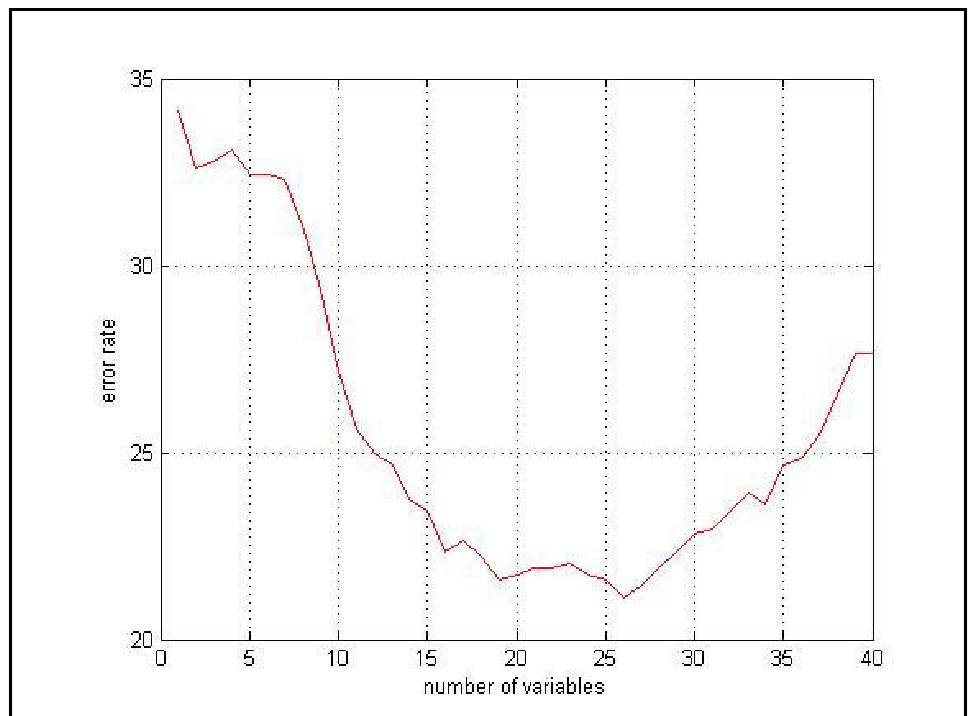 Figure 2: The performance curve showing how the binary LS-SVM improves with each added feature.
Results Breakdown
The results highlight a fascinating "Emotional Hierarchy" in speech:
- Happiness (92.4%) and Sadness (90.5%) are remarkably distinct in the spectral domain.
- Surprise (55.5%) is the most elusive, often confused with anger or fear due to similar high-energy spectral signatures.
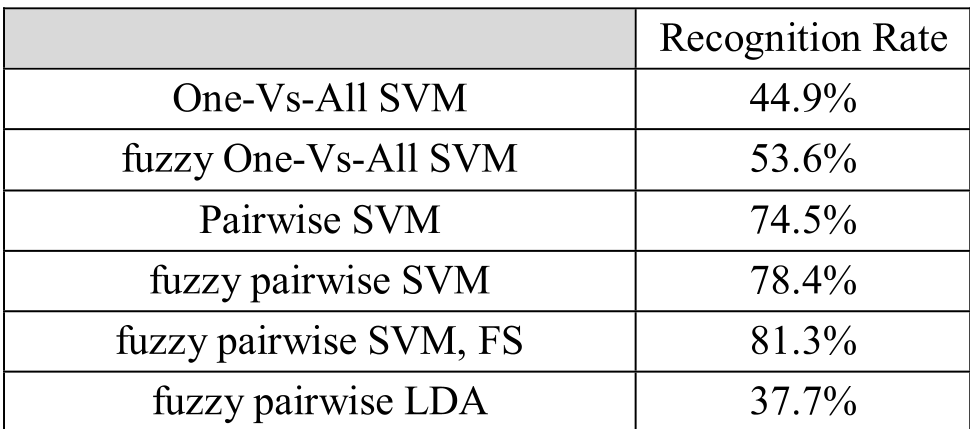 Table 1: Comparison of different SVM strategies and Linear Discriminant Analysis (LDA).
Critical Perspective: Takeaways & Limitations
Takeaways: This work establishes that Information Theory metrics (Entropy) are highly discriminative for emotion. By combining these with the efficiency of LS-SVM, the authors provide a blueprint for real-time AER in HCI applications like psychiatric diagnosis or customer service monitoring.
Limitations:
- Complexity of Surprise: The low accuracy for "Surprise" suggests that acoustic features alone may be insufficient; bimodal integration (adding facial expression analysis) might be necessary.
- Dataset Constraints: While the database included 14 nationalities, the utterances were "elicited" (acted). Real-world, spontaneous emotional speech often lacks the clear-cut boundaries found in reference datasets.
Conclusion
The leap to 81.3% accuracy using fuzzy-pairwise LS-SVM represents a significant step toward fluid Human-Computer Interaction. By focusing on the physics of the sound (spectral flux, entropy) rather than just the lyrics, we move closer to machines that truly "understand" human sentiment.