
Ensemble of Classifiers: A Hybrid Frontier in Textual Emotion Recognition
Recognizing emotions in text using ensemble of classifiers
The paper introduces a hybrid sentiment analysis system that employs an ensemble of classifiers—coupling statistical machine learning (Naïve Bayes and Maximum Entropy) with a dependency-based knowledge-based tool—to recognize emotions in text. The ensemble achieves State-of-the-Art performance in identifying both the presence of emotions and their specific polarity across diverse text types like news headlines and social media.
TL;DR
Determining how a person feels through a short string of text is an "NLP-complete" challenge. This paper presents a robust ensemble system that merges the statistical "common sense" of Naïve Bayes and Maximum Entropy with the surgical precision of syntactic dependency parsing. By combining these paradigms, the researchers achieved an 87% accuracy in detecting emotions across news and social media.
Context: Why Discrete Models aren't Enough
In the landscape of Affective Computing, most researchers lean toward one of two camps:
- The Statistical Camp: Excellent at spotting patterns but "blind" to structure. (e.g., missing the fact that "not happy" means the opposite of "happy").
- The Knowledge Camp: Great at understanding "Why," but fails if the specific word isn't in their dictionary.
The authors of this study argue that the real power lies in the Ensemble. By utilizing a Majority Voting schema, they allow the statistical learners to handle the "noise" of social media while the Knowledge-Based (KB) tool handles the complex linguistic interactions like negation and intensification.
Methodology: The Best of Both Worlds
The system architecture is a three-pronged attack on the text:
1. The Statistical Duo
- Naïve Bayes (NB): Operates on a probability mechanism, treating text as a "Bag-of-Words" (BOW).
- Maximum Entropy (MaxEnt): Unlike NB, it doesn't assume feature independence, allowing it to handle overlapping features like bigrams more effectively.
2. The Syntactic Specialist (KB-Tool)
This is the core innovation. Instead of just looking for keywords, it uses the Stanford Parser to build a dependency tree.
- Emotional Units: It identifies the "Subject–Verb–Object" backbone.
- Valence Shifting: It recognizes quantification words (e.g., "extremely," "hardly") and negations (e.g., "not") to dynamically adjust the emotion's strength and polarity.
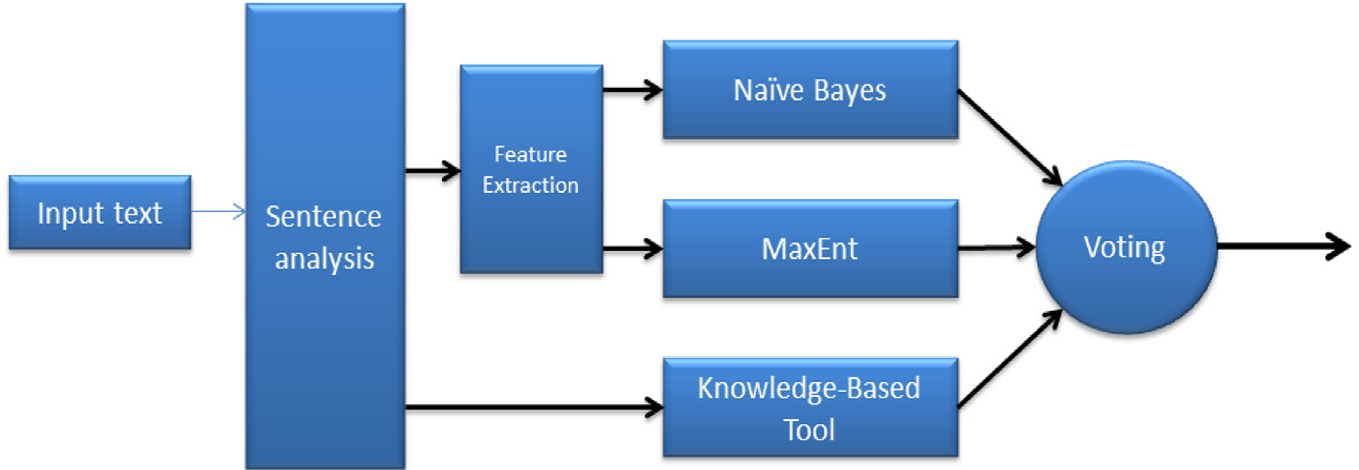 Figure 1: The Ensemble Classifier Schema showing the integration of statistical and knowledge-based modules.
Experiments and "The Gold Standard"
The researchers tested their system on a "Gold Standard" dataset of 750 manually annotated sentences from news headlines, articles, and Twitter.
Key Performance Insights:
- Headlines are easier: The system performed best on news headlines (89% accuracy) because they are syntactically well-formed and use expressive keywords.
- The Twitter Challenge: Accuracy dipped on Twitter (82%) due to slang, irony, and the "flighty" nature of social media syntax.
- Ensemble Superiority: In almost every category, the ensemble outperformed the best single classifier (Naïve Bayes), proving that collective intelligence mitigates individual model weaknesses.
 Table 1: Comparative performance across Headlines, Articles, and Tweets.
Critical Analysis & Conclusion
Takeaway
The study proves that linguistic structure matters. While pure ML models might guess the sentiment based on word frequency, the inclusion of a dependency-aware KB-tool ensures that the system doesn't get tripped up by simple negations.
Limitations
The system still struggles with irony and context. If a tweet is sarcastic (e.g., "Great, another flat tire!"), the models might see "Great" and rank it as positive joy. Solving this requires "World Knowledge" beyond just sentence-level syntax.
Future Outlook
The next step for this research is likely the integration of Pre-trained Language Models (like Transformers) into the ensemble. If the structural precision of the KB-tool can be mapped onto the contextual embeddings of a Transformer, we may finally approach human-level emotional intelligence in machines.