
Beyond Logic: The Functional Role of Emotion in Reinforcement Learning Agents
Emotion in reinforcement learning agents and robots: a survey
"Emotion in reinforcement learning agents and robots: a survey" provides the first comprehensive taxonomy of computational emotion models within Reinforcement Learning (RL) architectures. It categorizes how emotions are elicited from MDP components, their representation as categorical or dimensional states, and their functional utility in enhancing learning efficiency, meta-parameter tuning, and social interaction.
TL;DR
Is emotion the "glitch" in the machine, or the secret sauce for intelligence? This seminal survey by Moerland et al. argues for the latter. By systematically mapping affective theories onto the Reinforcement Learning (RL) framework, the paper reveals how emotions serve as functional tools for meta-learning, dynamic exploration, and social signaling. Far from being mere "flavor," emotions provide the mathematical machinery for agents to switch goals, prioritize survival, and interact meaningfully with humans.
The "Why" of Machine Emotion: A Functional Perspective
In traditional AI, emotions are often dismissed as irrational. However, neuroscience (notably Damasio’s Somatic Marker Hypothesis) suggests that without emotion, rational decision-making collapses. In the context of RL, this survey identifies three core motivations for keeping agents "emotional":
- Machine Learning Efficiency: Intrinsically motivated features (curiosity, surprise) help solve the sparse reward problem.
- Human-Robot Interaction (HRI): Emotions make agents transparent, allowing humans to "read" the agent's internal state.
- Refining Affective Theory: RL provides a rigorous, high-dimensional sandbox to test psychological models like the OCC or PAD.
Methodology: The Taxonomy of Elicitation and Function
The authors propose a rigorous mapping from the Markov Decision Process (MDP) to emotional states.
1. How is it Elicited? (The Input)
The survey categorizes emotion generation into four logical streams:
- Homeostasis (Extrinsic): Drives like "hunger" or "pain" based on internal resource levels (e.g., battery life).
- Appraisal (Intrinsic): Cognitive evaluations of novelty, control, and goal relevance.
- Value/Reward-Based: Direct derivatives of the -value or the Temporal Difference (TD) error (e.g., Positive TD error Joy).
- Hard-wired: Direct sensory-to-emotion mappings.
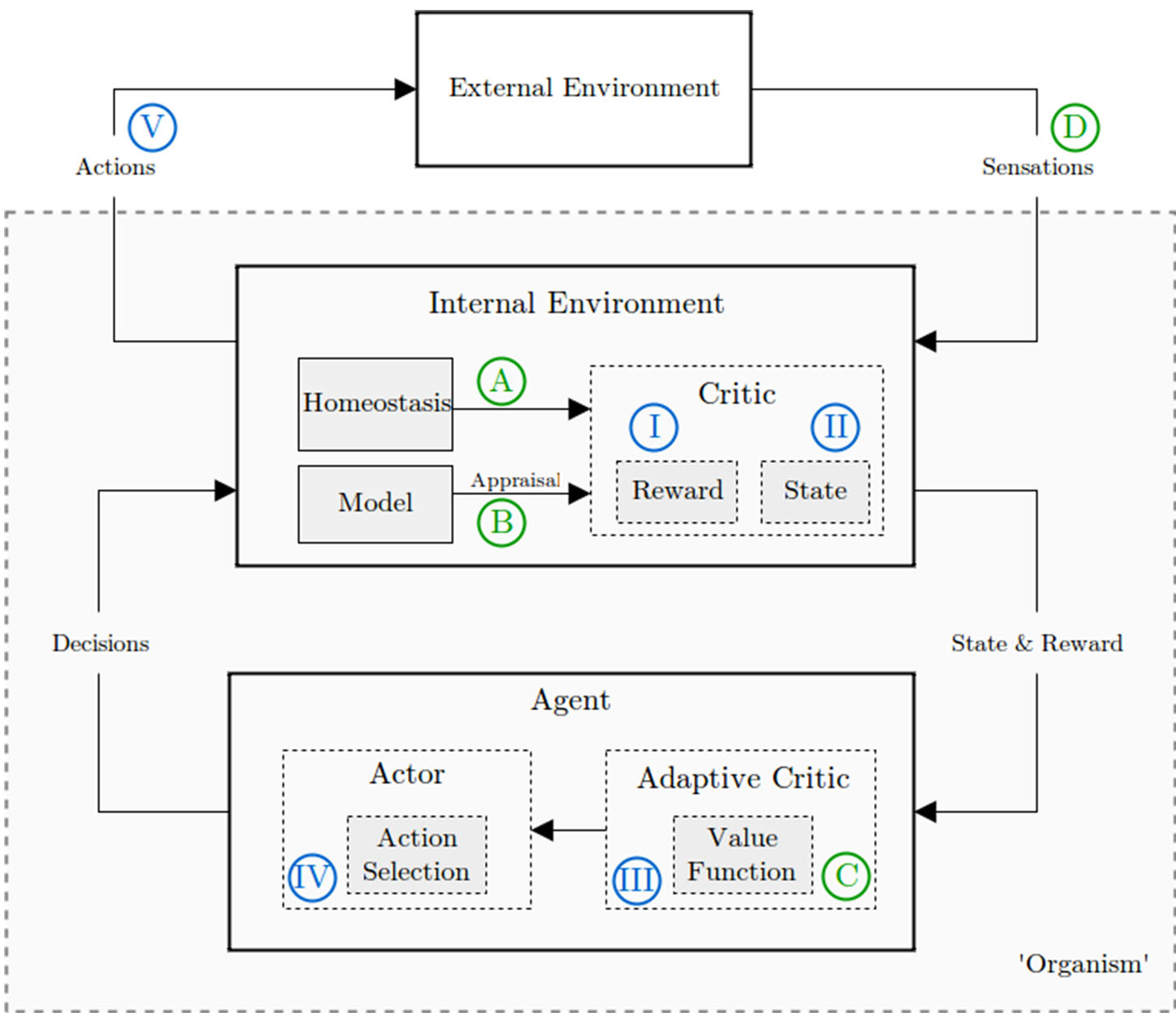 The Critic (internal to the agent) combines external sensations and internal drives to produce reward and state signals.
2. What is its Function? (The Output)
Once an emotion is "felt," how does it change behavior? The paper identifies five functional pathways:
- Reward Modification: Shaping the reward signal () to prioritize exploration or survival.
- State Modification: Information about the emotional state is fed back into the state-space, allowing for "mood-dependent" policies.
- Meta-learning: Tuning hyperparameters like the learning rate () or discount factor () based on "surprise" or "fear."
- Action Selection: Dynamically adjusting exploration (e.g., via the Boltzmann temperature ).
- Epiphenomenon: Purely communicative roles—showing "sadness" when performance drops to elicit human help.
Key Results: Academic Benchmarks
The survey highlights several SOTA achievements in the field:
- Efficiency: Categorical models (Joy/Fear) allowed agents to navigate mazes with fewer collisions and shorter paths compared to standard -learning.
- Social Impact: Physical robots using emotional intonation and facial expressions were perceived as significantly more "convincing" and "intelligent" by human participants in double-blind studies.
- Emergent Dynamics: In some studies, "hope" and "fear" emerged naturally from anticipated temporal differences, mirroring biological behavior in predator-prey scenarios.
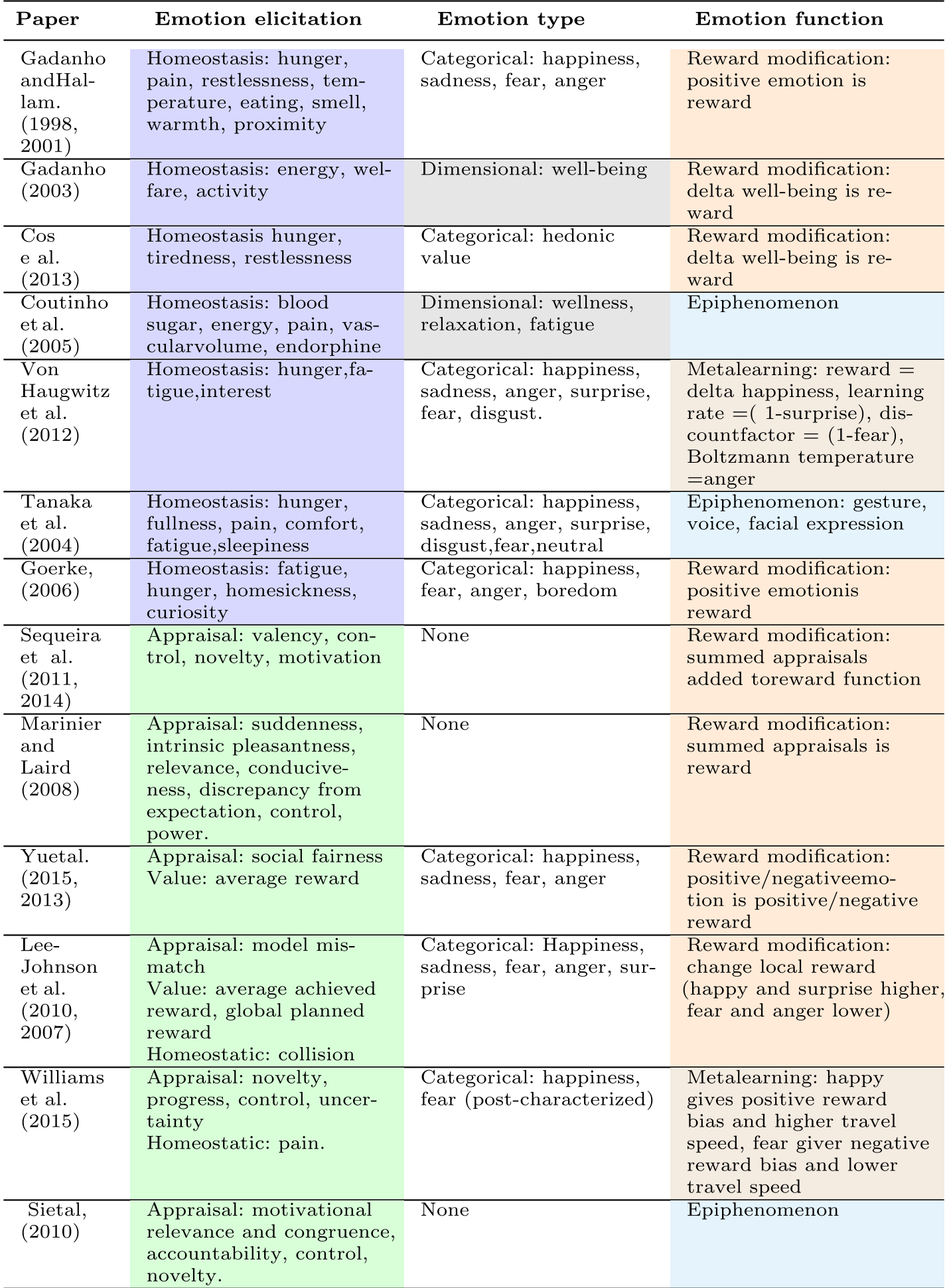 Selected summary of how various papers implement the Elicitation-Type-Function pipeline.
Critical Insight & Future Outlook
While the survey is comprehensive, it points out a significant "Reproducibility Crisis" in the field. Most researchers build custom grid-worlds and use non-standardized notation, making side-by-side comparison nearly impossible.
The Takeaway for Engineers: If you want a robot that is both efficient and "likable," stop treating the learning rate as a constant. Instead, view it as a function of the agent's "surprise."
The future of AI lies in Fully Learned Emotional Models—where "happy" nodes aren't hand-coded but emerge because they help the agent maximize its long-term viability. As Deep RL matures, we expect these affective frameworks to migrate from grid-worlds to complex, high-bandwidth social environments.
Conclusion
Moerland et al. have successfully transformed "emotion" from a nebulous psychological concept into a core component of the RL loop. For the next generation of social robots, feelings won't just be an "extra"—they will be the cognitive glue that holds the learning process together.