
ERM: Decoding the Emotional Architects of Online Social Networks
Emotion Role Identification in Social Network
The paper introduces the Emotion Role Mining (ERM) approach to identify specialized users—Emotion Leaders, Emotion Mediators, and Emotion Followers—within social networks. By leveraging six-element emotional features and social influence metrics, the authors achieve a precision of approximately 82% in identifying key emotional actors on Micro-blog datasets.
TL;DR
Human emotions flow through social networks just like information, yet not all users contribute equally to this "emotional contagion." This paper proposes the Emotion Role Mining (ERM) approach to identify three critical roles: Emotion Leaders (the influencers), Emotion Mediators (the bridges), and Emotion Followers. By combining fine-grained emotion recognition (6 categories) with structural network analysis, the authors provide a framework that significantly outperforms traditional social role mining baselines.
Problem & Motivation: Beyond "Positive" and "Negative"
Most social network analysis treats users as nodes in a graph of information exchange. While we know emotions spread (contagion), prior work often simplifies this to a binary sentiment polarity. This creates two major gaps:
- Granularity Gap: It ignores the nuance between "anger" and "sadness," each of which triggers different cascading behaviors.
- Impact Gap: It fails to identify who actually triggers these cascades.
The authors argue that identifying "Emotion Roles" is essential for applications like advertising, mental health monitoring, and public opinion detection.
Methodology: The Core of ERM
The ERM approach is built on two pillars: Emotion Influence and Emotion Preference.
1. Quantifying Emotion Influence
To find Emotion Leaders, the authors define a multi-dimensional metric:
- Range Factor (RF): Measures the scope and depth of a user's emotional spread.
- Emotion Change Factor (EF): A fascinating metric using Euclidean distance to measure the "before and after" emotional state of followers reacting to a post.
- Repost Ratio (RR): The frequency with which a user's emotional content is amplified by others.
2. Finding the Bridges (Emotion Mediators)
Emotion Mediators are the "Structural Hole Spanners" of the emotional world. They connect different "emotional communities"—clusters of users who share similar long-term emotional preferences (e.g., people who frequently post "disgust" regarding political topics).
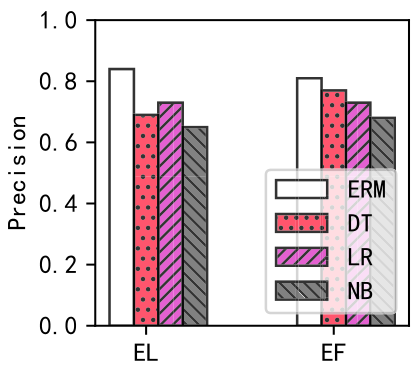 Figure 1: Comparison of identifying top-k emotion leaders.
Experiments & Results
The authors validated ERM using a dataset of over 500,000 Micro-blog posts.
Leader Identification
Using an SVM-based model with their custom features, ERM achieved an 82% precision, significantly higher than Decision Trees (DT) or Naive Bayes (NB).
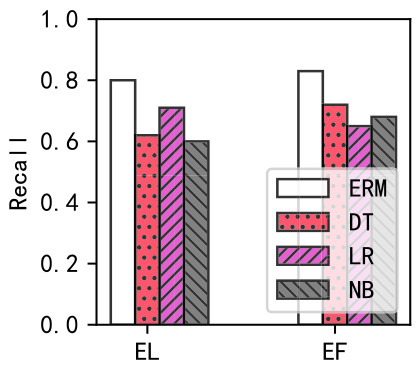 Figure 2: Precision/Recall/F-score comparison for Leader detection.
Mediator Performance
The most striking result was in Mediator identification. Standard algorithms like PageRank (38.6% F-score) failed because they look for "authority" (popularity), whereas ERM looks for "connectivity" between disparate emotional groups, achieving a 70.4% F-score.
| Emotion Role | Method | Precision | Recall | F-score |
|---|---|---|---|---|
| Emotion Mediator | ERM | 68.6% | 72.4% | 70.4% |
| Emotion Mediator | PageRank | 36.3% | 41.2% | 38.6% |
Critical Insight: Why Does This Matter?
The study proves that the emotional structure of a network is not identical to its social structure. A user might have many followers (socially important) but zero "Emotion Influence" if their posts don't change the emotional state of their audience.
Limitations & Future Work
While the results are strong, the study relies on a specific timeframe and platform (Micro-blog). The authors acknowledge that integrating temporal evolution (how roles change over time) and neighbor relations would be the next step in making the model more robust for real-world deployment.
Conclusion
ERM is a significant step toward a more "human-centric" social network analysis. By moving beyond structural links to emotional impact, it allows us to understand not just who is talking, but who is actually shifting the collective mood of the digital crowd.