
EXAI: Why Your AI Needs Emotions to Explain Itself
The role of emotion in self-explanations by cognitive agents
This paper introduces Emotion-aware eXplainable Artificial Intelligence (EXAI), a framework for cognitive agents to explain their actions using simulated emotions. By leveraging cognitive appraisal theory, the authors demonstrate how emotions can serve as heuristics for information selection and as rich content for natural language explanations.
TL;DR
The field of Explainable AI (XAI) has long focused on the "logic" of decisions—beliefs and desires. However, this paper argues that for an AI to be truly understandable, it must embrace Emotion-aware eXplainable AI (EXAI). By simulating emotions through cognitive appraisal theory, agents can use "feelings" as a heuristic to filter complex data and communicate in a way that resonates with human folk psychology.
The Problem: The "Bot" Explanation Gap
When a cognitive agent (like a robot tutor or a military simulator) explains itself, it usually lists a sequence of goals and facts. For example: "I performed Action X because I believed Condition Y and desired Goal Z."
While logically sound, this is not how humans communicate. We use Folk Psychology. We say, "I ran because I was scared," or "I gave you more work because I hoped it would help you pass." Previous XAI models fail to capture these "quasi-intentional" concepts, leading to explanations that are either overwhelming with detail or socially "off."
Methodology: The Three Pillars of EXAI
The authors structure their approach around the simulation of emotions using frameworks like CAAF (Cognitive Affective Agent programming Framework). They propose three revolutionary uses for these simulated emotions:
1. Emotions as a Heuristic (The "Affective Gain")
In a complex system, an agent might have hundreds of beliefs. Which ones should it tell the user? The authors introduce the Affective Gain () formula. It identifies which proposition () caused the biggest shift in the agent's "emotional state" (e.g., the largest increase in hope or decrease in fear).
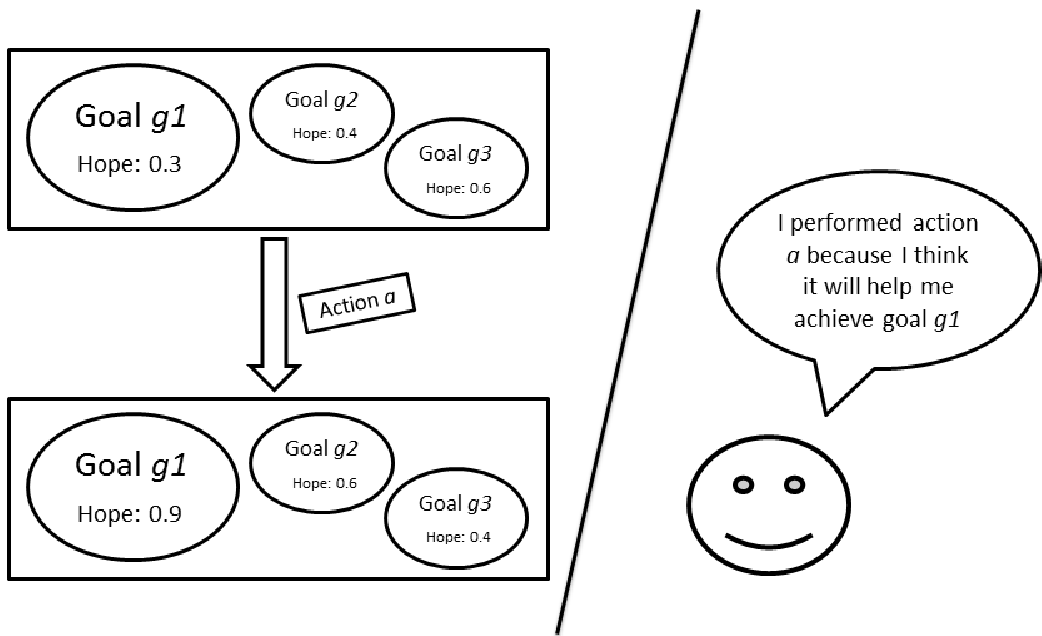 Figure 1: The agent selects the desire with the highest "hope" increase to explain its action.
2. Emotion-Based Content
Instead of saying "I want you to know about hypo's," the agent can say, "I was unhappy that you missed the question, so I opened the tutorial." Emotions act as a summary statistic for complex mental states, making explanations concise and natural.
3. Explaining the Emotion Itself
If a child asks, "Why are you sad?", the agent doesn't just say "My internal state is 0.5." It uses the appraisal process: "I am unhappy because you answered the quiz wrong, and I want you to stay healthy."
Case Study: The PAL Project
The theory was applied to the PAL project (Personal Assistant for a healthy Lifestyle), designed to help children with Type 1 Diabetes.
In the simulation, the agent observes "Jimmy" failing a quiz about hypoglycemia.
- Logic-only explanation: "I opened the educational material because desire was active."
- EXAI explanation: "I was unhappy to see you struggling with the quiz, and I hoped this material would help."
The authors provide a formal semantics for this "Mental State" update:
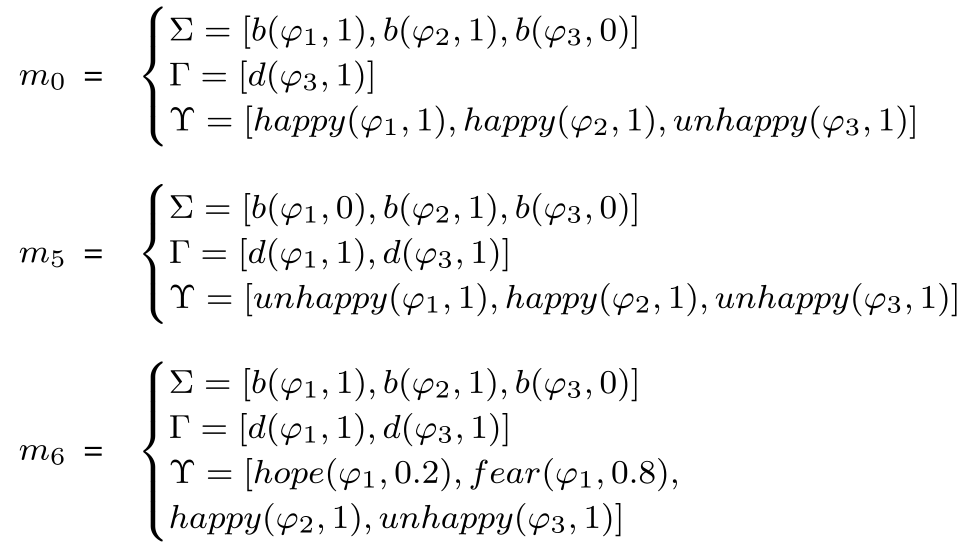 This mathematical framework captures the transition from belief/desire to a specific emotional intensity.
Critical Insight: Why This Matters
This work shifts the focus from "Black-box" explanation (looking at neural weights) to "Social" explanation (looking at human-centric communication).
The Takeaway: The "Affective Gain" technique creates a bridge between internal computational logic and external social intelligence. By using emotions as a filter, we solve the Information Overload problem in XAI.
Future Work & Limitations
While this paper provides a robust theoretical foundation, it leaves open the question of communicative effects. Does an "emotional" AI actually improve learning outcomes, or does it just seem "creepy"? The next frontier for the authors is to measure the longitudinal impact on user trust and behavior change in the PAL project.
Disclaimer: This analysis is based on "The Role of Emotion in Self-Explanations by Cognitive Agents" (2026).