
EmoSense: Turning WiFi Infrastructure into a Perceptive Emotional Radar
EmoSense: Computational Intelligence Driven Emotion Sensing via Wireless Channel Data
EmoSense is a pioneering wireless emotion sensing system that leverages Channel State Information (CSI) from off-the-shelf WiFi infrastructure to recognize human emotions via physical expressions (gestures). By utilizing a Fresnel zone-based theoretical model and computational intelligence classifiers, it achieves state-of-the-art performance comparable to vision-based and wearable sensor-based methods.
TL;DR
EmoSense is a groundbreaking system that transforms standard WiFi devices into sophisticated emotion sensors. By analyzing the "fingerprints" human gestures leave on wireless signals (Channel State Information), the system can identify emotions like happiness or anger with over 90% accuracy, matching the performance of intrusive cameras and wearable sensors in a completely contactless and privacy-preserving manner.
Background: Beyond the Lens and the Lead
Emotion recognition is the "Holy Grail" of Human-Machine Interaction (HMI). For years, we have relied on two modalities: Vision (which is creepy and requires light) and Bio-Sensors (which are uncomfortable and require contact). EmoSense introduces a third way: Passive Wireless Sensing. It treats the human body as a biological "reflector" that modulates WiFi waves according to emotional gestures.
The Core Challenge: Detecting "Micro-Gestures"
The primary hurdle in wireless emotion sensing is that emotional expressions—like a slight slump when sad or a subtle tremble when fearful—are far less pronounced than walking or running.
- Signal Extraction: How do we catch these tiny fluctuations in a sea of noise?
- Interpretation: Since expressions are person-dependent, how do we find the universal patterns?
Methodology: The Physics of Feeling
1. The Fresnel Zone Look-Up Method
Unlike previous empirical "trial-and-error" setups, EmoSense uses the Fresnel Zone theory. The authors modeled how signal amplitude is enhanced or degraded depending on the subject's position relative to the transceivers. By ensuring the subject is located in an "odd" Fresnel zone, the responsiveness of the signal to physical movement is maximized.
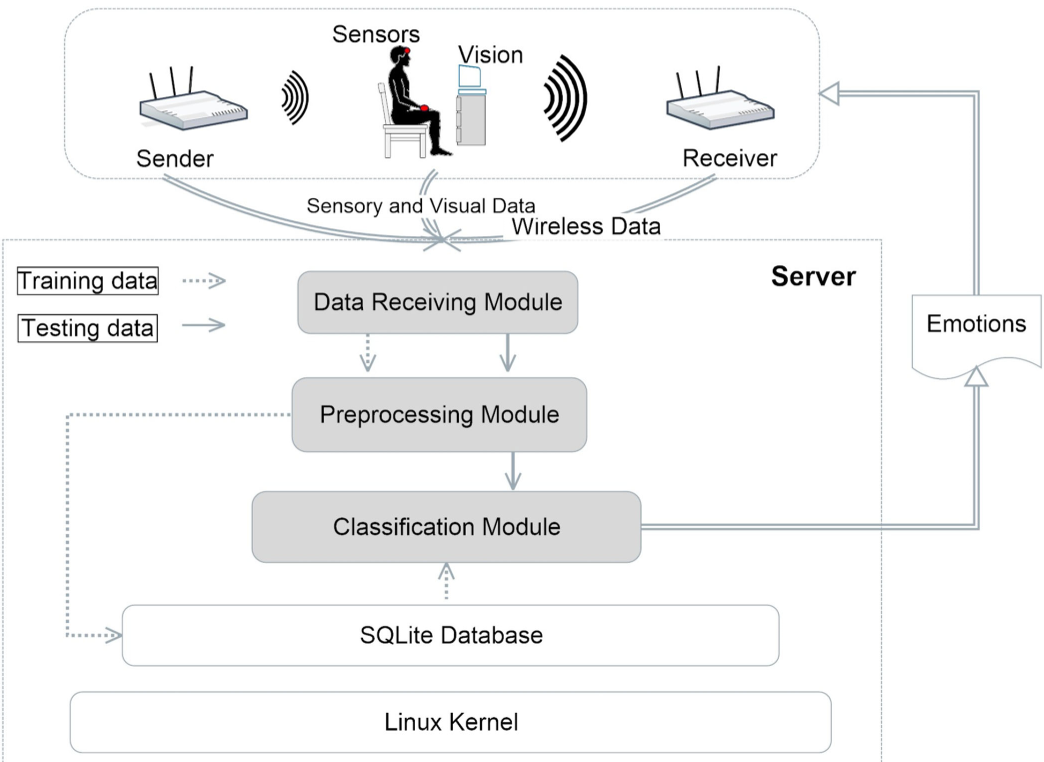 Figure 1: The EmoSense architecture showing the pipeline from CSI data reception to emotion classification.
2. Computational Intelligence Pipeline
The system processes raw CSI data through a Butterworth filter to remove high-frequency noise and then extracts seven key statistical features in both time and frequency domains, including:
- Entropy: To measure the complexity of the signal movement.
- Kurtosis & Skewness: To capture the specific "shape" of the physical expression transition.
Experimental Battle: WiFi vs. Sensors vs. Cameras
The researchers went head-to-head with mainstream benchmarks. They built an Arduino-based accelerometer system and a Google SqueezeNet-based vision system for comparison.
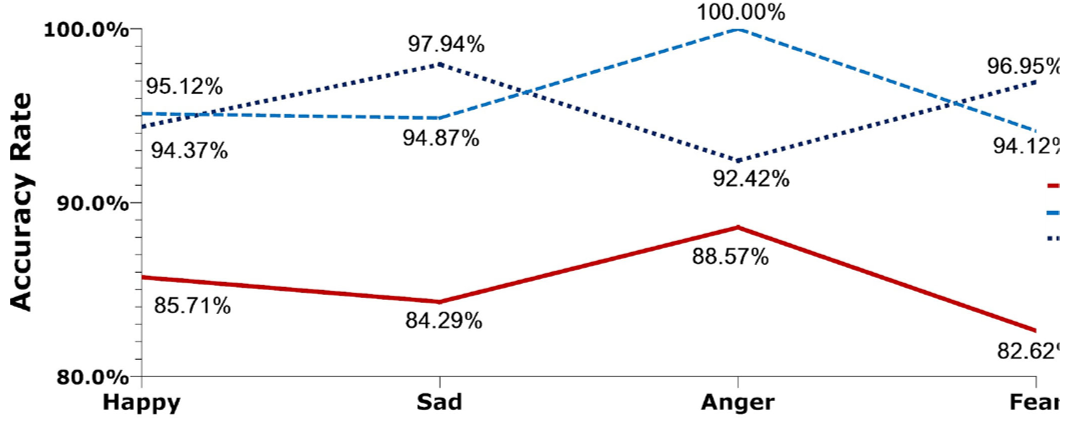 Figure 2: Performance comparison between EmoSense (WiFi), Vision-based, and Sensor-based systems across different emotions.
Key Findings:
- Happiness is Easy: Happy expressions are the most dynamic (clapping, leaning back), making them 100% recognizable.
- Fear is Subtle: Fear involves the least physical movement, leading to the lowest accuracy (83.81%).
- Person Dependence: The system performs excellently on known users (93%) but accuracy drops significantly for "unknown" subjects (40.86%), confirming that we all "feel" differently.
Critical Insight: The "Why" behind the Results
Why does WiFi work so well? It is because WiFi (especially 5GHz) doesn't just see the face; it captures the rhythm of the whole body. While a camera might miss a sad person slumping if their back is turned, the WiFi signal permeates the space, capturing the overall volumetric change in the environment.
Conclusion & Future Look
EmoSense demonstrates that we don't need a "Big Brother" camera in every room to create an emotionally intelligent environment. While the system currently struggles with person-independence (generalization), the shift from "hand-crafted features" to deep learning may soon solve this.
Takeaway: Your router might soon know you're having a bad day before you even say a word.
Limitations
- Single Subject: Currently optimized for one person in the room.
- Intentional Masking: Humans can still "fake" gestures to fool the system.
- Generalization: Requires training data for specific individuals to reach peak performance.