
The Emotion Slider: When Physical Movement Meets Psychological Feeling
10234_The emotion slider A self-report device for the continuous measurement of emotion.
This paper introduces the "Emotion Slider," a tangible self-report device designed for the continuous measurement of emotional valence in HCI. Built on theories of embodied emotion, it maps physical movements (pushing/pulling) to affective states, achieving a high correlation (r=0.99) with IAPS reference scores.
TL;DR
The Emotion Slider is a specialized tangible device designed to capture the "ebb and flow" of human emotion during technology use. By allowing users to push or pull a handle to report their feelings, it aims to make emotional annotation more intuitive. However, a rigorous test revealed a fascinating twist: our psychological intuition about "pushing away" the bad and "pulling in" the good doesn't always translate to faster interface interaction.
Background: Why Give Emotion a Handle?
In the world of User Experience (UX), understanding how a user feels in real-time is the "Holy Grail." Methods typically range from intrusive questionnaires to complex physiological sensors (like heart rate monitors). The Emotion Slider seeks a middle ground—a "tangible" interface that uses the physical body to report the mind's state.
The core motivation is Embodied Emotion. The theory suggests that thinking about emotions isn't just symbolic; it involves motor systems. Positive things trigger "approach" behaviors (pulling inward), while negative things trigger "avoidance" (pushing away).
The Problem: The Cognitive Cost of Reporting
Existing sliders and dials often treat the physical movement as a mere "pointer." If the movement required to report an emotion clashes with the body's natural impulse (e.g., having to pull a lever toward you to say you hate something), it creates "interference." This increases response time and leads to more errors, potentially tainting the very data researchers are trying to collect.
Methodology: Putting Intuition to the Test
The researchers developed a prototype—a wooden box with a sliding handle and internal springs for haptic resistance—to see if "congruent" movements (Pull = Positive, Push = Negative) actually outperformed "incongruent" ones.
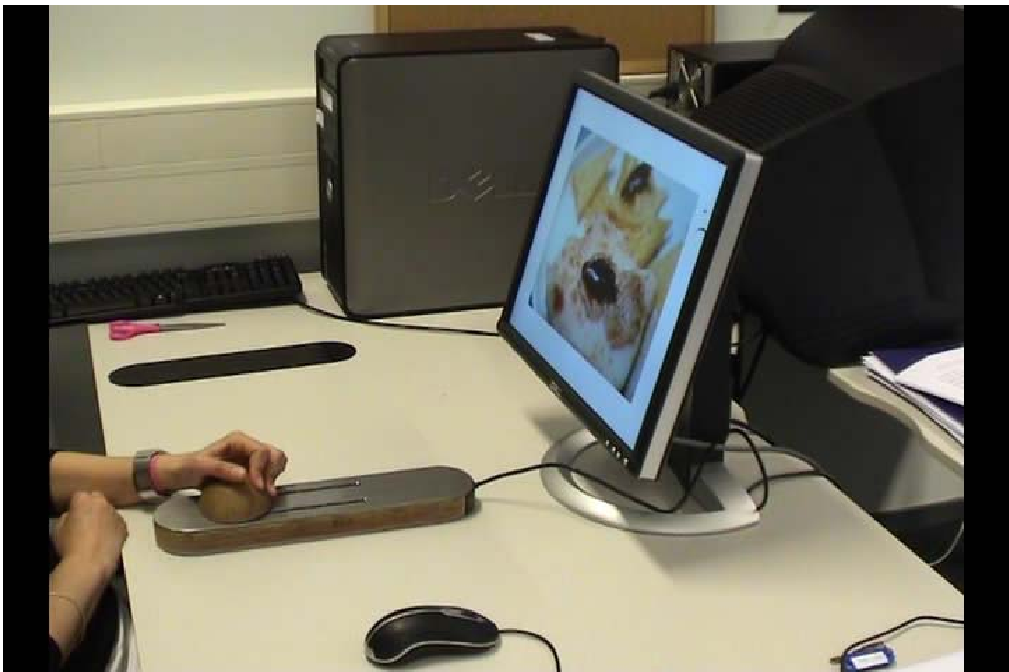
The Experiment
- Participants: 51 students.
- Stimuli: 20 images from the IAPS (International Affective Picture System), ranging from puppies and babies (positive) to war and dental exams (negative).
- The Twist: Half the participants were told to pull for positive/push for negative, while the other half did the exact opposite.
The Results: A Surprising Reversal
The device was highly successful in terms of validity: the distance participants moved the slider matched the intensity of the images perfectly (r = 0.99).
However, the "Inverted Congruence" found in the data shocked the researchers:
- Speed: Participants were significantly faster when pushing the handle away to report positive feelings.
- Accuracy: The group pushing for positive feelings made significantly fewer errors (14 vs 27 total errors).
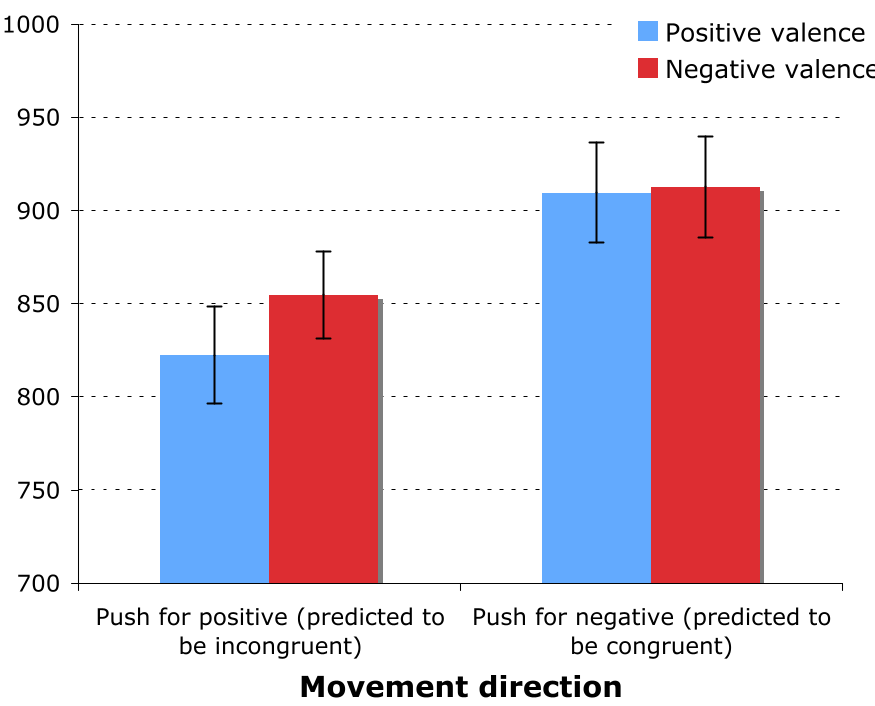
Why the Reversal?
The authors suggest that while "approach/avoidance" is a valid psychological theory, the context of the device matters more. In many interface metaphors, "Forward/Up" is associated with "More/Better/Positive." This socialized mapping seems to override the biological "approach/avoidance" impulse in the context of a desktop tool.
Critical Analysis & Conclusion
The Takeaway
The Emotion Slider is a powerful tool for continuous data collection, but it proves that design cannot be decoupled from psychology. Even a simple handle movement carries an "Inductive Bias" that can skew experimental results.
Limitations
- Static vs. Dynamic: The test used static photos. Real-world HCI is dynamic and interactive; a user's reaction to a crashing app might be different from their reaction to a photo of a cemetery.
- Cultural/Contextual Bias: The association of "Forward" with "Progress/Positive" might be culturally specific.
Future Outlook
For researchers building affective computing systems, the lesson is clear: Test your mappings. The most "theoretically sound" physical interaction might be cognitively slower for the user. Moving forward, the Emotion Slider should be deployed using the "Push = Positive" mapping to minimize user effort and maximize data integrity.