
EMDC: Decoding Human Emotions through Hierarchical Biosignal Fusion
Emotion-specific dichotomous classification and feature-level fusion of multichannel biosignals for automatic emotion recognition
This paper proposes an advanced emotion recognition framework using four-channel physiological biosignals (EMG, ECG, SC, RSP). The core contribution is the Emotion-specific Multilevel Dichotomous Classification (EMDC) scheme, which achieves a state-of-the-art accuracy of 95% for subject-dependent and 70% for subject-independent tasks by exploiting the dimensional properties of the 2D emotion model.
TL;DR
Researchers have developed a novel classification framework called Emotion-specific Multilevel Dichotomous Classification (EMDC). By shifting from traditional "flat" classification to a hierarchical approach based on the psychological axes of Arousal and Valence, they achieved a staggering 95% accuracy in recognizing musical emotions.
Context & Positioning
In the landscape of Human-Computer Interaction (HCI), "affect-sensitive" systems are the ultimate goal. While audiovisual recognition (facial expressions, speech) is common, it can be easily masked or faked. Physiological signals—the Autonomic Nervous System's (ANS) "unfiltered" response—offer a more robust alternative. This paper moves beyond simple pattern matching to a structurally informed classification that mirrors human psychology.
The Core Challenge: The "Mapping" Problem
Physiological signals like Heart Rate Variability (HRV) or Skin Conductivity (SC) are notoriously "noisy" and highly individualistic. Prior works often treated emotion recognition as a simple one-step multiclass problem (e.g., Sad vs. Happy vs. Angry). However, the human body doesn't react in a "flat" way; physiological changes often correlate more strongly with intensity (Arousal) than with positivity (Valence).
Methodology: The Power of Hierarchy
The authors leverage 110 distinct features extracted from four sensors: EMG, ECG, SC, and Respiration (RSP).
1. Feature-Level Fusion
Instead of making separate decisions for each sensor, all features are normalized and fused into a single high-dimensional vector. This allows the classifier to see the "cross-talk" between heart rate and breathing (BRV/HRV correlation).
2. The EMDC Scheme (The Secret Sauce)
The EMDC scheme exploits the 2D Emotion Model. Instead of asking "Which of these four emotions is this?", the system asks:
- Level 1: Is this High Arousal (Excited/Angry) or Low Arousal (Calm/Sad)?
- Level 2: Given the Arousal level, is the Valence Positive or Negative?
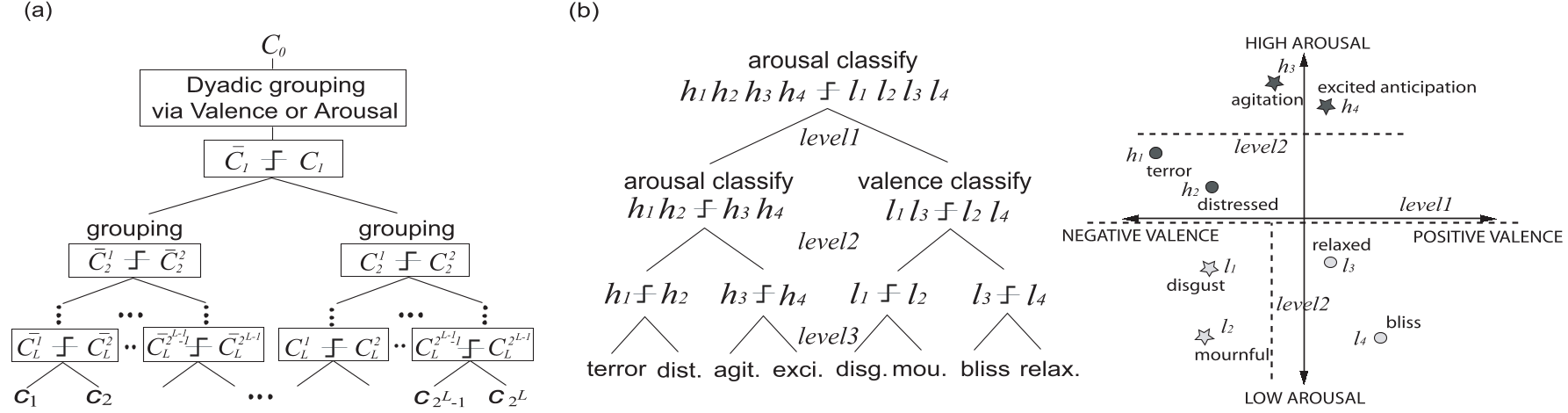
Figure: The EMDC framework showing the dyadic decomposition process.
Experimental Insights & Results
The study used music as an "emotion inducer," allowing subjects to pick their own songs to ensure genuine emotional responses.
- Arousal is easier to detect: The system reached 97-99% accuracy for Arousal alone.
- The EMDC Advantage: By using the hierarchical approach, the final 4-class accuracy jumped to 95% (Subject-Dependent).
- Sensor Specificity: The research confirmed that SC and EMG are the "arousal sensors," while ECG and RSP are the keys to unlocking "valence" (the quality of the emotion).

Table: Comparison between direct classification (pLDA) and the hierarchical EMDC approach.
Critical Insight: Why it Works
The success of EMDC highlights a fundamental truth in biological signal processing: Biological systems are hierarchical. By forcing the machine to resolve the strongest physiological signature (Arousal) before the more subtle one (Valence), the authors reduced "inter-class interference." This effectively "guides" the machine learning model through the manifold of emotional states in a way that aligns with human biology.
Conclusion & Future Outlook
While the 70% Subject-Independent accuracy is a massive leap forward, it also reminds us that "emotion signatures" still have a high degree of individuality. Future work will likely look into Transfer Learning to bridge the gap between specific users and general populations, potentially leading to wearables that can "sense" your mood in real-time with near-perfect precision.