
Beyond Static Meshes: Synthesizing Realistic Emotions via 4D Spatio-Temporal Meshes
Emotions Synthesis Using Spatio-Temporal Geometric Mesh
The paper introduces a novel framework for emotion synthesis in 3D avatars using Spatio-Temporal Geometric Meshes. By calculating centroids for facial regions and using machine learning (SVM/KNN) to identify trajectories, the method generates realistic 4D animations that capture the nuances of human expressions.
TL;DR
Achieving realism in 3D avatars requires more than just high-resolution textures; it requires the fluid, temporal "soul" of human expression. This paper proposes a method to synthesize these emotions by treating facial movements as Spatio-Temporal Geometric Meshes. By extracting region-based centroids and mapping their trajectories over time (creating a "4D mesh"), the researchers provide a pathway to realistic animations that are computationally efficient yet detailed enough to capture micro-expressions.
The Problem: The Uncanny Valley of Facial Animation
Creating realistic emotions in virtual performers is notoriously difficult. The "Uncanny Valley" effect often occurs because traditional systems miss the sectorized behavior of the face—how the corner of a mouth drags moments after the eyes widen.
Current SOTA methods often rely on heavy computational models or simple 2D-to-3D projection that lacks "temporal depth." The challenge lies in:
- Computational Cost: High-fidelity mesh deformation is expensive.
- Temporal Coherence: Movements often look robotic because they don't follow natural anatomical trajectories.
- Dimensionality: Moving from 2D training data (images) to 3D spatial controllers without losing emotional intensity.
Methodology: The 4D Trajectory Insight
The core innovation of this work is the 4D Geometric Mesh. Instead of viewing a facial expression as a series of static 3D frames, the authors view it as a continuous trajectory in a 4-dimensional space (X, Y, Z, and Time).
1. Centroid-Based Control
The researchers don't try to control every single vertex. Instead, they divide the face into regions (Action Units) and calculate a Centroid (C) for each region. These centroids act as the primary drivers for the mesh.
2. The B-Spline Trajectory
The movement of these centroids is modeled using B-Splines. This ensures that the transition from a neutral face to a "Surprise" or "Fear" expression is mathematically smooth.
 Fig. 1: Using 2D datasets to train 3D landmark controllers through spatial-temporal analysis.
3. Dimensionality Reduction (PCA & EDVA)
To keep the system fast, the authors use Principal Component Analysis (PCA) and Euclidean Distance Variance Analysis (EDVA). They assign an "influence parameter" () to different regions. If a region (like the forehead for certain smiles) has a low , it can be ignored to save processing power without sacrificing perceived realism.
Experiments and Results
The authors tested their synthesis by training Support Vector Machines (SVM) and K-Nearest Neighbors (KNN) on standard emotion datasets.
Key Findings:
- High Accuracy: The classification of the synthesized emotions reached over 90% accuracy, confirming that the geometry accurately reflects the intended emotion.
- Specific Challenges: Emotions like Fear and Surprise were the hardest to distinguish (producing more false positives), consistent with human psychological nuances where these expressions share similar physical traits (widened eyes).
- Efficiency: By using trajectory meshes (4D data as a sequence of slices), the system manages to interpolate complex expressions without the need for frame-by-frame manual rigging.
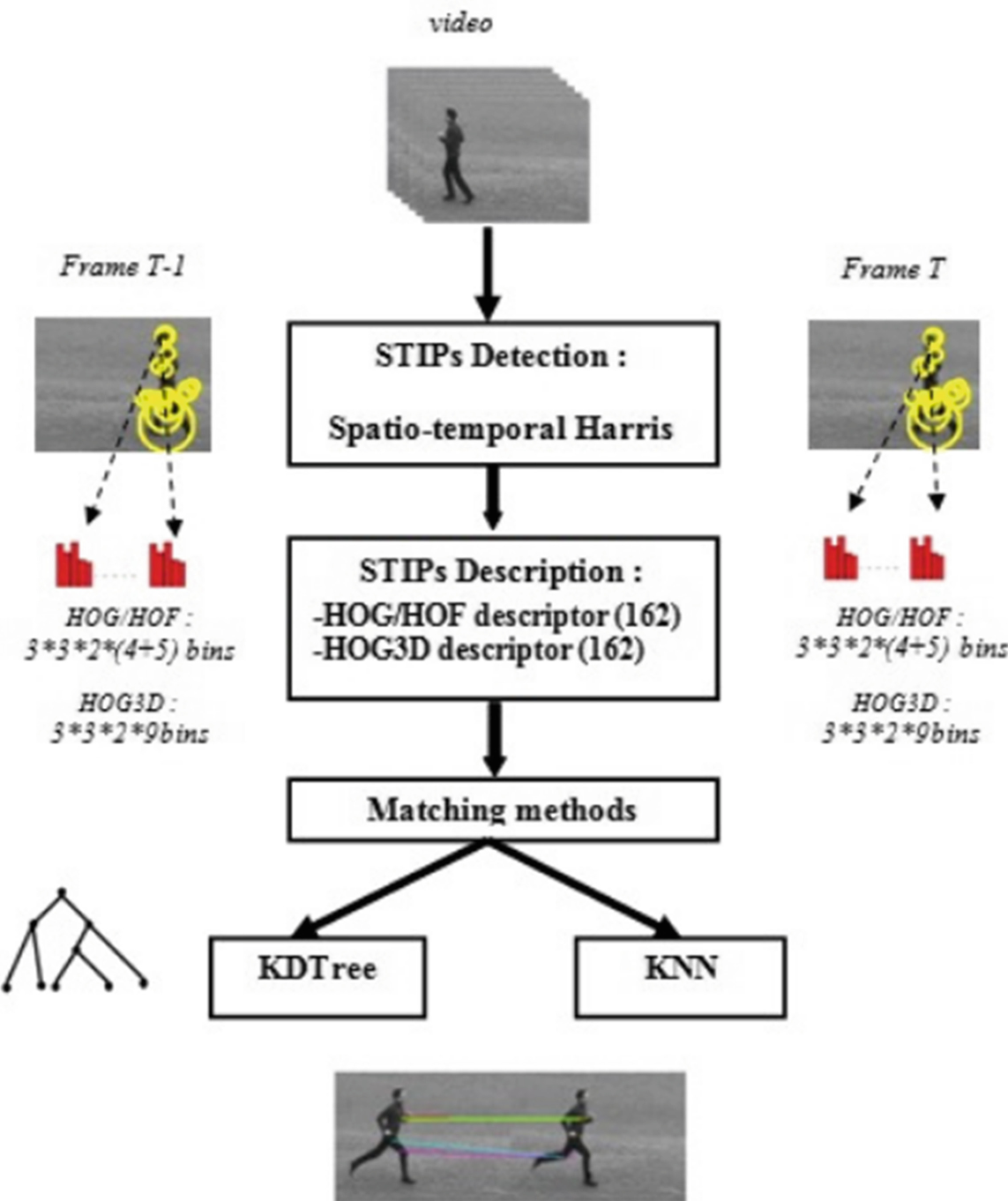 Fig. 2: Tracking Spatio-Temporal Interest Points (STIPs) to identify and classify motion patterns.
Critical Analysis & Conclusion
The strength of this paper lies in its mathematical rigor regarding temporal data. Instead of just "moving points," the authors use the PACOP-Miner algorithm to discover co-occurrence patterns in facial movements—effectively learning which parts of the face must move together to look natural.
Limitations
- Preliminary Scope: The results focus heavily on the "base" Ekman emotions (Joy, Sadness, Anger, etc.).
- Functional Integration: While the theory is sound, full integration into a real-time reactive avatar (like a digital assistant) still requires further testing on GPU-bound synthesis engines.
Future Outlook
The next frontier for this work is secondary interpolations—the "micro-labels" between emotions (e.g., a "bittersweet" smile). By defining these as blends of 4D spatio-temporal meshes, we can move away from "cartoonish" transitions toward truly human-like digital entities.