
Elfoid: Bringing Emotions to Life via Mobile Projection in Teleoperated Robots
Emotion Transmission System Using a Cellular Phone-Type Teleoperated Robot with a Mobile Projector
The paper introduces an emotion transmission system for "Elfoid," a palm-sized cellular phone-type humanoid robot. It utilizes a machine learning-based facial expression recognition pipeline and a built-in mobile projector to cast stylized facial expressions onto the robot's head, achieving a miniaturized telepresence solution.
TL;DR
Researchers at Tottori University have developed a way to make a cell-phone-sized robot, Elfoid, express human emotions without using a single facial motor. By combining real-time SVM-based facial recognition with a miniature internal projector, the robot "projects" its feelings through its soft skin, significantly enhancing the sense of human presence in remote communication.
The Miniaturization Paradox: Portability vs. Expression
In the field of telepresence, there is a constant tension between modality and portability. Large androids like the Geminoid offer hauntingly realistic expressions but are confined to laboratories. On the other hand, portable devices like mobile phones lack the "physical presence" that makes us feel truly connected.
The Elfoid was designed to bridge this gap—a robot small enough to be a phone but human enough to feel like a companion. However, its small size creates a mechanical dead-end: there is simply no room for the dozens of tiny motors (actuators) required to pull and push "skin" into a smile or a frown.
Methodology: Software-Defined Expressions
The authors propose a clever workaround: if you can't move the face, paint it with light.
1. The Recognition Pipeline
Before the robot can mimic an emotion, it must understand what the user is feeling. The system uses a camera to track facial landmarks via Constrained Local Model (CLM) fitting. The core logic follows:
- Feature Tracking: Identifying points around the eyes, nose, and mouth.
- Hierarchical Classification: Using an SVM (Support Vector Machine), the system categorizes expressions based on which facial regions contribute most (e.g., lip-based for happiness, lip-eye-eyebrow-based for anger).
2. Cartoon-Enhanced Projection
To overcome the low-resolution nature of small projectors and the diffusion of the robot's skin, the team employed cartoon techniques. Instead of realistic rendering, they used:
- Exaggeration: Making mouth and eyebrow movements larger than life.
- Color Stimuli: Using specific hues to reinforce emotions (e.g., red tones for anger).
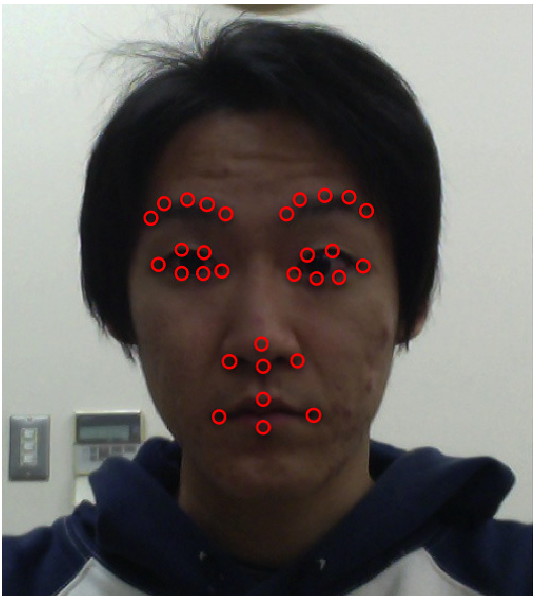 Fig 1. The feature points used for SVM-based classification of six universal emotions.
Experiments & Proof of Concept
The researchers tested both the technical accuracy of the recognition and the psychological impact on users.
- Technical Accuracy: The SVM classifier was incredibly robust for certain emotions, hitting a 100% recognition rate for Anger and over 82% for Surprise and Disgust.
- Subjective Usability: Participants engaged in remote conversations using the Elfoid. The results were clear: when the projector turned on, the "Uncanniness" score dropped, while "Presence" and "Human-like" scores saw a marked increase.
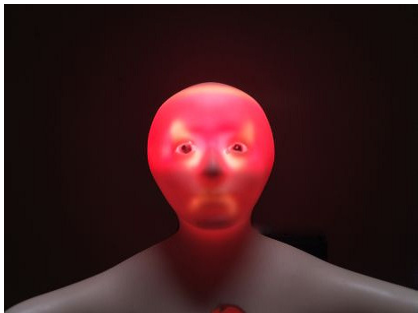 Fig 2. The projected results for Anger, Disgust, and Happiness on the physical Elfoid prototype.
Critical Insight: Beyond the Uncanny Valley
One of the most profound takeaways from this work is the effectiveness of "stylized" expression. By using cartoon-like projections rather than trying to mimic biological muscle movements exactly, the researchers managed to bypass the Uncanny Valley. The soft, human-like skin of the Elfoid provides the tactile sensation of a person, while the projected light provides the emotional data, creating a multi-modal experience that a flat screen simply cannot match.
Conclusion
The Elfoid project represents a shift in how we think about social robotics. It proves that we don't need complex mechanical engineering to convey a soul; sometimes, a well-placed projector and a smart algorithm are enough to make a piece of plastic feel like a friend.
Future Outlook: As miniature laser projectors and edge-AI chips become more powerful, we can expect "projected expressions" to become a standard feature in everything from smart home assistants to portable communication devices.