
Decoding the Heart of the Machine: A Dual-Memory Framework for Emotion Understanding
An emotion understanding framework for intelligent agents based on episodic and semantic memories
This paper presents a computational framework for emotion understanding in intelligent agents, integrating episodic and semantic memory systems. By combining the OCC emotion model with machine understanding paradigms, the authors enable agents to infer why others are in specific emotional states and predict associated actions, outperforming standard Q-learning in multi-agent simulations.
TL;DR
Researchers have developed a sophisticated framework that allows software agents to not just "see" emotions, but to understand them. By mimicking the human ability to store specific memories (Episodic) and abstract them into general knowledge (Semantic), these agents can predict how their actions will affect others, significantly outperforming traditional learning algorithms like Q-learning.
Context: This work shifts the focus from "Affective Computing" (detecting faces) to "Emotional Intelligence" (reasoning about social causality).
The "Why": Why can't agents understand us?
Most current AI treats emotions as simple labels or states in a reinforcement learning loop. However, human emotional intelligence relies on two critical pillars:
- Experience: "I remember that Agent A got angry when I took their resource."
- Abstraction: "Generally, humans feel 'Distress' when an undesirable event occurs."
The authors argue that agents fail because they lack the bridge between these two. Without Semantic Memory, an agent is a blank slate; without Episodic Memory, an agent is a rigid robot that cannot learn from its unique social environment.
Methodology: The Architecture of Empathy
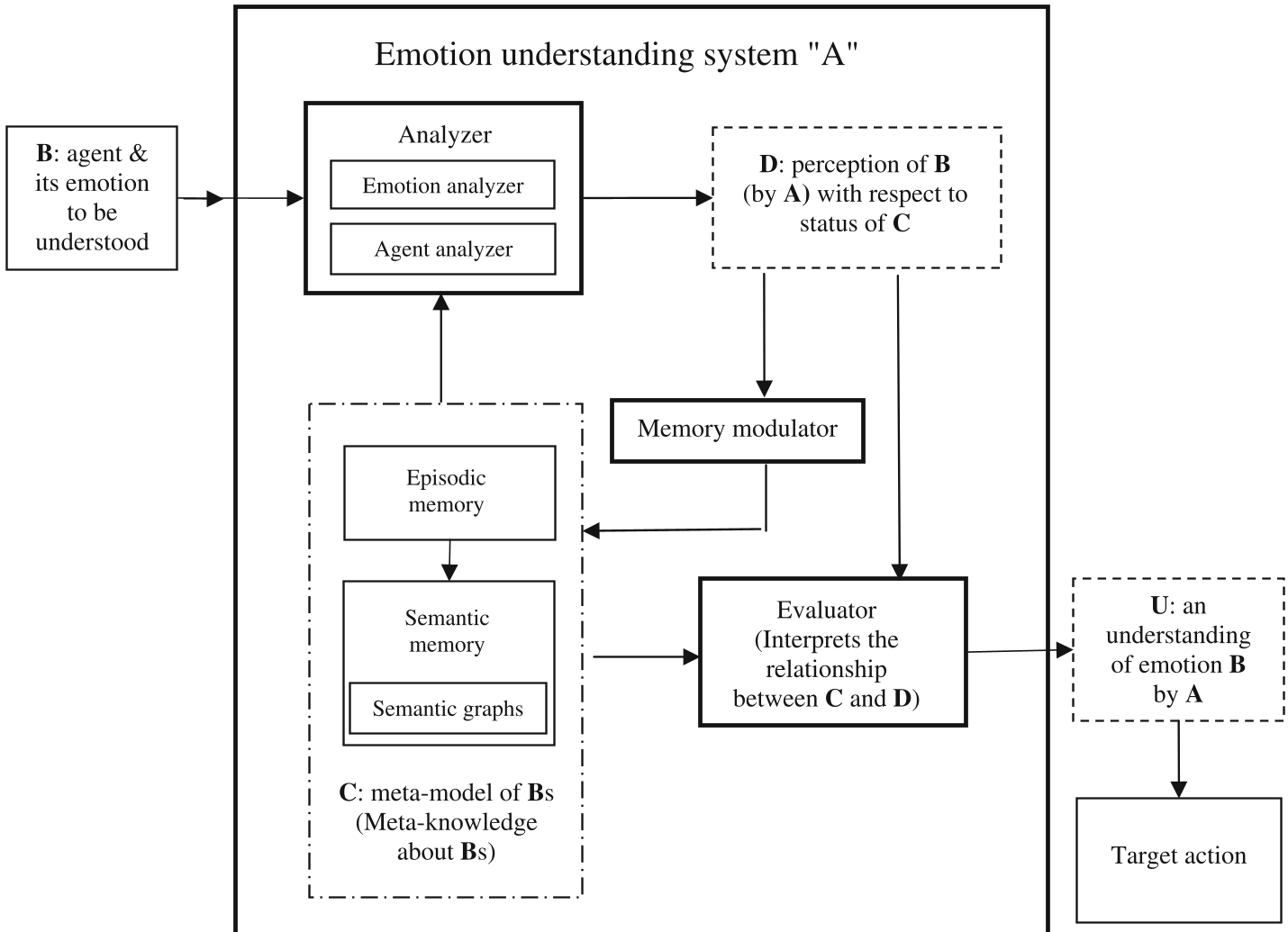
The proposed framework is built on a "Functional Decomposition" of machine understanding. It consists of four modules:
- The Meta-Model (The Brain):
- Episodic Memory: A log of (Time, Action, Group, Emotion, Intensity).
- Semantic Lookup Table: Hardcoded knowledge of emotion relations (e.g., Joy is similar to Hope but happens 'Now').
- Semantic Graphs: The "soul" of the method. It calculates a Certainty Factor (CF) for actions based on how recently and intensely they elicited specific emotions.
- The Analyzer: Categorizes agents into groups based on their goals using an adjusted k-means clustering algorithm.
- The Evaluator: Matches the current goal (eliciting a target emotion) against the memories to select the best action.
- The Memory Modulator: The feedback loop that updates the brain after every interaction.
The Secret Sauce: Informed Guessing
When an agent doesn't know how to make someone "Happy," it looks at its Semantic Memory. It knows "Happy" is the opposite of "Sad." It finds what makes the opposite group "Sad" and tries the inverse action. This "Informed Guessing" is what separates this framework from "hit-or-miss" algorithms.
Experiments: Performance vs. Precision
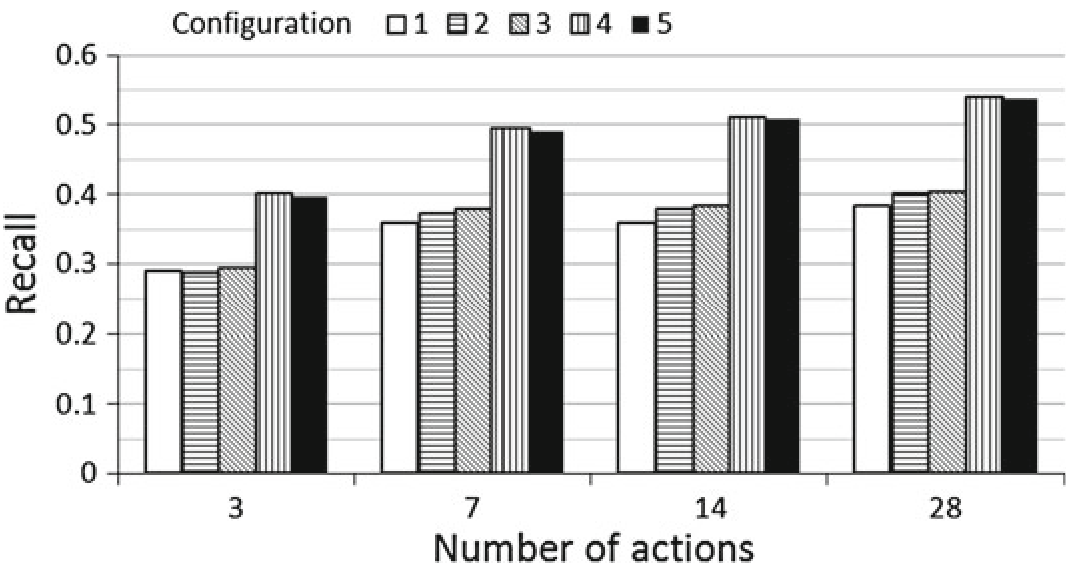
The authors tested five "lesioned" versions of their memory system.
- Configuration 2 (Episodic + Semantic Graphs): Won on Precision. It was the most "careful" agent, only acting when it was certain.
- Configuration 4/5 (Full Framework): Won on Recall. By using the lookup table to "guess" based on emotion similarities, it successfully elicited the target emotion much more often, even if it made a few more mistakes.
Victory over Q-Learning
The framework was benchmarked against Q-learning. Traditional Q-learning "forgets" the context—it doesn't care who the agent is or how intense the emotion was; it only sees the reward. The memory-based framework outperformed it consistently because it preserved the nuance of the social interaction.
Critical Insight: The "Emotive Agent"
The authors conclude by defining a new class of entity: the Emotive Agent. These aren't just "smart" bots; they are sensitive to inputs, aware of personalities, and capable of using emotional understanding to guide their logic.
Limitations: The study assumes "perfect" perception (the agent knows exactly what the other is feeling). In the real world, detecting a human's emotion is noisy. Additionally, the categorizations were based on goals—real-world personality categorization (like MBTI or Big Five) would add another layer of complexity.
Final Takeaway
This paper provides a robust blueprint for the next generation of domestic robots and virtual tutors. By structuring memory into episodic and semantic layers, we can move away from "Reactionary AI" toward "Understanding AI" that can truly navigate the complex social landscape of human emotion.