
Analyzing MOOC Learner Emotions: Bridging the Virtual Gap with Word2Vec
The Study of Learners’ Emotional Analysis Based on MOOC
The paper proposes a binary sentiment classification framework for MOOC learners by integrating Word2Vec embeddings with traditional machine learning algorithms. By leveraging forum interaction data, the system identifies positive and negative emotional tendencies to help educators improve learning quality and efficiency.
TL;DR
Massive Open Online Courses (MOOCs) have revolutionized education, but the physical distance often leaves learners feeling isolated. This paper presents a machine learning framework that uses Word2Vec and SVM to analyze forum interactions, identifying learners' emotional states to improve instructional quality and student retention.
Background & Motivation
Compared to traditional classrooms, MOOC environments are characterized by dispersed time and space. While cognitive interaction (answering questions about content) is well-supported, emotional interaction is often neglected.
The authors argue that emotion is a critical component of human cognition and decision-making. By analyzing the "textual traces" left in forums, educators can understand the mental state and potential frustration of students. However, MOOC data is notoriously sparse and lacks explicit emotional keywords, making traditional dictionary-based methods ineffective.
Methodology: From Words to Vectors
To solve the sparsity problem, the authors move away from simple keyword matching toward distributed representations of language.
1. Vectorization with Word2Vec
The core of the method is translating natural language into a numerical space. By using Word2Vec, the model captures the "contextual neighbors" of words, allowing it to understand that different words used in similar contexts share similar emotional polarities.
2. The Training Pipeline
The authors use a multi-stage workflow:
- Corpus Construction: Cleaning data using regular expressions and removing stop words.
- Feature Selection: Transforming text into 300 to 500-dimensional vectors.
- Classifier Training: Benchmarking SVM, Logistic Regression, and Decision Trees.
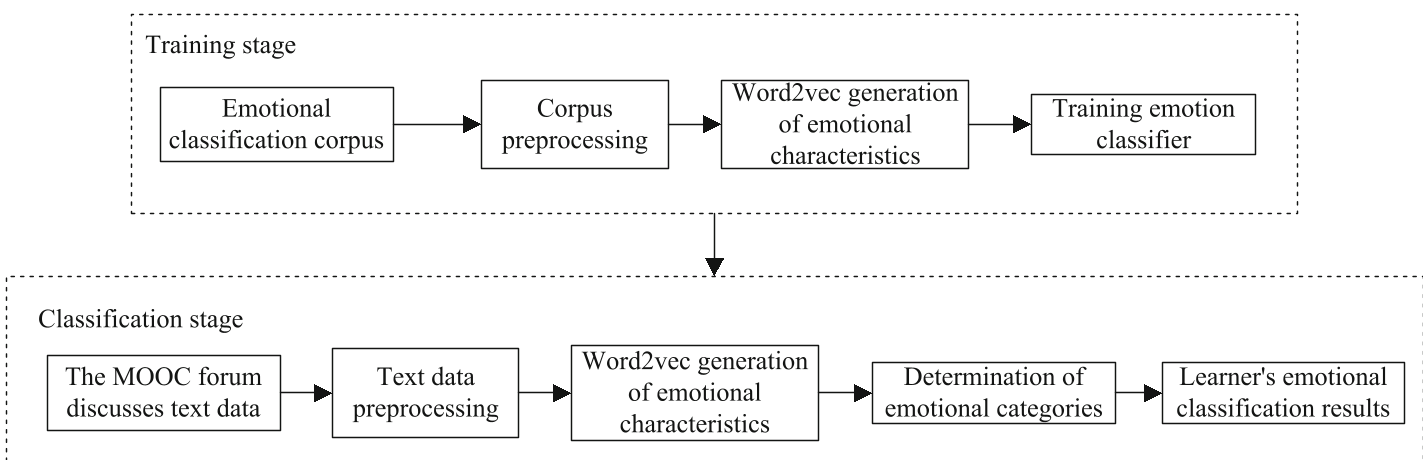 Figure 1: The proposed sentiment classification flow, moving from corpus preprocessing to final emotion judgment.
Experimental Insights
The researchers tested various hyperparameters to optimize performance. A key finding was the trade-off between vector dimensionality (num_features) and window size (context).
- The Sweet Spot: The best performance was achieved using a 300-dimensional vector, a context window of 5, and an SVM classifier.
- Algorithmic Comparison: While Decision Trees showed performance increases with more features, they were consistently outperformed by SVM in terms of AUC (Area Under the Curve).
 Table 1: Example of raw forum data combined with learner metadata before processing.
Results & Emotional Logic
The final model labels interactions as positive (1) or negative (-1). For instance, a student posting "It is too hard for me to learn" would be flagged with a negative sentiment, signaling to the instructor that intervention or cognitive scaffolding might be required.
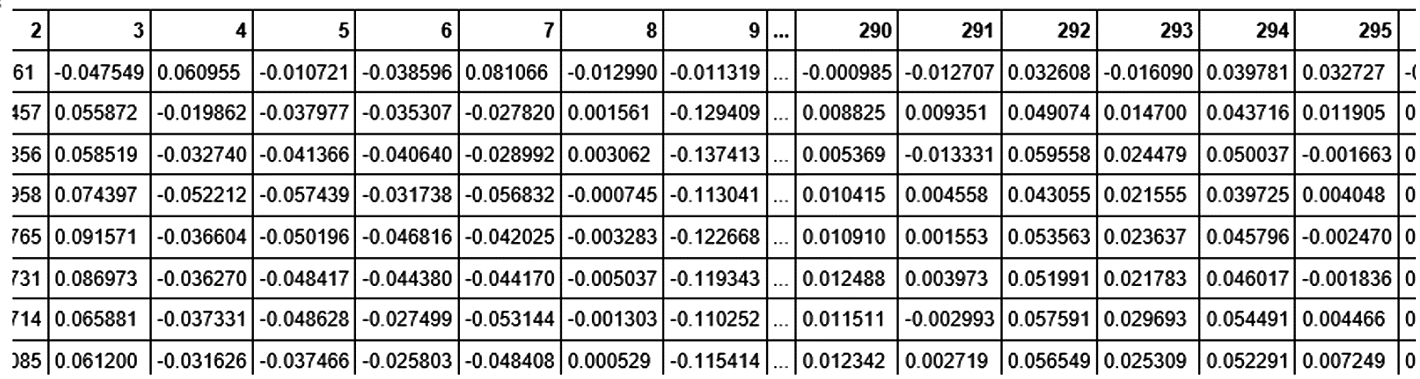 Figure 2: A snapshot of the high-dimensional word vectors generated by the model.
Critical Analysis & Conclusion
While this research provides a solid foundation for automated sentiment monitoring in MOOCs, it is not without limitations:
- Binary Limitations: The current model only classifies emotions as positive or negative. In reality, learner emotions are a spectrum including boredom, confusion, anxiety, and curiosity.
- Domain Adaptation: The model relies on Twitter data for training. While Twitter is rich in sentiment, it lacks the specific academic jargon found in MOOC forums.
Future Outlook: The authors suggest integrating psychological theories to better move from "polarity" (positive/negative) to "complex emotion" detection. As MOOCs evolve, this type of affective computing will be vital for creating truly adaptive and empathetic AI tutors.