
Emotional Attention: Bridging Neuroscience and Autonomous Agents for Human-Like Believability
Emotional Attention in Autonomous Agents: A Biologically Inspired Model
The paper introduces a biologically inspired computational model of emotional attention for autonomous agents, designed to mimic human neural pathways. By integrating emotional saliency with physical stimulus features (ICO and shape), it enables virtual agents like "Alfred" to prioritize and react to emotionally significant environmental cues, achieving more believable and human-like behavior.
TL;DR
Researchers have developed a new computational model that mimics the human brain's ability to prioritize emotionally charged stimuli—like a snake in the grass—over neutral objects. By integrating biological pathways (such as the Tecto-Pulvinar route and the Amygdala), the model allows virtual agents to shift focus and react with appropriate facial expressions, significantly boosting their behavioral realism in AI and VR applications.
Problem & Motivation: The "Divided Mind" of Artificial Intelligence
In the quest to create autonomous agents (AAs) that look and act human, researchers have long implemented Attention (resource allocation) and Emotion (environmental evaluation) as separate silos.
However, neuroscience tells a different story. In humans, these two are inextricably linked. A sudden threat captures our attention "preattentively"—before we even consciously recognize what it is. Current AI models often miss this: they are either too focused on task-specific saliency (like looking for a specific color) or they react emotionally only after a slow cognitive processing cycle. This leads to robotic, "unnatural" behavior, especially in dangerous or socially complex scenarios.
Methodology: Mapping the Brain to the Machine
The proposed model is a structural mirror of human neuro-circuitry. It breaks down the process into three distinct phases: Saliency Calculation, Attentional Deployment, and Emotional Experience.
1. The Dual-Path Saliency
The model processes visual data through two main "lanes":
- The High-Road (Ventral Stream): Precise but slower. It analyzes Intensity, Color, and Orientation (ICO) and complex shapes through the Striate and Extrastriate Cortices.
- The Low-Road (Tecto-Pulvinar Route): Fast and blurry. It sends low-spatial frequency images directly to the Amygdala, allowing for immediate emotional appraisal of potential threats.
2. The Architecture
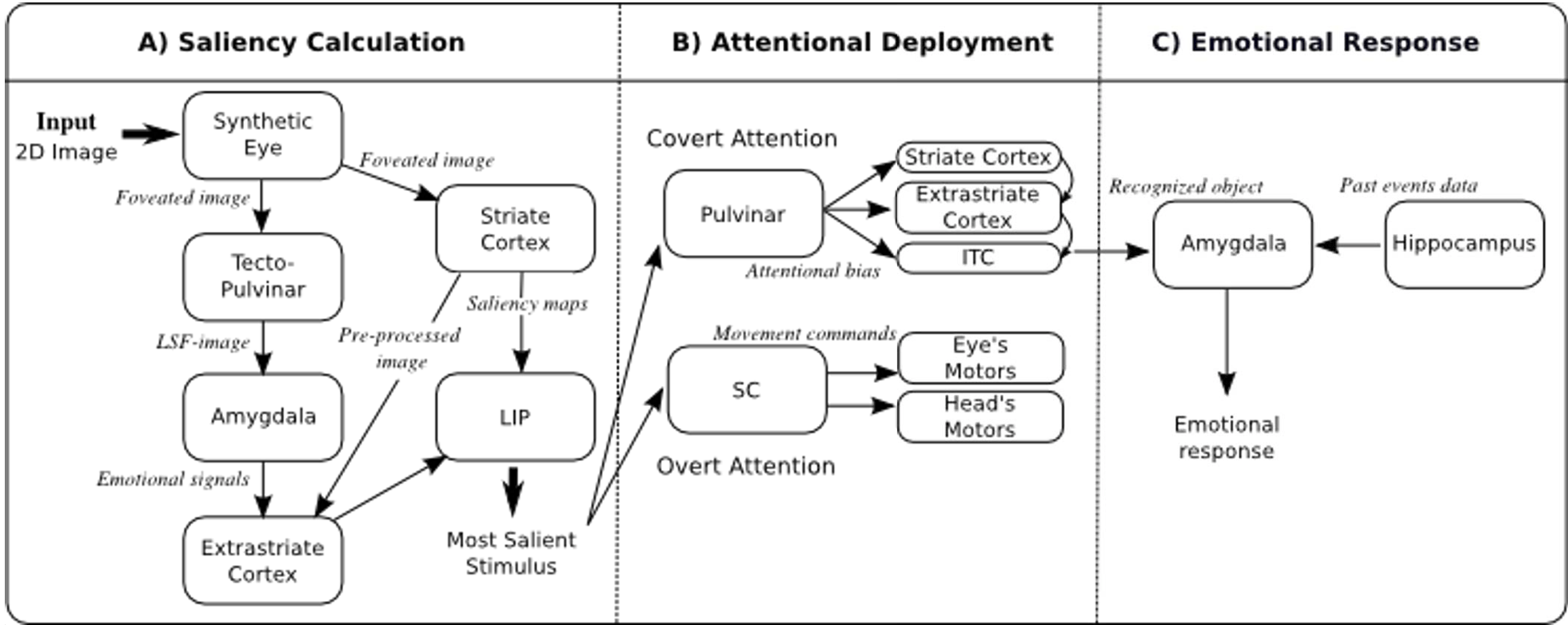 Figure 1: The architecture simulates specific brain regions like the Pulvinar (for information distribution) and the Superior Colliculus (for motor eye movement).
3. Integrated Global Saliency
The final "focus" is determined in the Lateral Intraparietal Area (LIP), which averages:
- ICO-based Saliency
- Shape-based Saliency
- Emotion-based Saliency
If an object (e.g., a spider) has high emotional valence, it receives a higher weight, effectively "hijacking" the agent's attention even if its colors are dull.
Experiments: "Alfred" in the Field
The model was validated using Alfred, a facial animation system capable of generating FACS (Facial Action Coding System) expressions.
Case Study: Snakes, Ropes, and Spiders
The agent was presented with 3x3 arrays of stimuli. The objective was to see if "Alfred" would ignore neutral distractors (like geometric shapes or ropes) in favor of emotionally salient ones (like snakes).
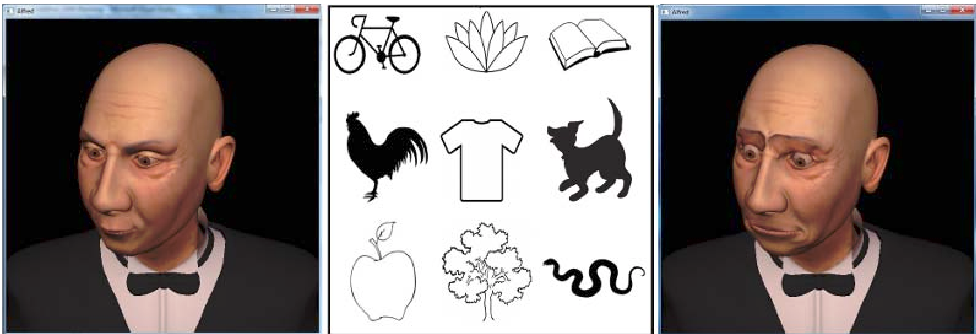 Figure 2: Alfred foveating on a snake and subsequently displaying a fear expression.
Key Results:
- Neutral Environment: In the absence of emotion, the agent followed standard physical saliency (bright colors/unique orientations).
- Emotional Dominance: When a high-valence object was introduced, it captured attention regardless of its position or the brightness of surrounding neutral objects.
- Shape Ambiguity: The agent effectively prioritized objects with "threatening" shapes (like a rope resembling a snake) until closer recognition in the Inferotemporal Cortex (ITC) allowed for a "relief" reaction.
Critical Insight & Conclusion
The true value of this work lies in its Biological Inductive Bias. By forcing the agent's architecture to follow the amygdala-cortical loop, the researchers achieved a "survival-oriented" attention mechanism that is vastly more believability-efficient than purely statistical saliency models.
Limitations & Future Work: While the model excels at 2D visual capture, real-world 3D environments with dynamic occlusion remain a challenge. Furthermore, the "emotional valence" is currently predefined; future iterations could benefit from Learning-based Appraisals, where the agent updates its emotional "Hippocampus" memory based on reinforcement learning.
In conclusion, this model proves that for AI to interact naturally with humans, it doesn't just need to see—it needs to feel what is worth looking at.