
Emotion-Aware Clustering: Decoding the Affective Pulse of Micro-blogs
Emotional Aware Clustering on Micro-blogging Sources
The paper proposes an "Emotional Aware Clustering" framework for Twitter, utilizing an extended emotional dictionary and path-based semantic similarity to group tweets. By mapping posts to eight primary emotions (e.g., joy, anger, sadness), it achieves structured sentiment categorization using K-means clustering.
TL;DR
This research introduces a novel framework for "Emotional Aware Clustering" on Twitter. Unlike traditional methods that merely classify text as "good" or "bad," this approach maps tweets to a multi-dimensional emotional space (8 primary emotions) using a hybrid of path-based semantic similarity and an enriched emotional lexicon. By applying K-means clustering to these profiles, the authors can group users with shared emotional outlooks on specific topics like "Christmas" or "WikiLeaks."
The "Nuance Gap" in Sentiment Analysis
Most sentiment analysis tools treat human emotion as a linear scale from negative to positive. However, human reactions are far more complex. Two tweets might both be "negative," but one expresses Anger while the other expresses Sadness. Existing SOTA methods at the time of this paper often struggled with the brevity and "noise" of micro-blogs, failing to capture these categorical distinctions. The authors argue that to truly understand social trends, we must move from sentiment (polarity) to affect (discrete emotions).
Methodology: The Fusion of Semantics and Sentiment
The core of the "SentiTweetAlgo" lies in how it calculates the relationship between a short tweet and a primary emotion.
1. Semantic Similarity (Sema)
The authors use the Wu-Palmer similarity, which measures the distance between two concepts in a taxonomic hierarchy (like WordNet).
 This formula calculates how closely a word in a tweet relates to the "representative words" of an emotion (e.g., how close "furious" is to the root concept of "Anger").
2. Sentiment Intensity (Senti)
To quantify the "strength" of an emotion, the authors built an Extended Emotional Lexicon. Starting with a seed list from UMBC, they used WordNet synonyms to expand the dictionary to over 28,000 terms, assigning each an intensity score between [-1, 1].
3. The SentiTweetAlgo Framework
The framework follows a clean three-step pipeline: Pre-processing (cleaning noise), Similarity capturing (calculating the weight of 8 emotions), and K-means Clustering.
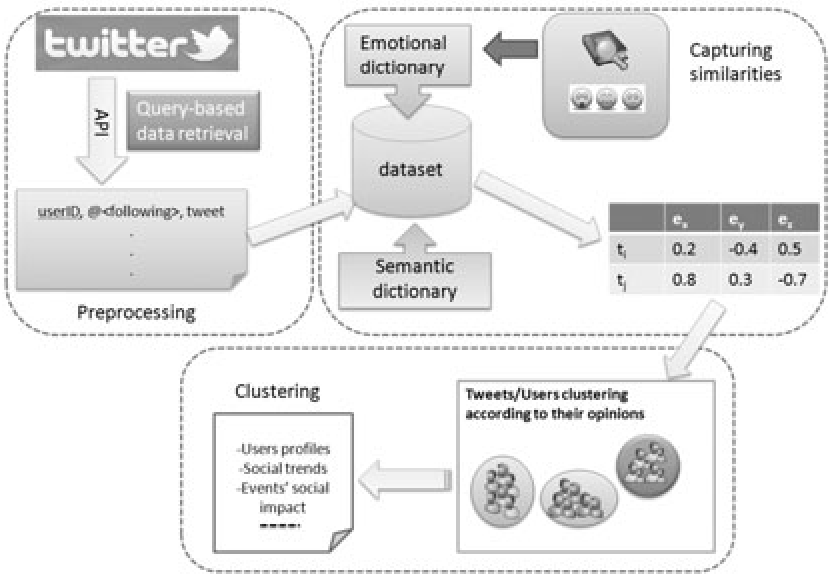
Experimental Insights: The Christmas Case Study
The authors tested their algorithm on 65,166 tweets related to "Christmas." The K-means algorithm (at k=3) successfully split the data into three distinct emotional clusters:
- Positive Cluster: Dominated by words like "great," "love," and "happy."
- Negative Cluster: Focused on words like "distance" and "working," reflecting seasonal loneliness or stress.
- Neutral Cluster: Descriptive tweets without heavy emotional lifting.
 Figure: The distribution of emotional scores across the three identified clusters, showcasing clear separation between positive and negative affect.
Critical Analysis & Professional Perspective
Why this works:
The strength of this paper is the hybrid approach. By using semantic similarity alongside a sentiment lexicon, the model handles synonyms and related concepts much better than a simple "bag-of-words" approach. It acknowledges that "joy" and "happy" are semantically linked even if the words themselves are different.
Limitations:
- Contextual Blindness: While path-based similarity is strong for synonyms, it often fails at sarcasm—a major component of Twitter discourse.
- Taxonomy Dependence: The system relies heavily on WordNet. If a word isn't in the hierarchy or is used in a slang context (e.g., "that's sick" meaning "that's great"), the semantic calculation may fail.
Conclusion
This work marks a shift toward Affecive Computing in social media analytics. By moving from 1D sentiment to an 8D emotional vector space, it provides a blueprint for brands and political analysts to understand why the public is reacting, not just that they are reacting. Future iterations utilizing Transformer-based embeddings (like BERT or RoBERTa) would likely enhance these results by capturing the context-dependent nature of these emotional words.