
Emotional Behavior Trees: Infusing Game AI with Psychological Realism
Emotional behavior trees
The paper introduces Emotional Behavior Trees (EmoBT), an extension to standard Behavior Trees (BT) that incorporates affective states into NPC decision-making. By proposing a new Emotional Selector, the authors move beyond static priority-based actions to dynamic selection influenced by risk perception, time-discounting, and planning effort.
TL;DR
Standard game AI is often "too rational" or predictably static. Emotional Behavior Trees (EmoBT) break this mold by introducing an Emotional Selector node. This mechanism uses real-time affective states (like fear, fatigue, or sadness) to dynamically calculate the desirability of actions based on their perceived risk, execution time, and mental "planning" cost.
Academic Context: This work bridges the gap between traditional hierarchical control (Behavior Trees) and Affective Computing, moving away from simple "if-then" emotional checks toward a holistic, math-driven selection process.
Problem & Motivation: The Predictability Trap
In modern game development, NPCs (Non-Player Characters) typically rely on Behavior Trees (BT) to choose their next move. While BTs are modular and scalable, they are inherently deterministic. If an NPC is programmed to "Attack" when a player is in range, it will always do so, regardless of whether it should feel "courageous" or "terrified."
The authors argue that simply adding "Condition Nodes" to check for emotions creates "cumbersome, large behavior trees" that are a nightmare to manage. Instead, they look to neurobiology (Damasio) and psychology (Loewenstein) to understand how emotions process information rather than just serving as triggers.
Methodology: The Core Mechanics
The breakthrough of EmoBT lies in treating emotions as weights that alter the perception of three critical decision factors:
1. The Three Pillars of Emotional Choice
- Planning Effort (): Does the action require complex, multi-step thinking? (e.g., a 10-step sequence vs. a 1-step grenade toss).
- Risk Assessment (): What is the probability of a negative outcome?
- Time Interval (): How long will this take? Humans discount the value of rewards that take longer to achieve.
2. The Emotional Selector
Unlike a standard Priority Selector that always checks children from left to right, the Emotional Selector performs a real-time calculation:
- Fear increases the weight of , making high-risk actions less desirable.
- Sadness affects Time-Discounting, making quick rewards (short ) more attractive.
- Fatigue increases the penalty for high-planning sequences.
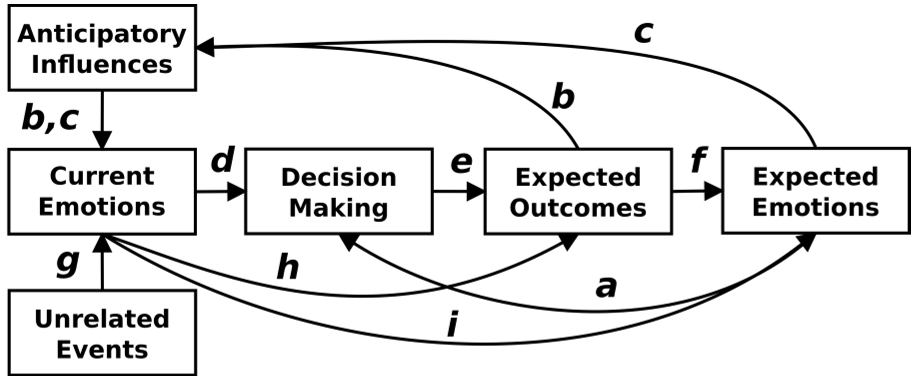 Fig 1: The Loewenstein and Lerner model illustrating how current emotions affect risk perception and information processing.
Experiments: The NPC Fighter
To validate the model, the authors designed a combat scenario where an NPC chooses between:
- Fancy Maneuver: High planning, low risk, moderate time.
- Grenade: Low planning, high risk, fast execution.
- Musket: Moderate planning, low risk, very slow execution.
- Sword: Low planning, high risk, fast execution.
Key Observations:
- Under Fear: The NPC consistently favored the Fancy Maneuver because its total risk (0.1) was significantly lower than the Sword or Grenade.
- Under Sadness: The NPC shifted to the Grenade, prioritizing the speed of the result over the high personal risk involved.
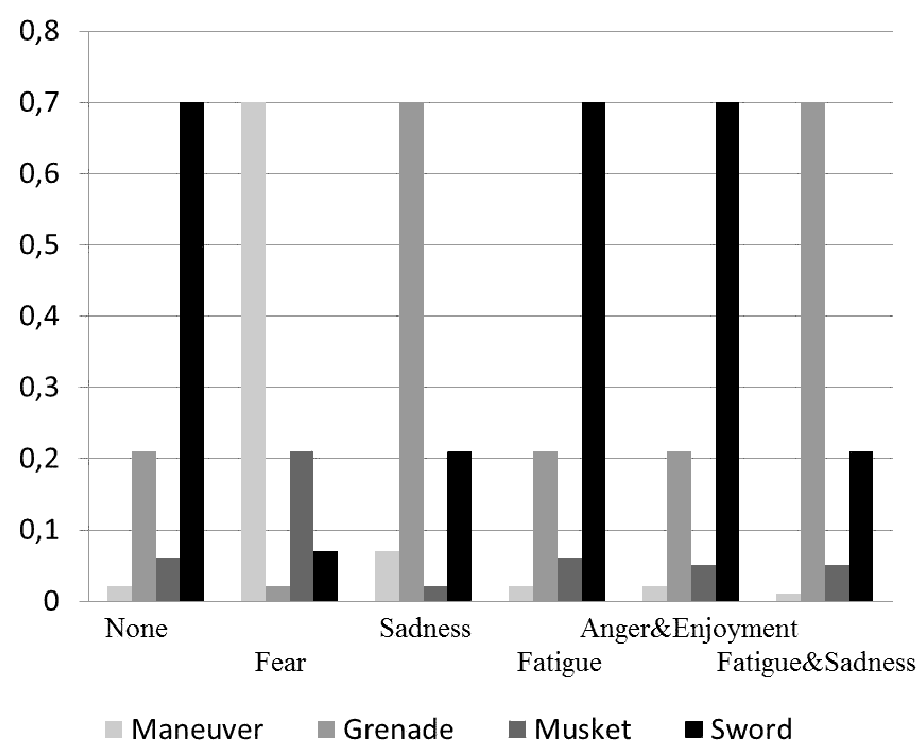 Fig 2: Probability distribution showing how the same NPC switches its primary strategy based on shifted emotional states.
Critical Analysis & Conclusion
Takeaway
EmoBT provides a robust framework for "Dynamic Personality" in games. By tweaking the emotional weights (), a designer can create a "reckless" NPC or a "cowardly" NPC using the exact same behavior tree structure.
Limitations
- Formula Intuition: The authors admit the formulas are "intuitive" rather than strictly derived from biological data, as psychological research lacks the precision needed for fine-tuned algorithmic constants.
- Displaying Emotion: The AI is smarter, but if the NPC doesn't look sad or afraid through animations, the player might just perceive the behavior as "random" rather than "emotional."
Future Work
The next frontier for EmoBT is the integration of Visual Feedback Loops—ensuring the character's physical state (posture, facial expressions) matches the internal emotional weights driving the Behavior Tree.