
Digital Hearts and Social Maps: How Facebook’s Architecture Shapes Our Emotions
Emotional disclosure on social networking sites: The role of network structure and psychological needs
This research investigates how Facebook's social network structure (size and density) influences emotional disclosure through three empirical studies. The study reveals that network density drives disclosure via the need for emotional expression, while network size influences positive disclosure through impression management motives.
TL;DR
Why do some people overshare their life's ups and downs on Facebook while others only post a polished highlight reel? This research proves that your network structure is the architect of your digital personality. High network density (interconnected friends) triggers a need for deep emotional expression, while a large network size triggers the "PR agent" within us, driving impression management and positive-only sharing.
The "Why" Behind the Post
We often think of self-disclosure as a personality trait—some people are just "open books." However, this study argues that the contextual properties of our social circles are powerful silent influencers. The authors sought to resolve a conflict in prior data: does a bigger audience make us share more or less? The answer lies in distinguishing between the number of friends (Size) and how many of those friends know each other (Density).
Methodology: From Diaries to Data Mining
The researchers employed a rigorous three-step validation:
- Context Comparison: They compared 100+ Facebook status updates against private diaries using LIWC (Linguistic Inquiry and Word Count).
- Structural Analysis: Using UCINET 6, they calculated the "Ego-network" metrics of participants, mapping exactly how interconnected their social circles were.
- Mediation Modeling: They used path analysis to see if psychological needs (Expression vs. Impression) acted as the bridge between the network map and the actual words posted.
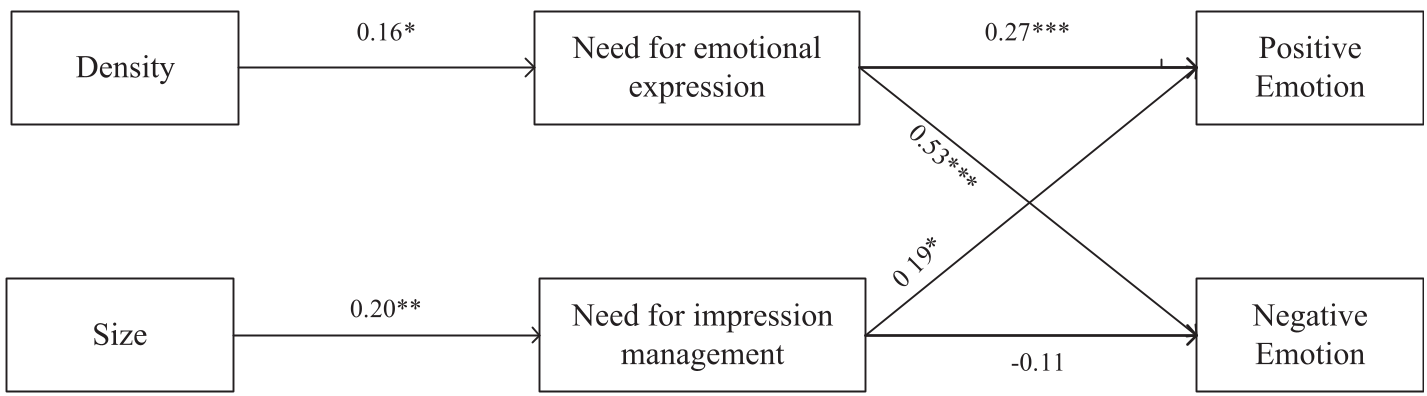 Figure: The final model showing how Density leads to Expression and Size leads to Impression Management.
The Core Insight: Two Paths to Disclosure
1. The "Bonding" Effect of Density
When your friends all know each other (a dense network), the environment feels like a "socially coherent community." This creates high levels of trust and Bonding Social Capital.
- The Result: A higher "Need for Emotional Expression."
- The Content: Users feel safe sharing both positive and negative emotions. This is "authentic" sharing aimed at maintaining intimacy.
2. The "Broadcasting" Effect of Size
When your network is huge, it inevitably includes "weak ties" and distant acquaintances. This triggers a "lowest common denominator" approach to communication.
- The Result: A higher "Need for Impression Management."
- The Content: Users selectively disclose positive emotions to appear successful and well-adjusted, while suppressing negative ones that might harm their social image.
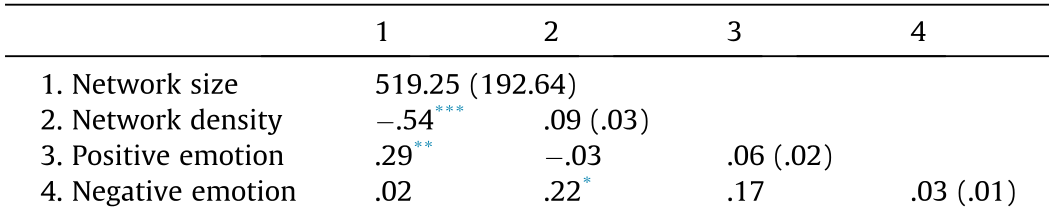 Table 1: Note the strong negative correlation (-.54) between Size and Density, highlighting the trade-off between reach and intimacy.
Critical Analysis & Conclusion
This study offers a profound takeaway for the "Social Media Well-being" debate. If we only see the "capitalized" positive emotions of users with large networks, it can lead to social comparison and decreased life satisfaction for observers.
Limitations: The study was conducted on Facebook during an era of "anchored relationships." Modern platforms like TikTok (algorithmic discovery) or Snapchat (ephemerality) might alter these dynamics. On TikTok, for instance, a user might have a massive "Size" but zero "Density," leading to a strange hybrid of performative vulnerability.
The Takeaway for Product Designers: Don't treat all users the same. Users in "Small/Dense" groups need tools for support and empathy, while those in "Large/Sparse" networks need better tools for audience segmentation (like "Close Friends" lists) to mitigate the paralyzing pressure of impression management.