
Toward Emotional E-Commerce: Bridging the Gap Between Logic and Feeling in Automated Negotiation
Toward Emotional E-Commerce: Formalizing Agents for a Simple Negotiation Protocol
This paper introduces an emotional e-commerce framework that formalizes Customer, Supplier, and Community agents using a Multi-Agent System (MAS). By integrating Russell's circumplex model of affect and a simple negotiation protocol, it enables automated bargaining that accounts for human-like emotional-rational conflicts.
TL;DR
Researchers have developed a multi-agent system that formalizes the "gut feeling" in e-commerce. By combining Multi-Context Systems with Russell’s Circumplex Model of Emotion, this framework allows software agents to negotiate not just on price, but on emotional value, using community sentiment to weight decisions.
Positioning: This work is a theoretical-to-practical bridge, moving from abstract affective computing theories into a formal multi-agent logic applicable to automated B2C retail.
Problem & Motivation: The "Cold" Machine Problem
Why do we still prefer haggling in person or reading hundreds of reviews before buying? Because traditional e-commerce is hyper-rational. Most bots operate on "If Price < X, then Buy." However, human decision-making is heavily influenced by "incidental emotions"—states triggered by events unrelated to the transaction.
The authors argue that for agents to truly represent humans, they must deal with the emotional-rational conflict. For example, a vacation package might be rational (cheap) but emotionally unappealing (boring location). Current SOTA recommendation engines like Amazon’s are purely historical; they lack the ability to "feel" the context of a live negotiation.
Methodology: The Affective Engine
The core of the paper lies in the formalization of three distinct agents using the Multi-Context approach by Parsons and Sabater.
1. Russell's Circumplex Model
Instead of discrete emotions (Happy, Sad), the system uses a 2D space:
- Valence: Pleasant vs. Unpleasant.
- Excitation: Aroused vs. Relaxed.
2. Multi-Context Framework
The Customer agent is broken down into specific functional units:
- Goal Manager (GM): Orchestrates tasks.
- Inference Engine (IE): The "brain" that calculates costs based on emotional references.
- Social Manager (SM): The gateway for external communication.
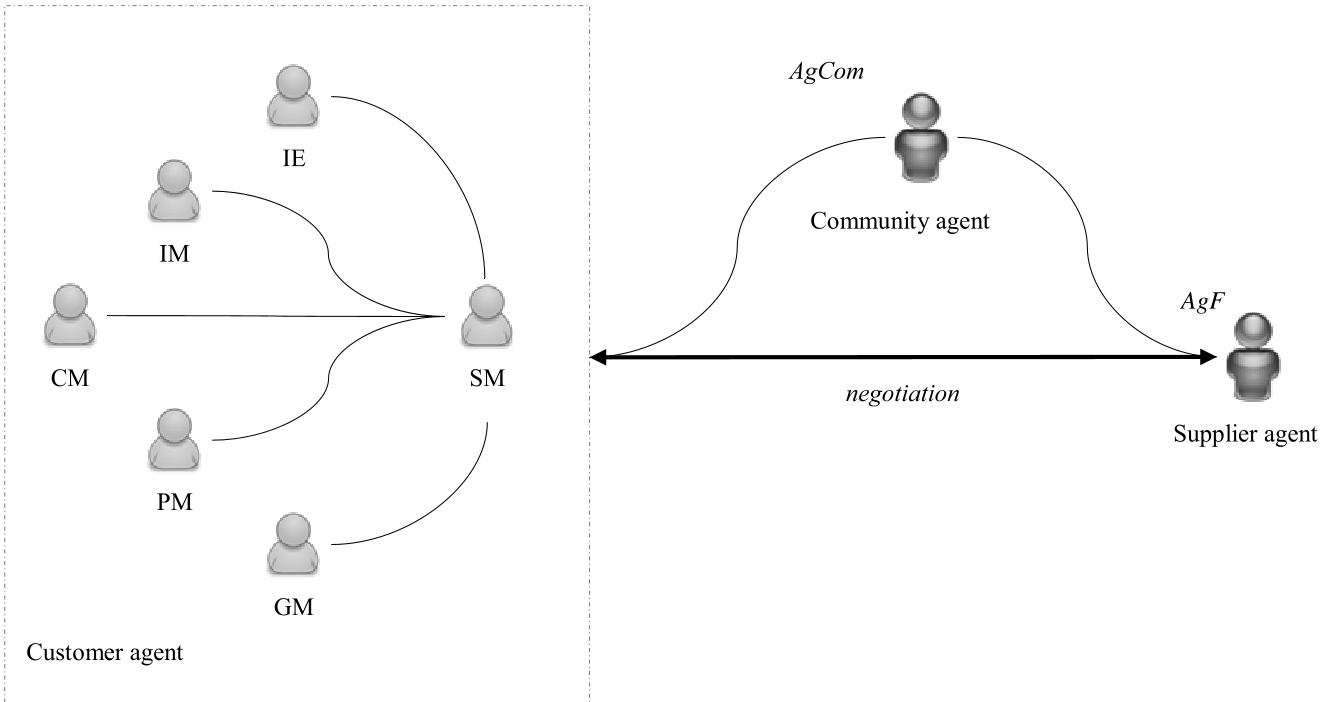 Figure: The internal architecture of the Customer Agent showing context units and bridge rules.
3. The Negotiation Logic
Negotiation isn't just a back-and-forth; it's a search for the "minimal cost" in the emotional space. The agent selects configurations by calculating a cost per emotional segment using a fuzzy inference system.
Experiments: Proof of Concept
The authors tested the protocol using a "Sea Trip" scenario (Price vs. Days vs. Distance).
- Configuration A: [$1000, 9 days, 10 min] → Cost: 1.33
- Configuration B: [$1000, 7 days, 6 min] → Cost: 1.36
The system chose Configuration A. While B is faster to the beach, the "emotional weight" of the extra 2 days (as categorized in the circumplex model) provided better value.
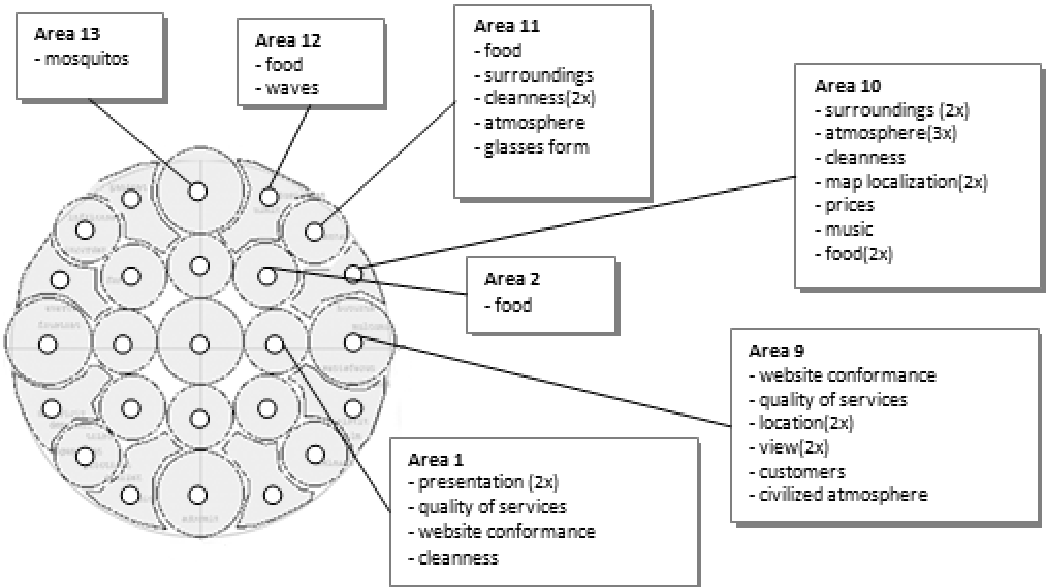 Figure: Emotional knowledge acquired from the community. Instead of text reviews, users place "emotional references" on a quadrant.
Critical Analysis & Conclusion
Strategic Takeaway
The shift from "Textual Reviews" to "Emotional Coordinates" is the paper's most radical suggestion. By aggregating these coordinates, the Community Agent provides a real-time "emotional weight" to product features, allowing the Customer Agent to "consult" the atmosphere of a deal before committing.
Limitations
- Simplicity: The negotiation protocol is currently rudimentary (Proof of Concept). Real-world negotiations involve complex counter-offers and multi-party incentives.
- Subjectivity: Mapping "10 mins to beach" to a specific coordinate on the circumplex model remains highly subjective and requires extensive prior data.
Future Outlook
The authors plan to integrate an argumentation framework. Imagine an agent that doesn't just say "No" to a price, but explains, "This price feels 'unpleasant' given the 'boring' community feedback on your service quality." This moves us toward a truly "Social Commerce" where AI mimics the subtleties of human nature.