
Collective Brainpower: Boosting Emotional Face Retrieval via Collaborative P300 Signals
Emotional Face Retrieval with P300 Signals of Multiple Subjects
The paper introduces a collaborative Brain-Machine Interface (BMI) for emotional face retrieval using P300 Event-Related Potentials. By averaging single-shot EEG signals across 12 subjects simultaneously, the method achieves a significantly improved F-measure of 0.832 compared to individual performance.
TL;DR
Researchers have developed a way to "merge" the brain signals of multiple people to perform high-speed image searches. By synchronizing 12 subjects to look for specific emotional facial expressions, the system achieved an 83.2% success rate in identifying targets from single-shot brain waves—a task where individual performance often falters due to noise.
Background and Motivation
The P300 signal is a specific brain response that occurs roughly 300ms after you see something you're looking for (a "rare target"). While used widely in "P300 Spellers" for communication, using it for rapid image retrieval has been limited by a fundamental bottleneck: SNR (Signal-to-Noise Ratio).
In a single person, brain noise is loud. To get a clear P300 signal, the subject usually has to look at the same image multiple times so the computer can average the results. This makes "real-time" searching near impossible. The authors of this paper ask: What if we average the signals across different people at the same time instead of one person over a long time?
Methodology: The Collaborative Approach
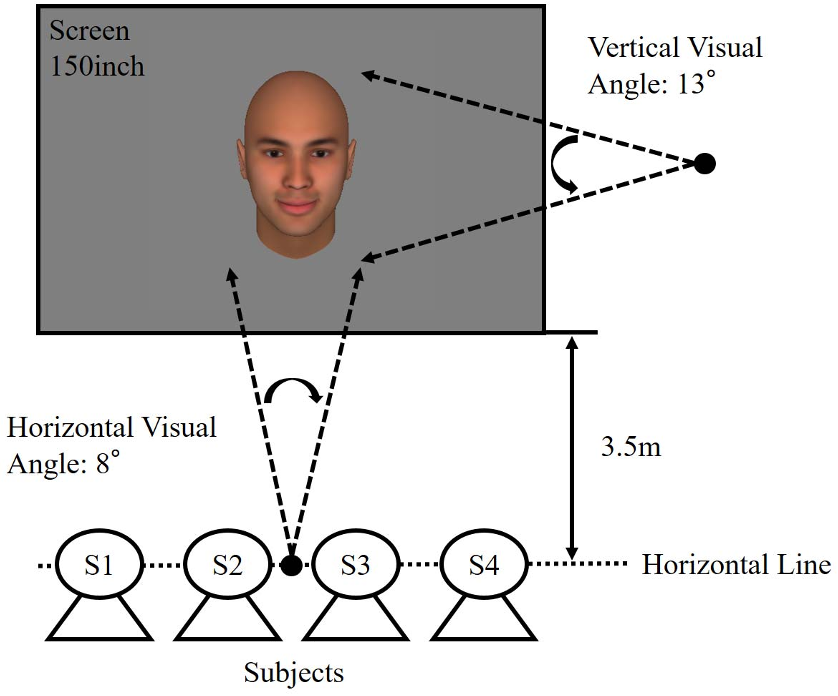
The study involved 12 subjects viewing a 150-inch screen displaying various facial expressions (angry, fearful, neutral, and smiling). Their task was to focus only on the smile.
The Pipeline
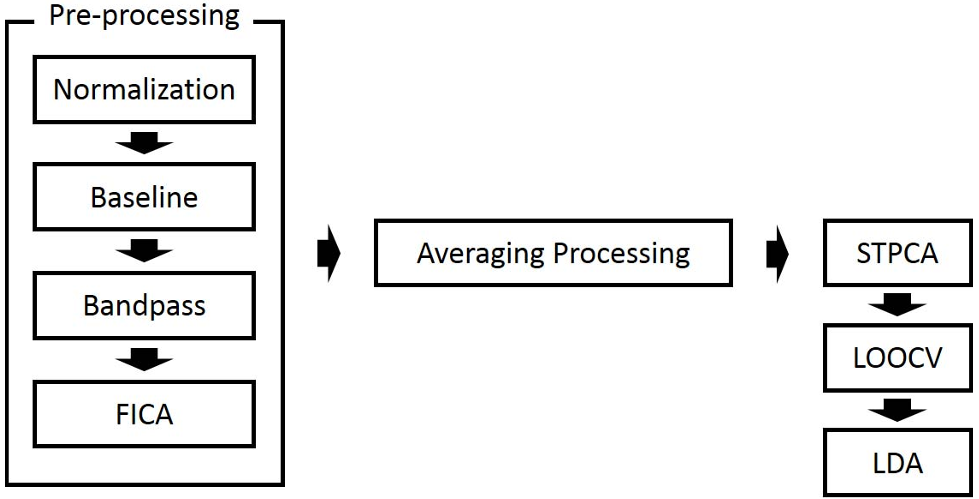
- Normalization & Filtering: Standardizing EEG signals across subjects and removing eye-blink artifacts using Independent Component Analysis (ICA).
- STPCA (Spatial and Temporal PCA): This is the "secret sauce." Instead of looking at every electrode and every millisecond, STPCA identifies the specific "virtual electrodes" and "time points" that provide the most discriminative information for the P300.
- Collaborative Averaging: Rather than waiting for one subject to view an image five times, the system takes the single-shot response from all 12 people viewing the image once and averages them.
Results and Performance
The contrast between individual and group performance was stark. In the single-subject condition, the F-measure (a balance of precision and recall) hovered at a mediocre 0.618. When the "Collaborative Brain" took over, this jumped to 0.832.
Data showed that the P300 waveform was much more distinct in the collaborative condition. The two-tailed t-test confirmed a highly significant difference in ERP amplitude between target and standard stimuli in the multi-subject group (p-value of ).
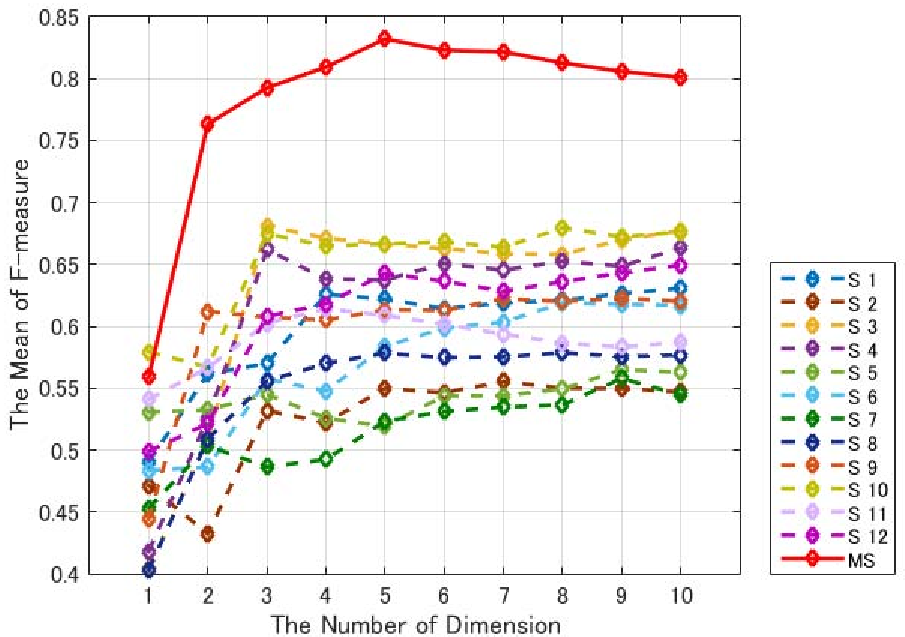
The chart above illustrates that as the dimensionality of the features (STPCA dimensions) increases, the group performance (MS) remains consistently superior to any individual subject (S1-S12).
Critical Insight & Future Outlook
This paper proves that Collaborative BMI is a viable path for high-throughput tasks like searching through "life logs" or big data archives. The core insight is that while individual internal states vary (distractions, fatigue), the P300 response to a shared goal (finding a smile) is consistent enough to be aggregated.
Limitations & Challenges:
- Synchronization: For this to work, everyone must be thinking about the same thing at the same time. If one subject "zones out," the average signal degrades.
- Portability: The study used high-end, stationary EEG amplifiers. For real-world use in Computer-Supported Cooperative Work (CSCW), we will need wearable EEG devices that maintain signal quality.
Future Directions: The authors suggest moving beyond just "attention" (P300) to "emotion/preference" (Late Positive Potentials or LPP). This could unlock "Neuromarketing" applications where groups of consumers provide instant, collective feedback on products without saying a word.
Takeaway: The future of BMI isn't just one brain talking to a computer—it's a network of brains working in symphony to solve complex retrieval problems.