
Decoding Visual Prosody: Predicting Emotional Head Motion from Speech
Emotional head motion predicting from prosodic and linguistic features
This paper introduces an emotional head motion prediction model using prosodic and linguistic features to enhance Human-Computer Interaction (HCI). It utilizes a two-layer clustering scheme (K-means and Hierarchical) and Classification and Regression Trees (CART) to map speech features to emotional head gestures, achieving superior realism in talking-head animations.
TL;DR
Researchers have developed a bimodal mapping system that predicts emotional head gestures from prosodic and linguistic speech features. By combining a two-layer clustering algorithm with Classification and Regression Trees (CART), the study identifies that linguistic features like Part-of-Speech (POS) and Prosodic Word Length (LW) are the primary drivers of head movement in long utterances, significantly improving the realism of digital avatars.
The "Uncanny Valley" of Head Motion
In human-to-human communication, head gestures are not random; they are tightly coupled with the rhythm and emotion of speech. However, most virtual agents suffer from the "stiff neck" syndrome—their head movements are either too robotic (predefined) or too chaotic (random). The core challenge lies in determining the Inductive Bias: which parts of a sentence actually trigger a nod, a tilt, or a shake?
Methodology: The Two-Layer Intelligence
To solve this, the authors moved beyond simple linear mapping. They treated head motion as a series of "rigid gestures" defined by Euler angles and derivatives.
1. Two-Layer Clustering
The system first uses K-means to group raw motion data and then applies Hierarchical Clustering with a dynamic distance histogram to merge these into reliable "Elementary Gesture Patterns." This avoids the noise typical in raw motion capture data.
2. The CART Mapping
By using a Decision Tree (CART) model, the researchers didn't just build a "black box" predictor; they built an interpretable map. The tree structure naturally places the most influential features at the root.
 Figure 1: The overall architecture of the speech-to-head-gesture mapping system.
Key Insights: What Drives the Head?
The study’s most significant contribution is the statistical mapping of feature importance.
- Long Utterances: The Length of Prosodic Word (LW) is the undisputed king. In long sentences, head gestures change systematically from the start to the end, reflecting a "fixed model" of emotional expression.
- Emotional Nuance: In negative states like Fear and Sadness, Stress (S) points and Boundary Types (B) (pauses) become far more influential than they are in neutral or happy speech.
- The Chinese Context: Tone (T) and POS play critical roles, proving that linguistic structure is just as important as acoustic pitch for visual prosody.
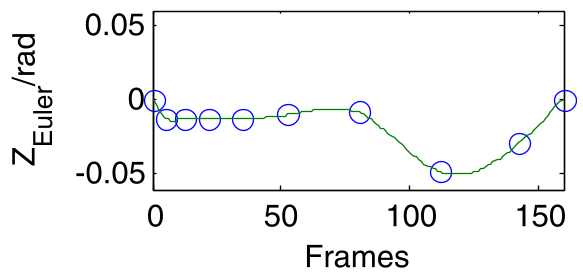 Figure 2: Synthesized translation and rotation curves for the sentence "The scenery is very beautiful" in a happiness state.
Experimental Results & Validation
The model was validated using a high-fidelity dataset of 489 sentences across six emotional states (Anger, Fear, Happiness, Sadness, Surprise, and Neutral).
- Accuracy: The system achieved a prediction accuracy of 71.2% for Fear and 70.8% for Surprise, significantly outperforming baseline neutral models.
- Subjective Realism: Mean Opinion Scores (MOS) peaked at 3.8/5.0, with users noting that the model successfully eliminated "dithering" (the shaky motion common in low-order models) and "stiffness" (common in rule-based systems).
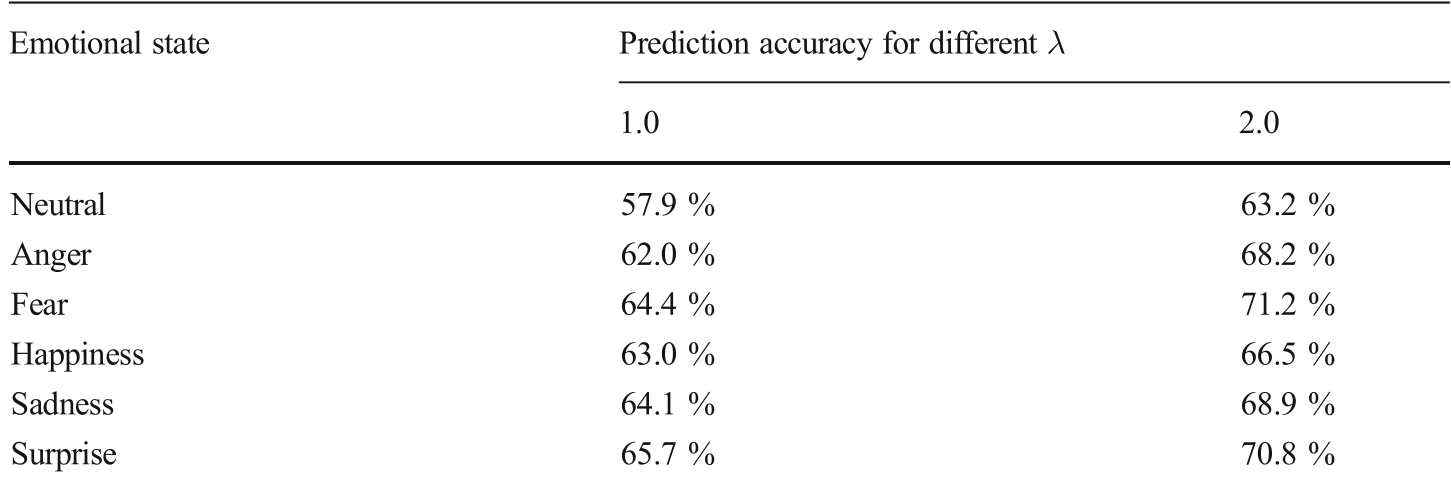 Figure 3: Prediction accuracy across different emotional states and clustering thresholds.
Critical Analysis & Future Directions
While highly effective, the model relies on a single actress's performance, meaning it inherits her specific "personality" or "style." Future research must incorporate multi-speaker datasets to generalize these head-motion "dialects." Furthermore, moving from CART to Deep Learning architectures (like LSTMs or Transformers) could capture even more complex temporal dependencies in speech.
Takeaway for the Industry: If you are building a digital human, don't just focus on the mouth. The key to "life" lies in the linguistic structure of the sentence—watch the part-of-speech tags if you want the head to move naturally.