
The Face of Frustration: Decoding Video Quality via Facial Expression Recognition
Emotional Impact of Video Quality: Self-Assessment and Facial Expression Recognition
This paper investigates the correlation between video quality degradations and human emotional responses using a dual-modality approach: Self-Assessment Manikin (SAM) and Facial Expression Recognition (FER). It proposes an automatic Video Quality of Experience (VQoE) prediction system using SVM and action unit (AU) features, achieving a significant accuracy of 84.6% for binary quality classification.
TL;DR
Researchers have successfully developed a non-intrusive system that predicts video quality by "reading" the viewer's face. By analyzing spontaneous facial muscle movements (Action Units) and handling data imbalance with synthetic sampling, the system achieves over 84% accuracy in distinguishing high vs. low quality without asking a single question.
Context: Why Subjective Feedback is Failing
In the world of multimedia services, Quality of Experience (QoE) is the ultimate metric. However, gathering this data is traditionally a headache. Standard subjective tests are slow, and in real life, users don't want to fill out surveys while watching Netflix. While sensors like EEG provide deep insights, no one wants to wear a specialized cap just to stream a video. This paper positions itself as a bridge—using standard webcams to capture behavioral "tells" that signal a drop in quality.
The "Goal-Hinderance" Insight
The authors' core intuition is that a blurry video isn't just a technical failure; it's an emotional trigger, specifically when it prevents us from completing a task. By using basketball clips where participants had to judge if a shot was made, the study found that blurring was most damaging when it occurred during the "critical event."
Interestingly, blurring half the video led to a quality drop almost as massive as blurring the whole video. This suggests our internal QoE score is heavily weighted by "pragmatic quality"—if I can't see the result of the shot, the video is "bad," regardless of how clear the first 10 seconds were.
Methodology: From Pixels to Emotions
The architecture of this study transitions from objective video degradation to subjective emotional reporting, and finally to automated machine learning.
1. Controlled Degradation
The researchers manipulated visual quality using Gaussian filters across three levels (5x5 to 15x15 masks) and two lengths (half vs. whole video).
2. Facial Feature Extraction
Using the OpenFace 2.0 toolkit, the team extracted 18 Action Units (AUs)—the building blocks of facial expressions—alongside gaze direction variance to monitor attentional focus.
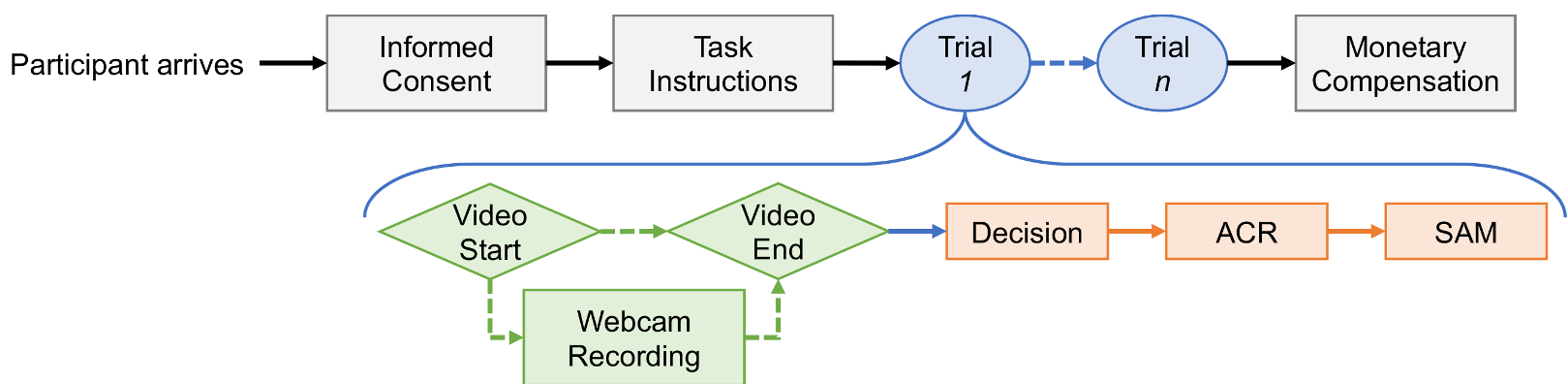 The automated pipeline: Video playback leads to facial recording, which is then processed into VQoE predictions.
Overcoming the "Boring" Data Problem
A major technical hurdle in VQoE research is that most users rate videos as "Bad" or "Poor" once they see blur, leading to an imbalanced dataset (very few "Good" or "Excellent" samples in a degraded study). The authors employed ADASYN (Adaptive Synthetic Sampling) to create synthetic data for the minority classes, ensuring the SVM (Support Vector Machine) classifier didn't become biased towards negative ratings.
Performance & Results
The results confirm a strong correlation between facial micro-expressions and perceived quality. The SVM model notably outperformed previous studies (like [11]) across all metrics.
- 5-Class ACR: 64.5% Accuracy (significant for a 5-way split).
- Binary Quality (High vs. Low): 84.6% Accuracy.
- Sensitivity: Reached 0.94 for the "Excellent" category, meaning the model is nearly perfect at spotting when a user is truly satisfied with the visual feed.
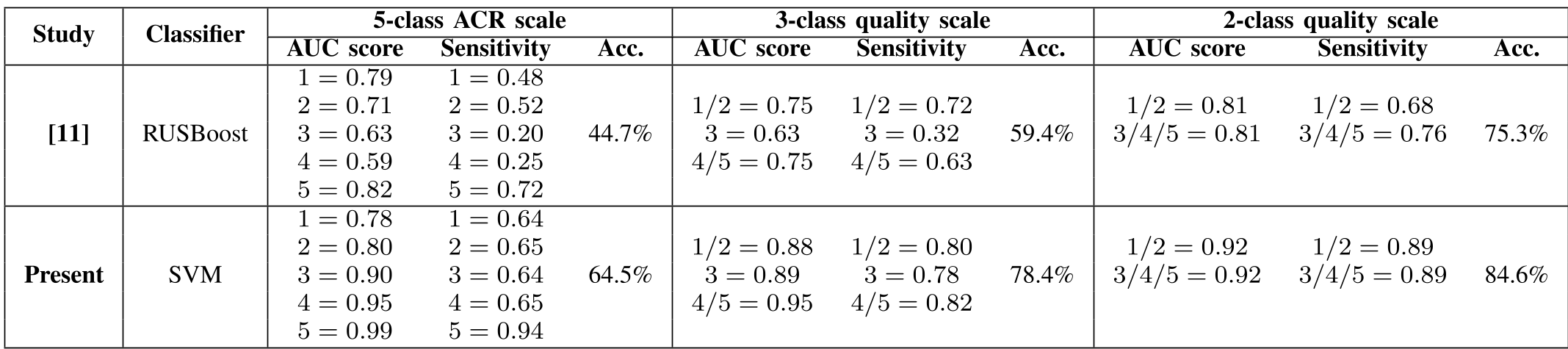 The jump in performance from previous work (RUSBoost) to the current SVM approach is evident in AUC scores.
Critical Analysis: Is Your Webcam the Future IRM?
The study demonstrates that our faces "leak" information about the quality of the service we are using. However, there are limitations:
- Task Dependency: The negative emotions were amplified because users had a monetary incentive to see clearly (a 10-cent bonus for correct decisions). Would a passive viewer react as strongly?
- Privacy: While the method is "concealed," it raises significant ethical questions regarding persistent facial monitoring by service providers.
Future Outlook
This work paves the way for "Emotional QoS." Imagine a YouTube algorithm that detects a faint micro-expression of annoyance and automatically switches to a more robust codec or lowers latency before you even consciously notice the lag. By shifting from explicit reports to implicit facial cues, we are moving toward a more empathic digital infrastructure.