
To Stay or Leave? Decoding the "Relational Glue" of Online Health Support Groups
To Stay or Leave? The Relationship of Emotional and Informational Support to Commitment in Online Health Support Groups
This study investigates member retention in online health support groups by analyzing the relationship between social support types and member commitment. Using machine learning to classify 1.5 million messages from a breast cancer forum, the authors achieved a SOTA correlation (r > 0.76) with human judgment and applied survival analysis to predict dropout risks.
TL;DR
Why do some members become stalwarts of online communities while others vanish after a few posts? This seminal piece from CSCW '12 utilizes machine learning to analyze 1.5 million messages from Breastcancer.org. The findings are counter-intuitive: while emotional support act as a powerful anchor for long-term commitment, informational support—the very reason many join—actually correlates with a higher likelihood of leaving.
Context & Motivation: The Retention Paradox
Online health support groups are vital resources for patients, yet they face a revolving-door problem. Most participants "lurk" or drop out before contributing back to the ecosystem. The researchers, hailing from CMU and the University of Pittsburgh, sought to understand the rewards that drive commitment.
They hypothesized that commitment is a result of an "evaluation process" where members weigh past rewards against future expectations. However, not all rewards are created equal. Is a "cyber-hug" (emotional) more valuable for retention than a detailed explanation of chemotherapy side effects (informational)?
Methodology: High-Stakes Text Mining
To analyze a massive corpus of 1.5 million messages without years of manual labor, the team pioneered a multi-tiered ML approach:
- Ground Truth: Using Amazon Mechanical Turk to rate 1,000 messages on 7-point scales for both support types.
- Feature Engineering:
- LIWC: Tracking psychological cues (e.g., "we" vs. "it").
- Structural Cues: Detecting advice patterns (e.g.,
<if+you>) and questions. - LDA (Latent Dirichlet Allocation): Creating 20 specialized "cancer dictionaries" (e.g., Lymphedema, Hair loss, Spiritual).
- Survival Analysis: Employing Weibull survival models to predict the time-to-event (dropout) based on support exposure.
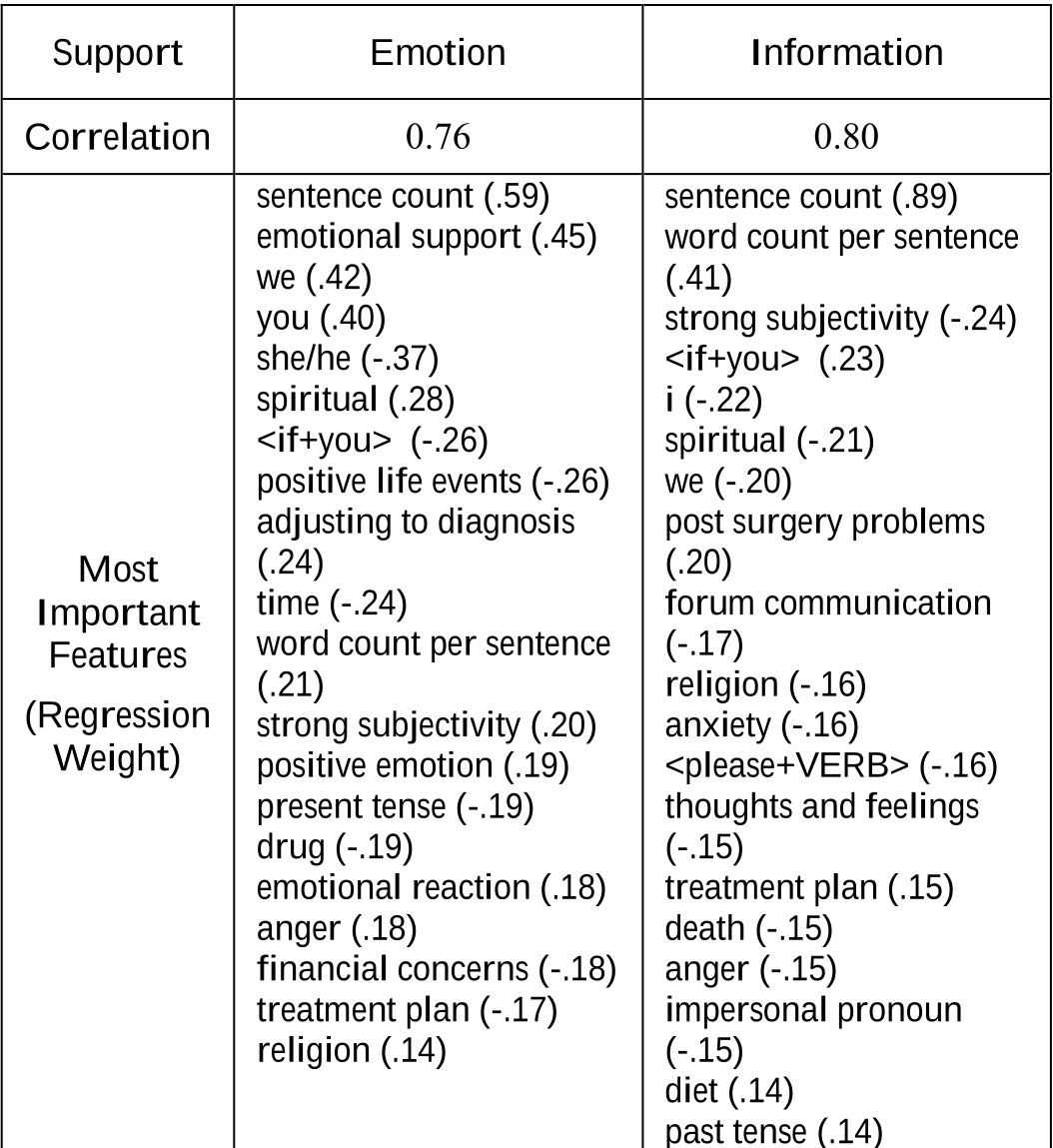 The table above highlights that "Sentence Count" and "Subjectivity" are key predictors for both types of support, but "Spiritual" and "Emotional Reaction" topics are unique drivers for emotional scoring.
Key Results: Hugs vs. Facts
The survival analysis revealed a stark dichotomy between the two support types:
- Emotional Support = The Anchor: For every standard deviation increase in emotional support received, the risk of dropping out decreased significantly.
- Informational Support = The Exit Sign: Surprisingly, those who received more informational support were more likely to leave.
The Interaction Effect
The most profound insight came from Model 3, which looked at the interaction between message volume and support type.
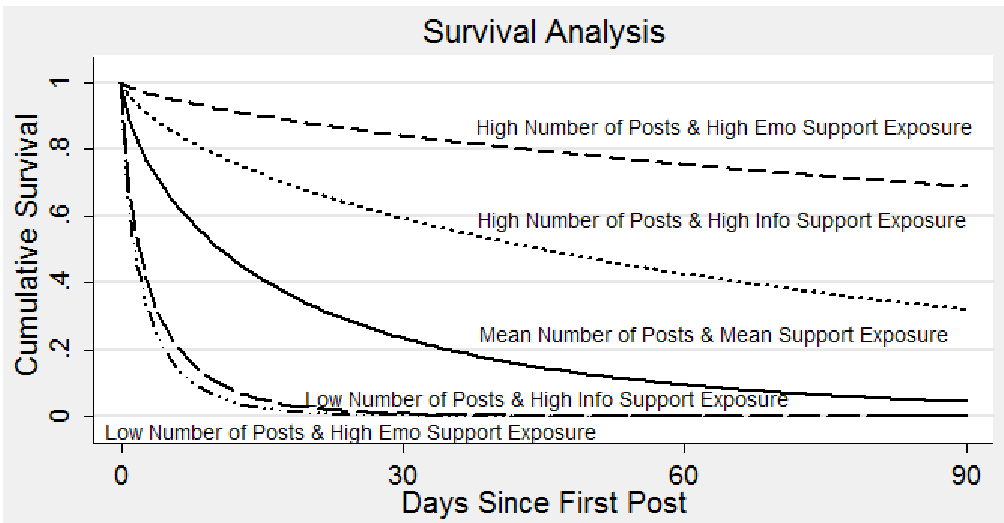 Figure 4: The top curve (Emotional+ / High Exposure) shows drastically higher survival compared to the Informational+ / High Exposure curve.
Critical Insight: Why Does Info Drive People Away?
The authors offer two brilliant "Why" explanations for why information might lead to exit:
- The Dictionary Effect: Informational needs are often finite. Once you learn what "extranodal extension" means, your "transaction" with the group is complete.
- Competitive Accuracy: Information in unmoderated forums may be perceived as less credible than professional medical sites. If a member only gets facts (which they could get from WebMD), they have no incentive to stay.
In contrast, Emotional Support is "relational." It builds ties that aren't easily replaced by a search engine, effectively transforming a seeker into a community member.
Lessons for Community Design
This research suggests that community managers shouldn't just focus on "answering questions." To maintain a healthy, sustainable group:
- Real-time Intervention: Real-time ML could identify posts receiving only dry information and route them to "empathizers" or moderators to add an emotional layer.
- Profile Building: The study found that simply having a user profile (HasProfile) correlated with a 54% higher survival rate, suggesting that identity-building is a prerequisite for commitment.
Conclusion
This study remains a cornerstone in Computational Social Science. It reminds us that while we may go to the internet for facts, we stay for the feelings. For designers of AI-driven support tools, the takeaway is clear: Empathy is not just a "nice-to-have"; it is the structural integrity of the community itself.