
Robotic Emotional Intelligence: Decoding Affect from Everyday Gestures
Emotional intelligence in robots: Recognizing human emotions from daily-life gestures
This paper introduces a real-time emotion recognition system for robots that identifies happiness, sadness, anger, and neutral states from non-stylized daily-life gestures (clapping, drinking, throwing, waving). Using a multi-sensory approach and Gated Recurrent Units (GRUs), the system achieves 0.68 to 0.80 accuracy, significantly outperforming human baselines.
TL;DR
Researchers have developed a system that allows robots to "read between the lines" of human movement. By analyzing functional gestures like drinking or throwing using Gated Recurrent Units (GRUs) and a multi-sensory setup (Kinect, IMU, and Balance Board), the system can detect emotions with up to 80% accuracy—nearly double the performance of average humans.
Context: Why "Non-Stylized" Motion Matters
In the quest for seamless human-robot symbiosis, robots must understand not just what we are doing, but how we are feeling. While facial recognition is a mature field, body language—specifically functional, daily-life motions—remains a "hard problem."
The difficulty lies in the distinction between stylized motion (e.g., a theatrical bow or dance) and non-stylized motion (e.g., picking up a glass of water). In the latter, the primary goal is functional; emotion is a subtle modulation, a rhythmic "flavor" added to the movement. Previous SOTA methods using static features often failed to capture these temporal nuances.
Methodology: The Hierarchical Approach
The authors suggest that emotion is context-dependent. How "anger" looks while throwing is different from how it looks while drinking. To solve this, they implemented a two-stage pipeline:
- Preprocessing & Multi-Sensory Fusion: Data from a Kinect v2 (skeleton), Wii Balance Board (Ground Reaction Force/Center of Pressure), and Shimmer IMU (Wrist acceleration) are synchronized and normalized.
- The Multiplexer Architecture:
- Stage 1: A motion classifier recognizes the activity (e.g., "This person is clapping").
- Stage 2: Based on the identified activity, a specific emotion classifier is triggered to hunt for affective cues within that specific context.
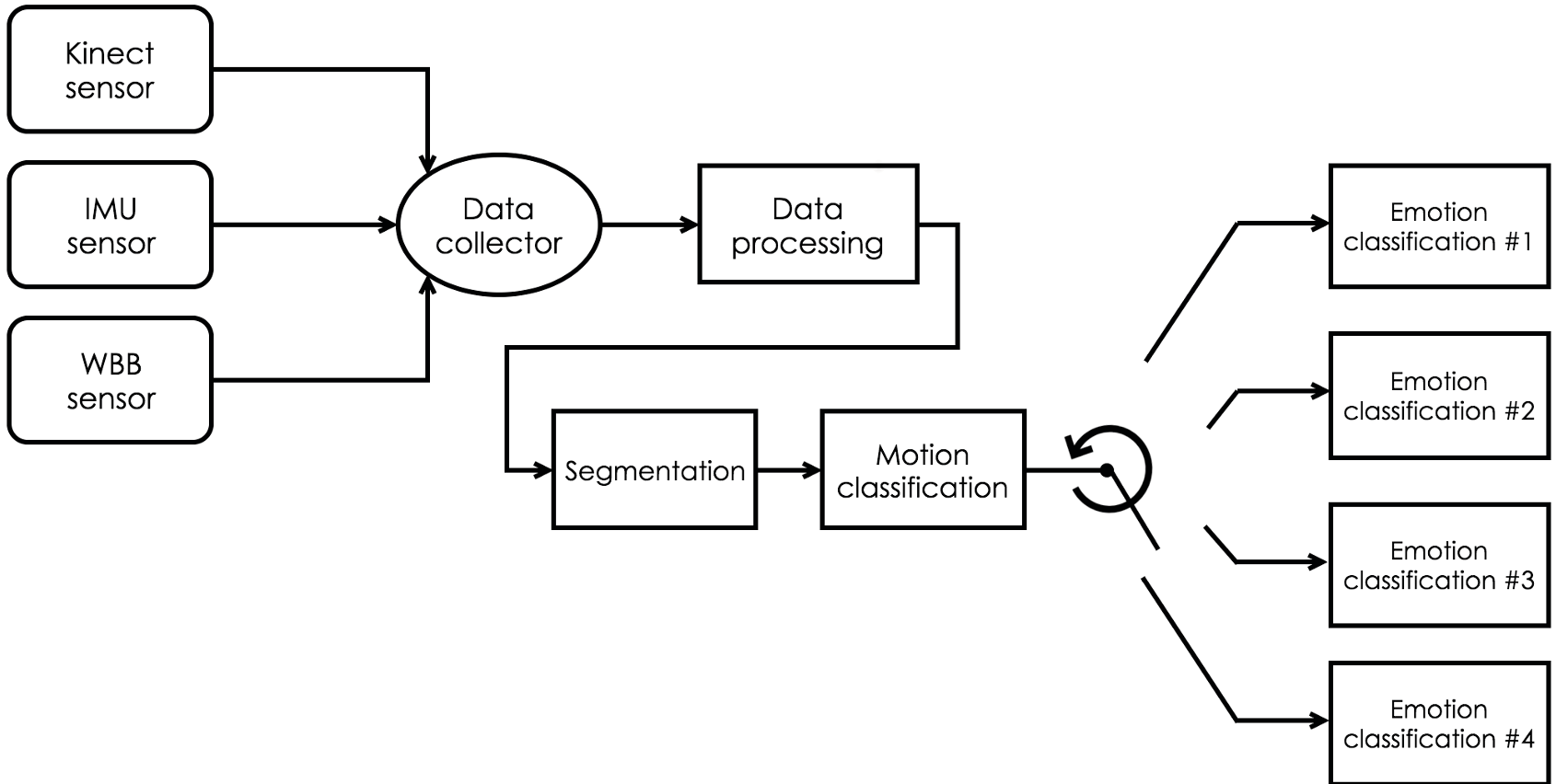
The core engine uses Gated Recurrent Units (GRUs). Unlike vanilla RNNs, GRUs utilize "gates" to decide which temporal information to keep or discard, making them ideal for identifying long-term emotional signatures in variable-length gestures.
Results: Outperforming the Human Eye
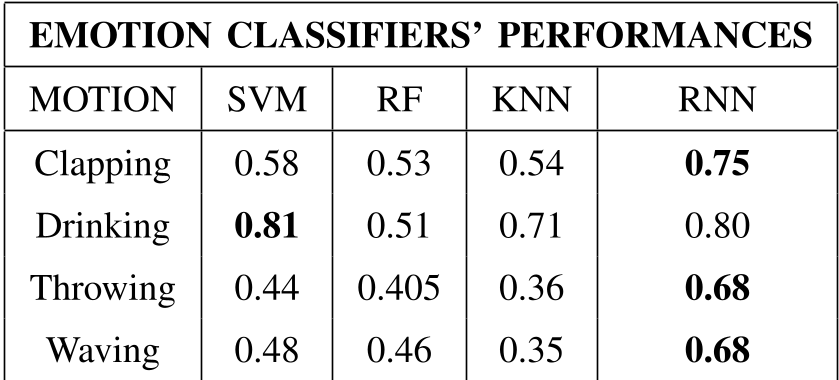
One of the paper's most striking findings is the "Human Baseline" experiment. When 18 participants were asked to identify emotions from blurred videos of the same motions, they achieved an accuracy of only 0.45.
In contrast, the GRU-based algorithm showed significant gains:
- Motion Classification: 99% accuracy.
- Emotion Recognition: 68% to 80% accuracy.
- Top Performance: The "Drinking" gesture proved most telling, with an 80% success rate in identifying the underlying emotion.
The Rejection Option
In high-stakes robotics (e.g., healthcare), a wrong guess is worse than no guess. The authors implemented a "Rejection" class based on "chaotic outputs"—instances where the network's prediction flips rapidly between classes. By adding this "I don't know" option, they further improved the system's reliability.
Critical Analysis & Deep Insights
The study reveals a fascinatng "Physics of Emotion":
- Anger is easiest to detect in "Throwing" due to the specific jerkiness and force.
- Neutral vs. Angry Clapping are distinct, but Happy vs. Sad Clapping are often confused due to high interpersonal variance (people express happiness in their hands in wildly different ways).
The transition from SVMs/Random Forests to GRUs is the "magic bullet" here. By treating motion as a continuous signal rather than a static snapshot, the model captures the dynamics (acceleration and rhythm) rather than just the pose.
Future Outlook
While the current system uses lab-based sensors (Kinect, Balance Board), the high performance of the wrist IMU suggests that future iterations could work using only wearable devices or onboard robot vision.
As robots move from factory floors into our homes, the ability to recognize that a user is "angrily washing dishes" vs. "calmly washing dishes" will be the difference between a helpful assistant and a social nuisance. This work marks a significant step toward that empathic future.