
CTS: Bridging the Gap Between Emotion and Episodic Learning in Cognitive Agents
How emotional mechanism helps episodic learning in a cognitive agent
This paper introduces the Conscious Tutoring System (CTS), a cognitive agent that integrates a biologically plausible "pseudo-hippocampus" for episodic learning. By combining emotional valences with Sequential Pattern Mining (SPM), the agent learns frequently occurring event sequences to adapt its autonomous behavior in Virtual Learning Environments (VLE), such as a Canadarm2 spacecraft simulator.
TL;DR
Researchers have developed the Conscious Tutoring System (CTS), a cognitive architecture that mimics the human brain's relationship between the amygdala (emotion) and the hippocampus (episodic memory). By using data mining to "consolidate" memory, the agent learns to assist astronauts in complex simulations by remembering not just what happened, but how it felt and what worked.
Contextual Positioning
In the landscape of cognitive science, architectures like ACT-R have long dominated. However, they often ignore the "affective" dimension of learning. CTS moves beyond simple rule-based systems by treating memory as a dynamic, emotionally-weighted sequence of events, positioning itself as a more biologically plausible alternative to LIDA and ACT-R.
Problem & Motivation: Why Emotion Matters
In human cognition, we don't remember every detail of every day; we remember events characterized by high emotional impact. Existing cognitive agents suffer from "data overload"—they perceive too much and struggle to filter the signal from the noise.
The authors argue that:
- Prior Work (LIDA/ACT-R): Either lacks an emotional layer or fails to consolidate episodic and semantic memories effectively.
- Insight: Emotion serves as an "activation level" that helps the agent decide which coalitions of information are worth bringing into "consciousness" and storing for the long term.
Methodology: The Pseudo-Hippocampus and Data Mining
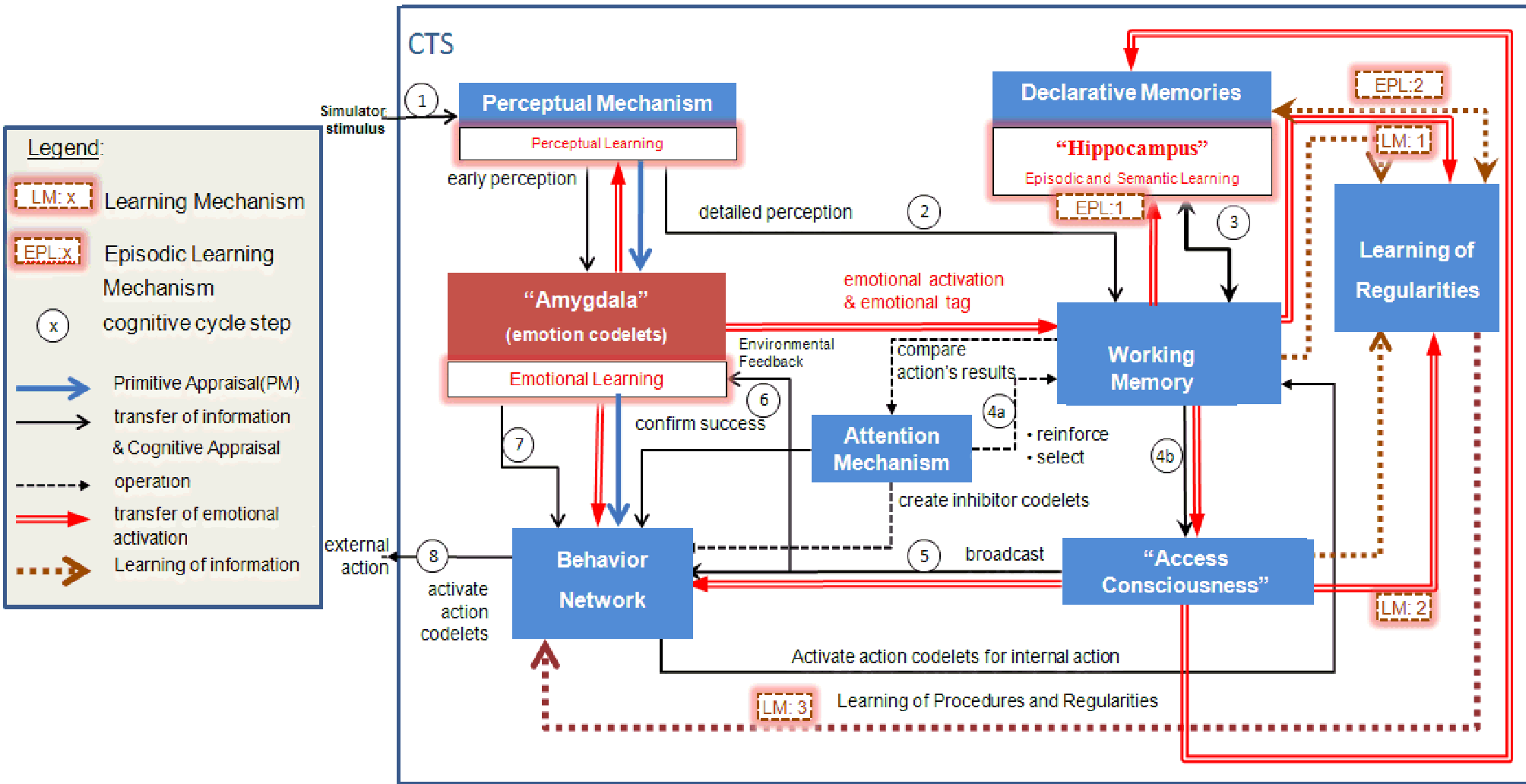
The core of CTS is its Episodic Memory Consolidation model. Unlike traditional databases, this system doesn't just store logs; it mines them for patterns.
1. The Architecture
CTS uses a "Working Memory" (WM) where coalitions of "codelets" (small pieces of information) compete for attention. The pseudo-amygdala infuses these codelets with emotional valences.
2. Sequential Pattern Mining (SPM)
To solve the problem of overwhelming data, the authors treat memory consolidation as a Knowledge Discovery task. They use a sequential pattern mining algorithm to find "Closed Sequences"—the most compact representation of frequent events.
- Emotional Weighting: A sequence's strength is calculated as:
Support × Σ(Emotional Valences). - Decision Making: When the agent encounters a familiar situation, it scans these mined patterns and selects the behavior that historically led to the most positive emotional state (e.g., "self-satisfaction").
Experiments & Results: Tutoring the Astronauts
The system was tested in a Canadarm2 simulator. When a user (User 3) made mistakes during a robotic arm manipulation, CTS had to decide how to intervene.
Performance Metrics
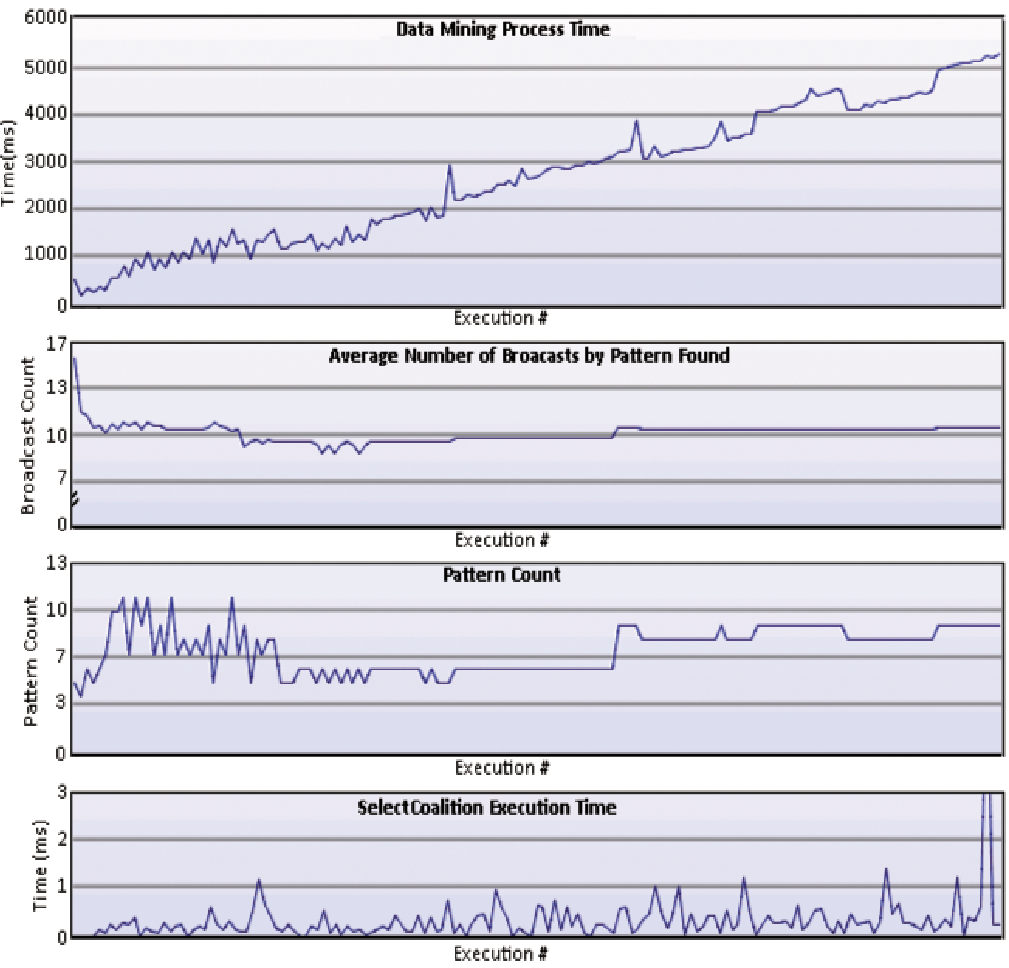
The data mining algorithm demonstrated impressive efficiency:
- Linear Scaling: The time to mine patterns increased linearly, staying under 6 seconds even after 160 executions.
- Efficiency of "Closed" Patterns: Mining non-closed patterns took over an hour, whereas mining closed patterns took only 0.558 seconds for the same dataset, representing a massive jump in real-time viability.
Qualitative Outcome
For a struggling user, the agent learned that giving a "hint" (Scenario 2) followed by a question led to better emotional outcomes and performance than simply providing a "direct solution" (Scenario 1). The agent "remembered" that the hint path had a higher valence (+0.8 compassion) and prioritized that strategy in future iterations.
Critical Analysis & Conclusion
Takeaway: This work represents a significant step in making cognitive agents "human-like" not just in logic, but in memory management. By using Data Mining as a functional analog for hippocampal consolidation, CTS provides a blueprint for managing "Big Data" within a single agent's mind.
Limitations: While the linear scaling is promising, the algorithm currently recomputes patterns from scratch. Transitioning to Incremental Sequential Pattern Mining is the necessary next step to allow the agent to learn indefinitely without a background "reset."
Future Outlook: The integration of temporal pattern mining (like trends) could allow agents to predict user frustration before it happens, leading to even more proactive and empathetic tutoring systems.