
Inside the Mind of a Robot Athlete: Uncovering Emotional Memories in Soccer
Uncovering emotional memories in robot soccer players
This paper introduces an emotional memory model for RoboCup soccer robots using a data mining approach to replicate the human link between emotion and memory. By integrating the Pleasure-Arousal-Dominance (PAD) scale with a Naïve Bayes classifier, the authors enable a NAO robot to optimize its penalty kick strategies based on past emotional experiences.
TL;DR
Can a robot feel the "paralysis" of a 7-1 World Cup loss? This research moves beyond standard AI by endowing RoboCup NAO robots with Emotional Memory. By linking the success of a penalty kick to internal emotional states (Pleasure and Arousal), researchers achieved a 97% scoring accuracy and even explored how neurological disorders like Bipolar and Alzheimer's affect robotic performance.
The Motivation: Why Robots Need "Feelings"
In the 2014 World Cup, the Brazilian national team famously suffered an "emotional paralysis." In human sports, memory is never just data; it is colored by emotion. A striker doesn't just remember where they kicked; they remember the feeling of the goal.
Current RoboCup agents are mathematically precise but psychologically "flat." They struggle with common-sense reasoning because they lack the ability to weight memories based on emotional significance. The authors argue that to achieve "Strong AI," we must encode the dramatic "flashbulb memories" that humans use to navigate high-stakes decisions.
Methodology: The PAD Model and Naïve Bayes
The researchers utilized the Pleasure-Arousal-Dominance (PAD) scale to quantify a robot's internal state. For the specific task of a penalty kick, this was simplified into a three-step memory model:
- Memory Encoding: Each kick records physical data (angle, goalie position) and its emotional outcome.
- Personality Profiles: Three distinct personalities were created:
- Profile 1: Practical; seeks maximum pleasure through easy goals.
- Profile 2: The "Show-off"; prefers difficult shots near the goalie for higher arousal.
- Profile 3: The "Excitement-seeker"; values a contested game over a guaranteed score.
- Behavior Selection: A Naïve Bayes (NB) classifier acts as the "brain," analyzing thousands of past memories to predict which kick angle will maximize the desired emotional state.
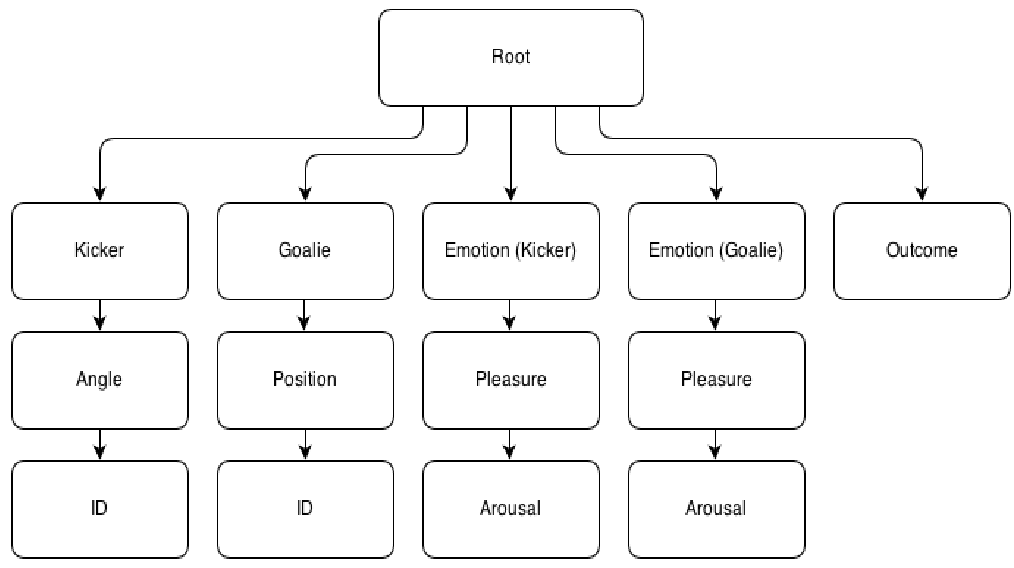 Figure 1: The architecture of the memory model, linking physical attributes to internal PAD states.
Testing the "Broken" Brain: Bipolar and Alzheimer's
The most unique aspect of this study is the simulation of neurological disorders:
- Bipolar Disorder: Modeled as "emotional dysregulation." When stress (the difference between expected and actual emotion) exceeds a threshold, the robot's emotional state swings violently to the opposite sign.
- Alzheimer’s Disease: Modeled as a failure to store "neutral" events. Only events with emotional strength above 0.4 were "remembered" (learned by the classifier).
Results: Emotion as an Optimizer
The experimental results in the Webots simulator were striking. While a random agent scored only 40.7% of the time, the emotional memory-driven NAO achieved:
- 97.7% accuracy for the "Practical" personality.
- 79.7% accuracy even for the "Excitement-seeker" profile, which intentionally took harder shots.
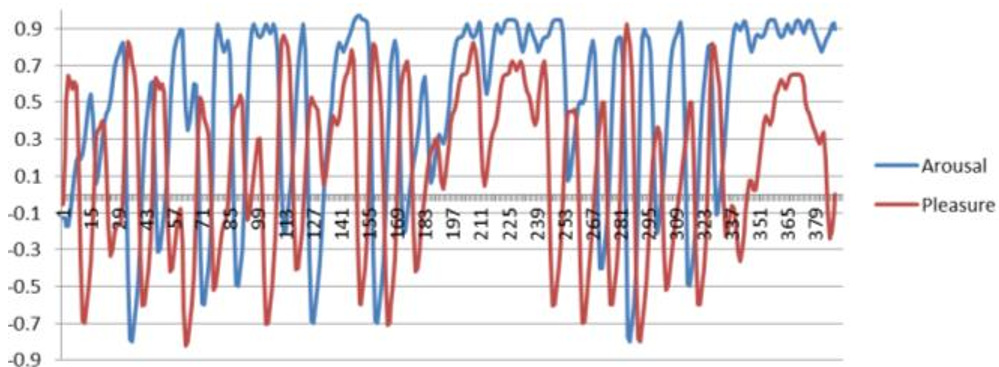 Figure 2: Visualization of emotional instability in a robot "diagnosed" with bipolar disorder during learning.
Critical Insights & Takeaways
The study proves that emotion is not a distraction for AI; it is a priority filter. By using Pleasure and Arousal as metrics for success, the Naïve Bayes classifier could ignore irrelevant data and hone in on optimal behaviors faster than traditional trial-and-error methods.
Future Outlook: As we move toward the 2050 goal of robots playing human World Cup champions, we must move beyond pure physics. The next step is "Forgetting"—implementing a weights-based system where older or less emotional memories fade, allowing robots to adapt to opponents who change their strategies in real-time.
Academic Credit: Allan, C., Couceiro, M. S., & Vargas, P. A. "Uncovering Emotional Memories in Robot Soccer Players." IEEE RoboCup Research.