
Digital Empathy: How Personalities are Mirrored in the Twitterverse
10029_Determining Emotional Profile Based on Microblogging Analysis.
The paper presents a methodology for determining "Emotional Profiles" by analyzing microblogging interactions on Twitter. Using NLP techniques and lexicon-based sentiment analysis, the authors demonstrate a significant emotional and grammatical alignment between content creators and their most frequent audience, achieving Pearson correlation coefficients as high as 0.99.
TL;DR
Do we interact with people because they are like us, or do we become like the people we interact with? This study investigates the Emotional Profile of Twitter users, revealing a staggering correlation between authors and their audiences. By analyzing 2,500 tweets across diverse sectors, the research proves that our digital "writing style"—both emotional and grammatical—is a reflection of our social circle, providing a blueprint for the next generation of "personality-aware" chatbots.
Problem & Motivation: The "Childhood" of an AI
Human personality is often viewed through the lens of psychodynamics (Freud, Erikson), suggesting it is forged in childhood. However, software lacks a childhood, an id, or an ego. To create chatbots that don't feel like "soulless machines," we must find a way for them to "learn" a personality.
The authors pivot from traditional sentiment analysis (which usually just asks "Is this tweet happy or sad?") to a more profound question: Is there a structural alignment in how we express emotions compared to our audience? They hypothesize that if a chatbot can mirror the "Emotional Writing Style" of its users, it can achieve a much higher level of social acceptance.
Methodology: Deconstructing the Writing Style
The researchers built a robust pipeline to transform raw, noisy microblogging data into structured emotional profiles.
1. The Preprocessing Pipeline
Twitter data is messy—full of emoticons, slang, and mentions. The authors used a parallel processing approach:
- POS-Tagging: Identifying nouns, verbs, and adjectives (the carriers of sentiment).
- NER (Named Entity Recognition): Stripping out locations and names to ensure they don't confuse the emotion engine.
- Stemming: Reducing words to their roots (e.g., "happily" to "happi") for better lexicon matching.
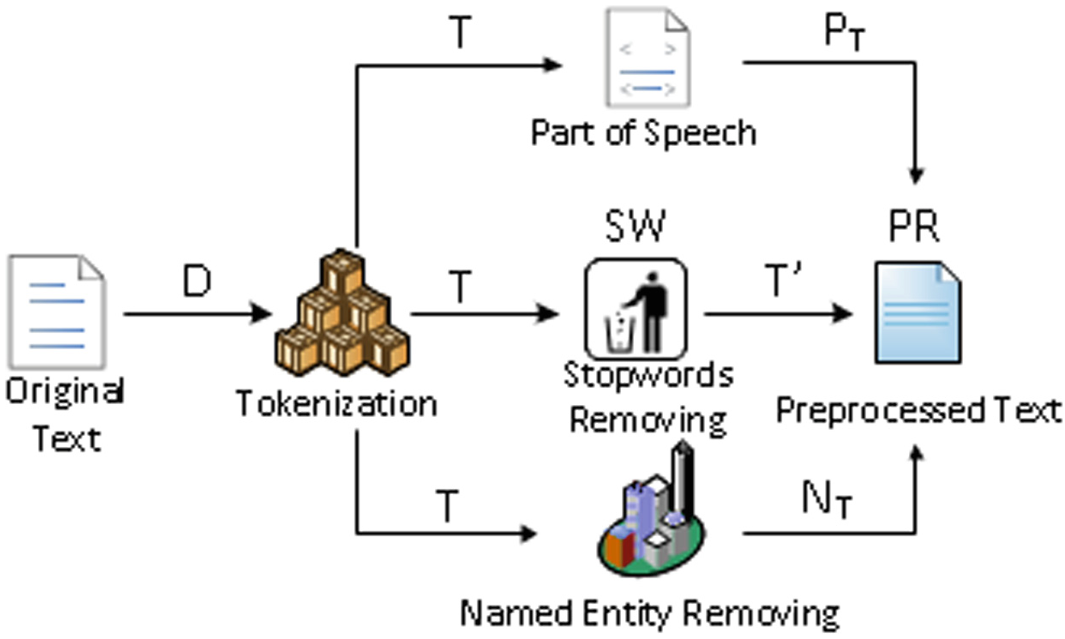 Figure 1: The architecture of the NLP preprocessing pipeline.
2. Emotional and Grammatical Mapping
The study utilizes Plutchik’s Wheel of Emotions, categorizing text into 8 basic emotions: Anger, Anticipation, Disgust, Fear, Joy, Sadness, Surprise, and Trust. By comparing the frequency of these emotions (and the distribution of grammatical tags like the Penn Treebank tags), they created a "fingerprint" for each user.
Experiments & Results: The "Average of Five" Rule
The results provided empirical evidence for the famous social theory by Jim Rohn: "You are the average of the five people you spend the most time with."
Key Findings:
- High Correlation: For authors like Elon Musk or Katy Perry, the correlation between their emotional profile and their top audience was nearly perfect (r² = 0.93 to 0.99).
- The Decay Factor: As the researchers expanded the audience pool from the top 5 most frequent contacts to the top 100, the correlation began to drop. This suggests that our "true" emotional style is most closely influenced by our immediate digital "inner circle."
- The "Press Office" Pattern: Interestingly, the study could distinguish between individuals writing "by themselves" (like Donald Trump in the sampled period) and those managed by "Press Offices" (like Elon Musk or Katy Perry), identifying a distinct, more polished emotional signature for professional accounts.
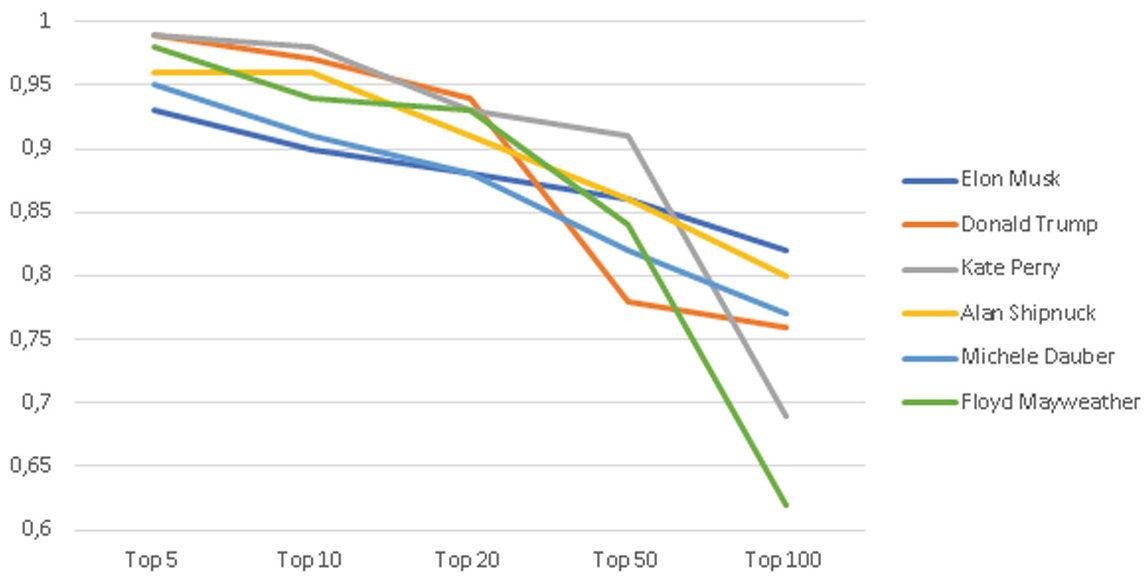 Figure 2: The decay of emotional correlation as the audience size increases.
Critical Analysis & Conclusion
Takeaway
The study confirms that Emotional Profiles are not just individual traits but social ones. The strong grammatical alignment (r² > 0.95 in many cases) suggests that we subconsciously mimic the sentence structures and emotional intensities of those we interact with most.
Limitations & Future Work
While the correlation is high, the paper relies heavily on Lexicon-based analysis, which can sometimes miss sarcasm or complex context that a transformer-based model (like BERT or GPT) might catch.
The ultimate goal? Emotional Chatbots. The authors propose using Generative Adversarial Networks (GANs) to train agents that don't just "answer questions" but adapt their entire emotional and grammatical "vibe" to match the user, creating a much more seamless and "human" communication experience. This marks a shift from AI as a tool to AI as a social entity.