
Sentiment Bursts: Decoding Real-World Events Through the Global Lens of Social Mood
Emotional Reactions to Real-World Events in Social Networks
This paper introduces a sentiment-indexed framework for detecting real-world events within the blogosphere by analyzing mood tags. By leveraging "current mood" metadata from 12 million Livejournal posts, the authors propose a Sentiment Index and a "Sentiment Burst" detection method using a stochastic model to identify both periodic and non-periodic events.
TL;DR
Researchers at Curtin University have moved beyond simple keyword tracking to detect global events. By analyzing over 12 million "current mood" tags on Livejournal, they developed a Sentiment Index and a Sentiment Burst detection system. Their work proves that the collective emotional state of the internet can accurately pinpoint everything from Christmas celebrations to the exact onset of the Iraq War.
Problem & Motivation: Beyond Word Frequencies
Most event detection systems act like simple scanners: they look for a sudden spike in a word like "attack" or "stocks." However, language is messy. A spike in a word doesn't always tell you the impact or the nature of an event.
The authors' insight was that emotions are the primary reaction to reality. When something major happens, people don't just use different words; they feel different things. By treating the "current mood" tags as a time-series signal, the researchers aimed to create a "biological" sensor for the blogosphere that distinguishes between the "Tuesday blues" and genuine global tragedies.
Methodology: Calculating the Heartbeat of the Web
The researchers utilized two core components to turn raw moods into actionable data:
1. The Sentiment Index
Each mood (e.g., "content," "angry," "jubilant") is assigned a Valence value—a psychological measure of happiness—derived from the ANEW (Affective Norms for English Words) lexicon. By summing these values daily, they created a fluctuating "Sentiment Index" ().
- Periodic Trends: They found that global happiness peaks on weekends and reaches its annual zenith on Christmas Day.
- The Deviations: The most significant research value lies in the "Sentiment Deviation" (), where sudden drops into "negative" territory almost always aligned with major news events (e.g., 9/11).
2. Sentiment Bursts and the KLB Algorithm
To find the duration of an event, the authors adapted Kleinberg’s Burst Detection (KLB) algorithm. Instead of applying it to message volume, they applied it to mood intensity.
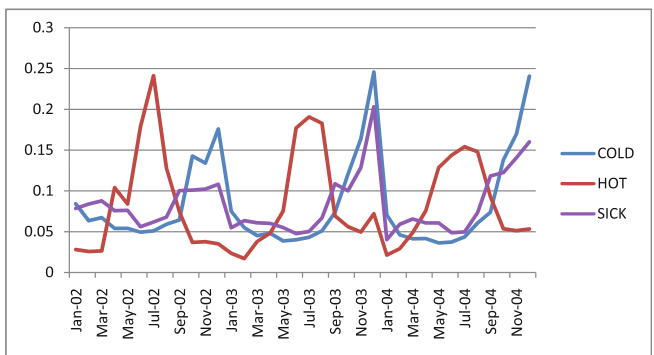 Figure 1: The Affect Circle mapping moods to valence/arousal, and the corresponding weekly/annual sentiment patterns.
Experiments: What the Data Revealed
The study’s results were remarkably consistent with historical reality.
- Periodic Indicators: Low entropy moods like "busy" and "stressed" peaked every Tuesday morning (likely work-related), while "drunk" peaked predictably on weekends.
- Catastrophic Indicators: When the Sentiment Index hit historic lows, the authors used LDA (Latent Dirichlet Allocation) to extract topics. For the lowest points, the extracted keywords perfectly matched CNN's top stories: "terrorists," "World Trade Center," "Pentagon," and "hijacked."
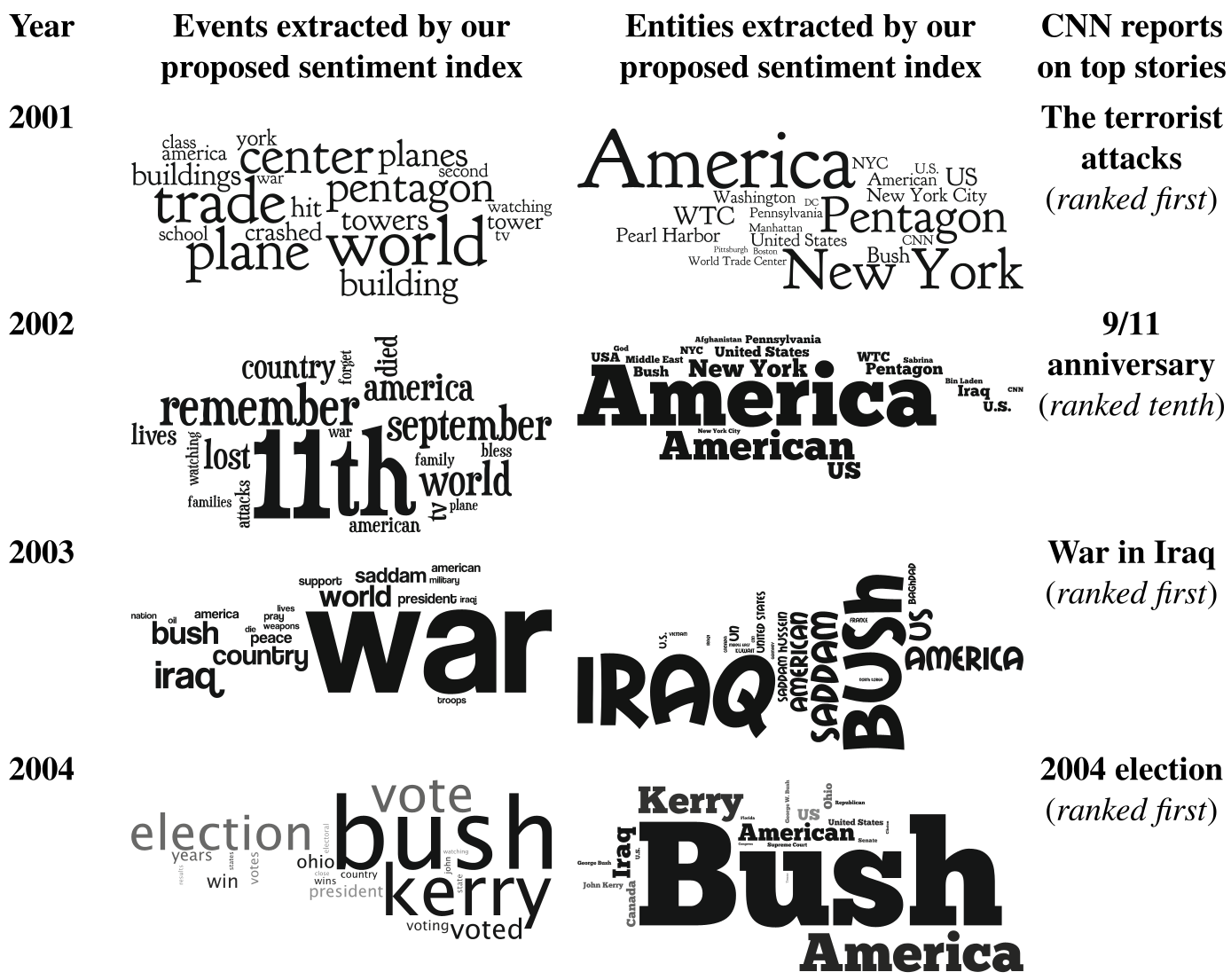 Figure 2: The systems ability to detect the 9/11 attacks and other major news events based purely on mood dips.
The 9/11 Case Study
During the 9/11 event, several moods entered a "Burst" state simultaneously. Interestingly, different moods had different "decay" rates:
- "Shocked" and "Pissed off" were intense but short-lived (3-5 days).
- "Sympathetic" and "Enraged" lasted much longer (up to 14 days), reflecting the transition from immediate shock to prolonged national mourning and anger.
Critical Analysis & Conclusion
Takeaway
The study successfully demonstrates that Sentiment Bursts are more than just noise; they are structured, predictable reactions to external stimuli. By combining valence-based indexing with stochastic burst modeling, the authors provides a blueprint for real-time "societal health" monitoring.
Limitations
A significant limitation is the reliance on predefined mood tags. In modern platforms like X (Twitter) or Mastodon, users rarely tag a specific "mood" from a dropdown menu. For this method to scale in 2024, it would require highly accurate NLP-based emotion classifiers (like BERT-based sentiment analysis) to "infer" the tags that Livejournal users provided manually.
Future Work
The logical next step is the application of this method to Predictive Analytics. If we can detect the start of a sentiment burst in real-time, can we predict the stability of financial markets or the likelihood of civil unrest before the "textual" news even breaks? The blogosphere is no longer just a diary; it is a global nervous system.